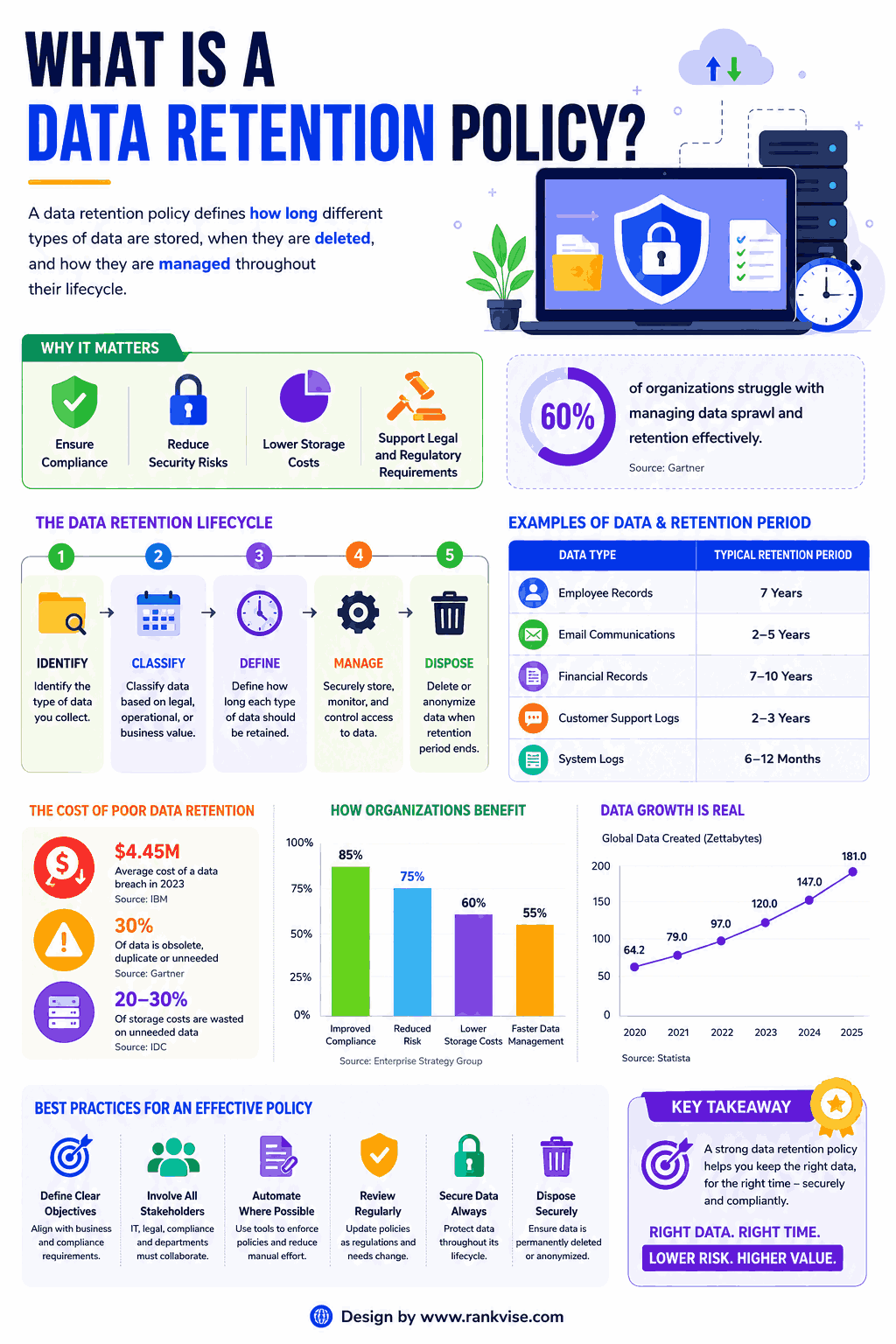
A data retention policy is a set of rules that defines how long your organization keeps different types of data. It specifies what information you store, where you store it, how long you keep it, and when you delete it. Every business that collects data needs this framework.
- Ensure regulatory compliance: justify retention periods to meet GDPR, HIPAA, CCPA and avoid fines.
- Minimize security and legal risk by deleting unnecessary data to shrink the attack surface and simplify discovery.
- Reduce storage costs and boost efficiency by removing expired records and keeping clean, searchable data.
- Define retention schedules, secure disposal methods, assign ownership, train staff, automate rules, and review the policy annually.
Think of it as a rulebook for your company’s information lifecycle. Without clear guidelines, businesses hoard data indefinitely. This creates unnecessary risk, increases storage costs, and violates privacy regulations. A well-defined policy brings order to the chaos.
Data retention applies to everything—customer records, employee files, financial documents, emails, and system logs. Each data type requires its own retention schedule based on legal requirements and business needs.
Why Your Business Needs a Data Retention Policy?
Stay Compliant With Data Protection Laws
Regulations like GDPR, HIPAA, and CCPA require organizations to justify how long they keep personal data. Holding information longer than necessary violates these laws. Fines reach millions of dollars for non-compliance. A clear retention schedule demonstrates you take regulatory obligations seriously.
Reduce Security and Legal Risk
Every piece of stored data represents potential exposure during a breach. The less unnecessary data you retain, the smaller your attack surface. During litigation, courts may request all stored records. Excessive data hoarding complicates legal discovery and increases liability.
Lower Storage Costs
Data storage costs money—whether on-premise servers or cloud platforms. Organizations that never delete outdated records pay for storage they do not need. A retention policy systematically removes expired data, reducing infrastructure expenses over time.
Improve Operational Efficiency
Employees waste time searching through massive, unorganized data stores. When you retain only relevant, current information, teams find what they need faster. Clean data environments support better decision-making and faster workflows.
What Should a Data Retention Policy Include?
A comprehensive policy covers several critical elements. Each section provides clarity for employees who handle data daily.
| Policy Component | What It Defines |
|---|---|
| Scope | Which data types and systems the policy covers |
| Retention periods | How long each category of data remains stored |
| Legal basis | Regulations or business reasons justifying retention |
| Storage locations | Where data lives during its retention period |
| Disposal methods | How data gets deleted or destroyed securely |
| Roles and responsibilities | Who manages, enforces, and audits the policy |
| Exceptions | Circumstances requiring extended retention (legal holds) |
| Review schedule | How often the policy gets updated |
Document each element clearly. Use plain language that non-technical staff can understand and follow.
Common Data Retention Periods by Category
Retention periods vary based on data type, industry, and applicable regulations. Here are typical guidelines businesses follow:
- Financial records – 7 years (tax law requirements in most jurisdictions)
- Employee personnel files – 3 to 7 years after employment ends
- Customer transaction data – 3 to 7 years depending on industry
- Email communications – 1 to 3 years for general correspondence
- Tax documents – 7 years minimum in most countries
- Healthcare records – 6 to 10 years (HIPAA and state regulations)
- Marketing consent records – Duration of relationship plus 2 to 3 years
- System and access logs – 90 days to 1 year for security monitoring
Always verify requirements specific to your industry and jurisdiction. Some regulations mandate minimum periods. Others set maximum limits on how long you can keep personal data.
How to Create a Data Retention Policy Step by Step
Step 1: Audit Your Current Data
You cannot manage what you do not understand. Catalog all data your organization collects and stores. Identify where it lives, who accesses it, and what purpose it serves. This data inventory becomes the foundation of your policy.
Step 2: Identify Legal and Regulatory Requirements
Research the data compliance regulations that apply to your business. Consider your industry, operating locations, and customer base. A company serving European customers must follow GDPR regardless of where the company operates.
Key regulations to evaluate:
- GDPR (European Union)
- CCPA/CPRA (California)
- HIPAA (healthcare in the United States)
- SOX (publicly traded companies)
- PCI DSS (payment card data)
- Industry-specific regulations for finance, education, or government
Step 3: Define Retention Periods for Each Data Category
Assign specific timeframes to every data type in your inventory. Base these periods on the longest applicable requirement—whether legal, regulatory, or legitimate business need. Document the justification for each period.
Step 4: Establish Disposal Procedures
Decide how data gets destroyed when retention periods expire. Digital data requires secure deletion that prevents recovery. Physical documents need shredding or incineration. Define methods for each storage medium your organization uses.
Step 5: Assign Ownership and Accountability
Designate data stewards responsible for each category. Clarify who authorizes exceptions. Define who conducts regular audits. Without clear accountability, policies remain documents that nobody follows.
Step 6: Train Your Team
Every employee who handles data needs to understand the policy. Conduct training during onboarding and annually thereafter. Make the policy accessible and easy to reference. Provide practical examples relevant to each department’s daily work.
Data Retention Policy vs. Data Disposal Policy
These terms sometimes cause confusion. A data retention policy defines how long you keep information. A data disposal policy specifically governs how you destroy it when the retention period ends. Most organizations combine both into one document.
Disposal deserves special attention because improper deletion creates risk. Simply deleting a file does not remove it permanently. Secure disposal requires overwriting digital storage or using certified destruction services for physical media.
Challenges Businesses Face With Data Retention
Implementing a retention schedule sounds straightforward. Reality proves more complex. Common obstacles include:
- Legacy systems storing data in formats that resist automated deletion
- Employees creating shadow copies outside approved storage locations
- Unclear ownership when data spans multiple departments
- Balancing analytics needs against privacy minimization principles
- Managing retention across dozens of cloud applications and SaaS tools
- Handling legal holds that pause normal deletion schedules
Address these challenges proactively during policy creation. Acknowledge limitations honestly and build processes to manage them over time.
Best Practices for Managing Data Retention in 2026
Modern data environments require updated approaches. These practices help organizations maintain effective retention programs.
- Automate deletion workflows wherever possible to reduce human error
- Tag data with classification labels at the point of collection
- Integrate retention rules directly into your cloud storage and SaaS platforms
- Conduct annual policy reviews to reflect regulatory changes
- Maintain audit trails proving compliant deletion occurred
- Use data loss prevention tools to identify unauthorized copies
- Test disposal procedures regularly to confirm they work completely
Automation makes the biggest difference. Manual deletion processes inevitably fail as data volumes grow. Invest in tools that enforce retention schedules automatically across all systems.
How Often Should You Review Your Data Retention Policy?
Review your policy at least once per year. Additionally, trigger reviews when specific events occur:
- New regulations take effect in your operating regions
- Your business enters a new market or industry
- You adopt new technology platforms or storage systems
- A data breach exposes weaknesses in current practices
- Mergers or acquisitions introduce new data sets
- Legal counsel identifies updated compliance requirements
Document every review, including decisions to keep existing periods unchanged. This documentation demonstrates ongoing governance to regulators and auditors.
Real-World Example: Why Retention Policies Matter
Consider a mid-sized e-commerce company storing customer purchase records indefinitely. They experience a data breach exposing ten years of transaction history. Under GDPR, regulators ask why they retained records from customers inactive for eight years. The company cannot justify the retention. The fine increases significantly because excessive data storage amplified the breach impact.
With a proper policy, that company would have deleted records from inactive customers after three years. The breach would have exposed far less data. The regulatory penalty would have been substantially lower.
FAQs
A data retention policy defines how long your business keeps different types of data and when to delete it. It ensures legal compliance, reduces security risk, and controls storage costs.
Most businesses retain customer data for 3 to 7 years depending on regulatory requirements. GDPR requires deletion when data no longer serves its original collected purpose.
Many regulations like GDPR and HIPAA require organizations to define and follow retention periods. While not every law mandates a written policy, having one demonstrates compliance during audits.
Without a policy, businesses risk regulatory fines, increased breach exposure, higher storage costs, and legal complications during litigation discovery processes.
Typically a data protection officer, compliance team, or IT governance lead enforces the policy. However, every employee handling data shares responsibility for following retention guidelines.