A marketing cloud is an integrated suite of digital marketing tools hosted on a single platform. It brings together email marketing, social media management, advertising, analytics, and customer data into one unified system. Instead of juggling disconnected tools, marketers manage everything from a centralized dashboard.
Major technology companies offer marketing cloud solutions. Salesforce, Adobe, Oracle, and HubSpot each provide their own version. These platforms help businesses deliver personalized customer experiences across every digital touchpoint.
The core idea is simple. Connect all your marketing channels, unify your customer data, and automate campaigns at scale. This connected approach replaces fragmented tool stacks that create data silos and inconsistent messaging.
How Does a Marketing Cloud Platform Work?
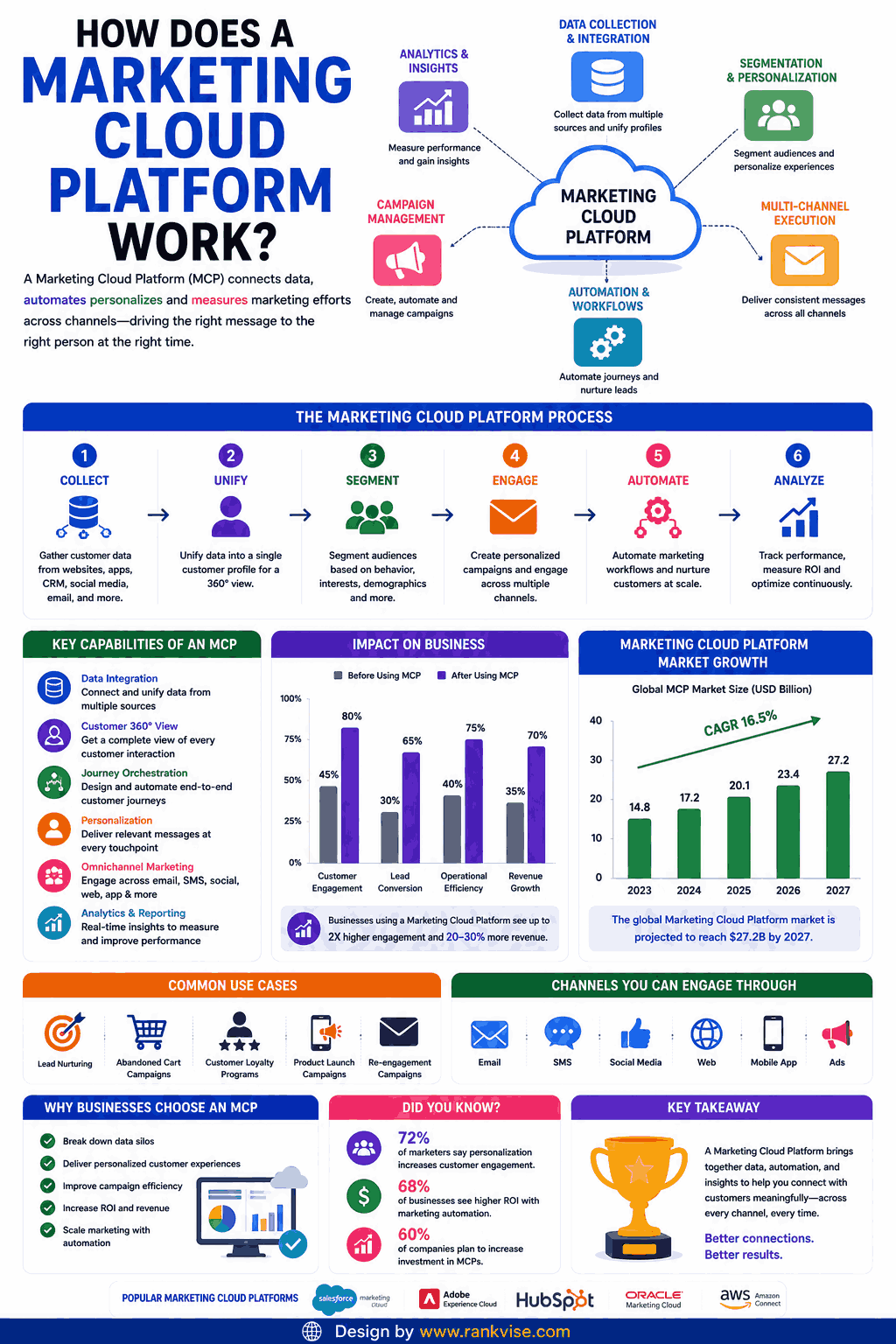
A marketing cloud platform collects customer data from multiple sources. It tracks website visits, email interactions, purchase history, social engagement, and advertising responses. All this information flows into a centralized customer profile.
Marketers then use this unified data to build targeted campaigns. The platform automates message delivery based on customer behavior and preferences. When someone abandons a shopping cart, the system triggers a follow-up email automatically. When a prospect visits your pricing page three times, it alerts your sales team.
This automation operates across channels simultaneously. One platform coordinates email, SMS, push notifications, social ads, and website personalization. The result is a consistent experience wherever customers interact with your brand.
Key Features of a Marketing Cloud Solution
Marketing cloud platforms vary by vendor. However, most include these core capabilities:
| Feature | What It Does |
|---|---|
| Email marketing automation | Sends targeted emails based on triggers, segments, and schedules |
| Customer data platform | Unifies data from all sources into single customer profiles |
| Journey orchestration | Maps and automates multi-step customer experiences |
| Social media management | Publishes, monitors, and analyzes social content |
| Advertising management | Manages paid campaigns across Google, Meta, and display networks |
| Analytics and reporting | Tracks performance across all channels in unified dashboards |
| Personalization engine | Delivers tailored content based on individual behavior |
| Mobile marketing | Manages push notifications, SMS, and in-app messaging |
These features work together rather than operating independently. That integration separates a marketing cloud from a collection of standalone tools.
Benefits of Using a Marketing Cloud for Your Business
Unified Customer View Across All Channels
Most businesses store customer data in dozens of disconnected systems. A marketing cloud connects these sources into comprehensive profiles. You see every interaction a customer has with your brand in one place. This visibility enables smarter targeting and personalization.
Improved Marketing Automation at Scale
Manual campaign management limits your reach. Marketing automation platforms within the cloud handle repetitive tasks without human intervention. You build workflows once, and they execute continuously. This efficiency lets small teams perform like much larger organizations.
Better Personalization and Customer Experience
Today’s customers expect relevant messaging. Generic blasts get ignored. A marketing cloud analyzes individual behavior patterns and delivers content that matches each person’s interests. Companies using advanced personalization see revenue increases of 10% to 15% on average.
Data-Driven Decision Making
Centralized analytics eliminate guesswork. You see which campaigns drive revenue and which waste budget. Attribution modeling shows how different channels contribute to conversions. These insights let you allocate marketing spend with confidence.
Consistent Messaging Across Channels
Customers interact with brands through email, social media, websites, and ads—often in the same day. A marketing cloud ensures your message stays consistent regardless of channel. This coherence builds trust and reinforces brand recognition.
Top Marketing Cloud Platforms in 2026
Several vendors dominate the marketing cloud landscape. Each serves different business sizes and needs.
Salesforce Marketing Cloud
Salesforce offers one of the most comprehensive marketing cloud solutions available. It excels at enterprise-scale email marketing, journey building, and customer data management. Organizations with complex sales cycles and large customer bases benefit most. Pricing starts high, making it best suited for mid-market and enterprise companies.
Adobe Experience Cloud
Adobe combines marketing automation with powerful content creation and analytics tools. Its strength lies in experience management and personalization at scale. Brands with heavy content marketing needs and existing Adobe tool investments find natural alignment here.
HubSpot Marketing Hub
HubSpot provides an accessible marketing platform for small and mid-sized businesses. It integrates marketing, sales, and service tools in one ecosystem. The learning curve stays manageable compared to enterprise alternatives. Free and starter tiers make it approachable for growing companies.
Oracle Marketing Cloud
Oracle targets large enterprises with complex data environments. Its platform emphasizes data management, B2B marketing automation, and cross-channel orchestration. Companies with massive customer databases and sophisticated segmentation needs gravitate toward Oracle.
Braze
Braze focuses specifically on customer engagement through mobile and cross-channel messaging. It excels at real-time personalization and handles high-volume messaging efficiently. Consumer brands with mobile-first audiences find particular value in its capabilities.
Who Should Use a Marketing Cloud?
Not every business needs a full marketing cloud platform. These solutions deliver the most value in specific scenarios.
A marketing cloud makes sense when you:
- Manage campaigns across four or more digital channels simultaneously
- Have a customer base large enough to require segmentation and automation
- Need to unify data from multiple disconnected systems
- Want to deliver personalized experiences based on real-time behavior
- Spend enough on marketing to justify platform investment
- Have a team capable of operating sophisticated marketing technology
Early-stage startups and very small businesses often find simpler tools more practical. A basic email platform and social scheduler may serve your needs until complexity demands consolidation.
Marketing Cloud vs. Individual Marketing Tools
Many businesses debate whether to adopt a unified platform or maintain separate best-in-class tools. Both approaches have merit.
Individual tools offer specialized functionality. You choose the best email tool, best analytics platform, and best social manager independently. However, integrating these creates technical overhead. Data flows between systems imperfectly. Reporting requires manual consolidation.
A marketing cloud sacrifices some specialized depth for integration benefits. Every feature connects natively. Data flows automatically between modules. Reporting pulls from a single source of truth. You trade best-in-class individual tools for best-in-class connectivity.
The right choice depends on your team’s technical resources, budget, and complexity needs. Companies outgrowing disconnected tools typically migrate toward unified platforms.
Common Challenges When Implementing a Marketing Cloud
Adopting a marketing cloud involves more than purchasing software. Organizations face predictable hurdles during implementation.
- Data migration from legacy systems takes longer than expected
- Team training requires significant time investment before full productivity
- Integration with existing CRM and sales tools demands technical expertise
- Customization needs often exceed out-of-the-box capabilities
- Total cost including implementation, training, and ongoing licenses exceeds initial estimates
- Internal processes must change to leverage platform capabilities fully
Plan for a 3 to 6 month implementation timeline for mid-size deployments. Enterprise rollouts often take 12 months or longer. Budget for professional services and ongoing optimization beyond the license fee.
How to Choose the Right Marketing Cloud for Your Business
Selecting a platform requires honest assessment of your current needs and future goals. Consider these factors during evaluation:
- What channels do you actively market through today?
- How large is your customer database and how fast is it growing?
- What is your total marketing technology budget including implementation?
- Does your team have technical skills to manage a complex platform?
- Which existing tools must integrate with the new platform?
- What specific outcomes do you expect the platform to improve?
Request demos from three to four vendors. Run proof-of-concept projects before committing. Speak with existing customers in your industry about their experiences. The vendor relationship lasts years—choose carefully.
FAQs
A CRM manages customer relationships and sales pipelines. A marketing cloud focuses on campaign execution, automation, and multi-channel engagement. Many platforms integrate both, but they serve distinct functions.
Pricing ranges from 800 USD monthly for mid-tier solutions to over 10,000 USD monthly for enterprise platforms. Total cost depends on contacts, features, and required implementation services.
No. Salesforce targets large enterprises with complex needs and higher budgets. HubSpot serves small to mid-sized businesses with simpler requirements and more accessible pricing and usability.
Yes, if they choose appropriately scaled platforms. HubSpot and ActiveCampaign offer marketing cloud features at small business price points without enterprise complexity.
Marketing automation is one feature within a marketing cloud. A full marketing cloud also includes analytics, data management, advertising, social media tools, and cross-channel orchestration beyond email automation alone.