High ticket affiliate marketing involves promoting products or services that pay commissions of 500 USD or more per sale. Some programs pay thousands per conversion. You earn significant income without needing massive traffic volumes.
- Target qualified, smaller audiences for premium offers; sales cycles take longer but each conversion is higher value.
- Build deep trust with thorough, educational content rather than shallow promotions; buyers need confidence before purchasing premium products.
- Choose a niche you understand, build authority with quality content, and apply to vetted premium affiliate programs.
- Create conversion focused content: detailed reviews, comparisons, educational guides, and long term email nurture sequences.
- Treat it as a business: diversify programs, cultivate affiliate manager relationships, and track metrics to scale sustainably.
Instead of earning 5 USD per sale from low-cost items, you focus on premium offers. These include enterprise software, luxury goods, coaching programs, financial services, and high-end online courses.
The math is straightforward. Ten sales at 1,000 USD commission each generates the same revenue as 2,000 sales at 5 USD each. Fewer transactions mean less customer support, simpler operations, and more focused marketing efforts.
How Does High Ticket Affiliate Marketing Differ from Standard Programs?
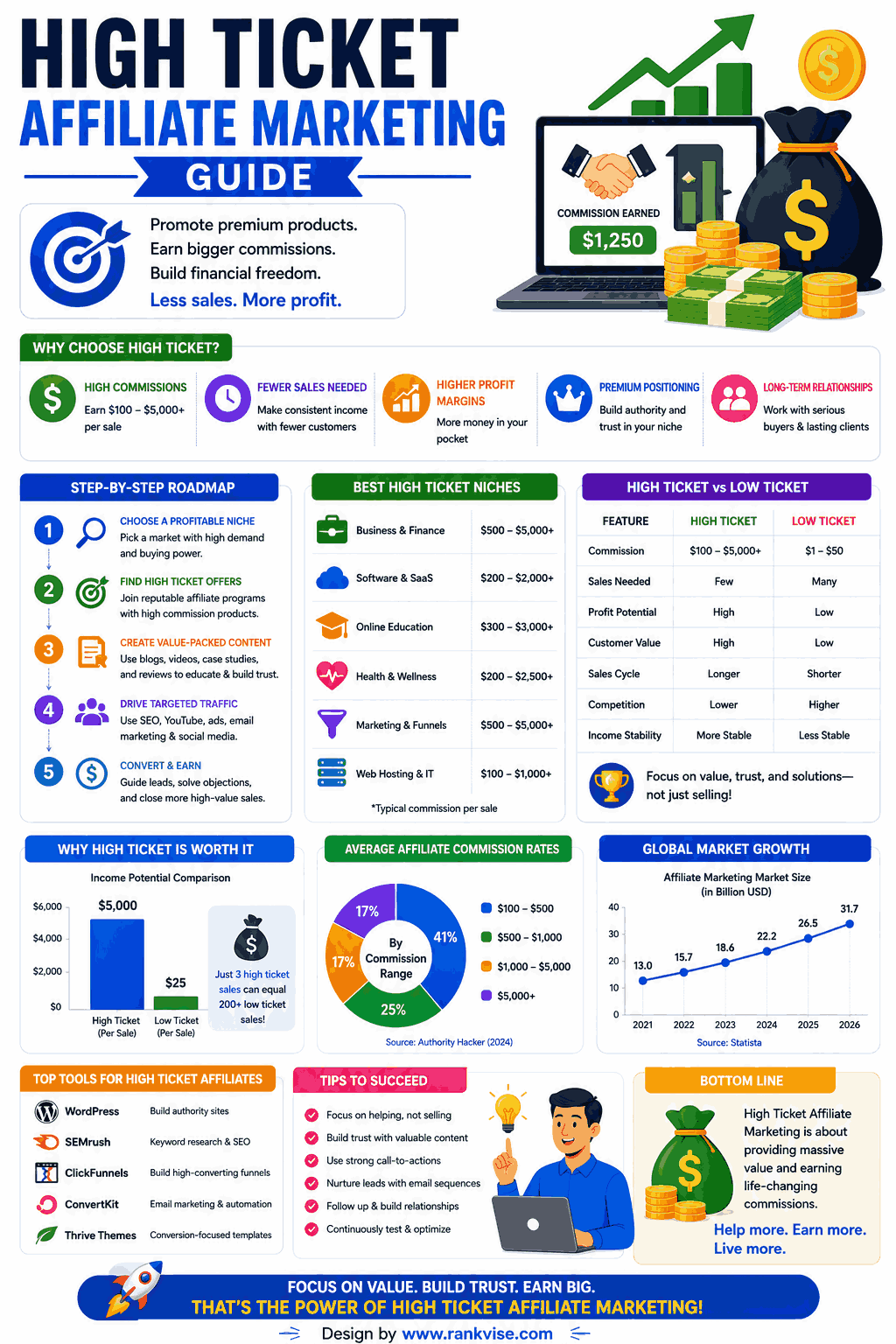
Standard affiliate programs pay small commissions on low-cost products. Amazon Associates pays 1% to 10% on items often priced under 50 USD. You need enormous traffic to generate meaningful income.
High ticket programs flip this model. You promote premium offerings to a smaller, more qualified audience. The sales cycle takes longer, but each conversion delivers substantial revenue.
Here is how the two models compare:
| Factor | Low Ticket | High Ticket |
|---|---|---|
| Commission per sale | 1–50 USD | 500–5,000+ USD |
| Traffic needed | Very high | Moderate |
| Sales cycle length | Minutes to hours | Days to weeks |
| Content depth required | Basic reviews | Detailed, trust-building |
| Audience relationship | Transactional | Consultative |
| Refund risk | Lower per sale | Higher per sale |
High ticket affiliate marketing demands more skill in building trust. Buyers spending thousands need confidence before clicking your referral link. Your content must educate, not just promote.
What Types of Products Pay High Commissions?
Not all industries offer premium affiliate commissions. Focus on niches where products carry substantial price tags and vendors have healthy margins to share with partners.
Software and SaaS Platforms
Enterprise software companies pay generous recurring commissions. Programs from platforms like HubSpot, Salesforce partners, Kinsta, and Kajabi pay 200 to 1,000+ USD per referral. Many offer recurring monthly commissions for the lifetime of the customer.
Online Education and Coaching
Premium online courses and coaching programs regularly price between 1,000 and 10,000 USD. Creators share 20% to 50% with affiliates. A single referral to a 5,000 USD program earns 1,000 to 2,500 USD.
Financial Services and Investment Platforms
Trading platforms, investment tools, and financial advisory services pay premium commissions. Credit card affiliate programs, insurance referrals, and forex platforms offer 100 to 1,000+ USD per qualified lead or sign-up.
Luxury and High-End Physical Products
Luxury travel, high-end electronics, premium furniture, and jewelry programs pay meaningful commissions. While percentage rates may seem modest, 5% on a 10,000 USD product still yields 500 USD per sale.
How to Get Started With High Ticket Affiliate Marketing
Breaking into premium affiliate programs requires more preparation than signing up for Amazon Associates. Vendors protect their brand by vetting partners carefully.
Step 1: Choose Your Niche Strategically
Select a niche you understand deeply. Your audience will ask detailed questions before purchasing expensive products. Surface-level knowledge collapses under scrutiny.
Profitable niches combine high buyer intent with products that genuinely solve expensive problems. Business software, professional development, and financial tools meet this criteria consistently.
Step 2: Build Authority Before Applying
Most high ticket affiliate programs reject applicants without established platforms. Build a content library first. Publish in-depth reviews, comparison guides, and educational content that demonstrates expertise.
A website with 20 to 30 quality articles, an email list of engaged subscribers, or a YouTube channel with consistent viewership signals credibility. Programs accept affiliates who can drive qualified buyers, not random traffic.
Step 3: Apply to Premium Affiliate Programs
Research programs in your niche through affiliate networks like PartnerStack, Impact, ShareASale, or CJ Affiliate. Contact companies directly if they lack public programs. Many enterprise vendors run private partner programs.
When applying, explain your audience demographics and traffic sources clearly. Show how your content aligns with their ideal customer profile. Demonstrate that you reach decision-makers, not casual browsers.
Step 4: Create Content That Converts High-Value Buyers
Premium buyers consume content differently. They research extensively before purchasing. Your content must address objections, compare alternatives, and build confidence throughout a longer decision-making process.
Content Strategies That Drive High Ticket Conversions
Content for high ticket affiliate marketing requires depth that low-ticket promotions never demand. Buyers spending thousands need thorough information before committing.
In-Depth Product Reviews and Walkthroughs
Write comprehensive reviews that cover features, limitations, pricing, and ideal use cases. Include screenshots, personal experiences, and specific scenarios where the product delivers value. Superficial reviews do not convert premium buyers.
Comparison Content That Helps Decisions
“Product A vs. Product B” articles attract buyers in the final decision stage. These readers have budget allocated. They need help choosing between options. Your honest comparison earns their trust and their click.
Educational Content That Qualifies Buyers
Teach your audience how to solve their core problem. Within that educational context, recommend the premium tool or program as the implementation path. This approach positions your recommendation naturally rather than forcefully.
Email Sequences That Nurture Over Time
High ticket conversions rarely happen on the first visit. Build an email list. Create nurture sequences that deliver value over days or weeks. Introduce your affiliate recommendation after establishing trust and demonstrating expertise.
Common Mistakes in High Ticket Affiliate Marketing
Beginners often approach premium programs with tactics suited for low-ticket promotions. These mistakes cost time and credibility.
- Promoting products you have never used or deeply researched, destroying trust when buyers ask specific questions
- Focusing entirely on traffic volume rather than traffic quality and buyer intent
- Neglecting email list building, missing the multi-touch nurturing that premium sales require
- Choosing programs based solely on commission size without evaluating product quality or refund rates
- Using aggressive sales language that repels sophisticated buyers seeking honest guidance
The most successful high ticket affiliates operate as trusted advisors. They recommend selectively. They disclose limitations honestly. This integrity builds long-term audience loyalty that compounds over years.
How Much Can You Realistically Earn?
Income varies dramatically based on niche, traffic quality, and content effectiveness. Setting realistic expectations prevents discouragement during the initial building phase.
New affiliates in premium niches typically earn their first commission within 60 to 90 days of consistent content creation. Monthly income of 2,000 to 5,000 USD becomes achievable within six to twelve months for disciplined marketers.
Experienced high ticket affiliates earning 10,000 to 50,000 USD monthly exist across many niches. They have established authority, substantial email lists, and content libraries driving consistent organic traffic.
The compounding nature of content-driven affiliate marketing rewards patience. Articles published today generate commissions for years. Each piece of content adds to a growing asset that works without ongoing effort.
Building Long-Term Success in High Ticket Affiliate Marketing
Sustainable affiliate income requires treating this as a real business, not a side hustle you check occasionally.
Diversify across multiple programs. Relying on one vendor creates dangerous dependency. If they change commission rates or close their program, your income disappears overnight.
Invest in relationship building with affiliate managers. They provide early access to promotions, custom landing pages, and increased commission rates for top performers. Personal connections open doors that application forms cannot.
Track your metrics rigorously. Know your conversion rates by content type, traffic source, and product. Double down on what works. Cut what does not. Data-driven decisions separate professionals from hobbyists.
FAQs
You can start with minimal investment. A domain, hosting, and content creation tools cost under 50 USD monthly. Your primary investment is time spent creating quality content consistently.
Software and online education offer the most accessible entry points. These niches have abundant programs, digital delivery eliminates shipping complexity, and recurring commissions build predictable income.
Most affiliates earn their first premium commission within 60 to 90 days of publishing consistent, targeted content. Results depend on niche competition and content quality.
No. Quality matters more than quantity. A small email list of 500 engaged subscribers in the right niche can generate more revenue than 50,000 random social media followers.
Yes. Premium product demand grows annually. Companies increasingly rely on affiliate partners for customer acquisition, offering generous commissions to attract quality promoters.