LLP partner liability defines the extent to which partners in a limited liability partnership bear personal responsibility for business debts and obligations. In an LLP, each partner’s liability is limited to the amount they invested in the business. Their personal assets remain protected from claims against the partnership.
- Partners are protected from others' negligence, but each partner remains personally liable for their own negligent or wrongful acts.
- Personal guarantees, fraud or criminal acts, and lapsed state registration can expose a partner's personal assets to business claims.
- Use a thorough partnership agreement, separate finances, required insurance, and current state filings to preserve LLP liability protection.
This structure differs fundamentally from a general partnership. In a general partnership, every partner carries unlimited personal liability for all business debts. One partner’s mistake can put another partner’s house, savings, and personal property at risk.
The limited liability partnership model was designed to solve this exact problem. It gives partners the collaborative flexibility of a partnership while shielding individuals from collective financial exposure. Professionals like lawyers, accountants, architects, and consultants use this structure most frequently.
How Does Liability Protection Work in an LLP?
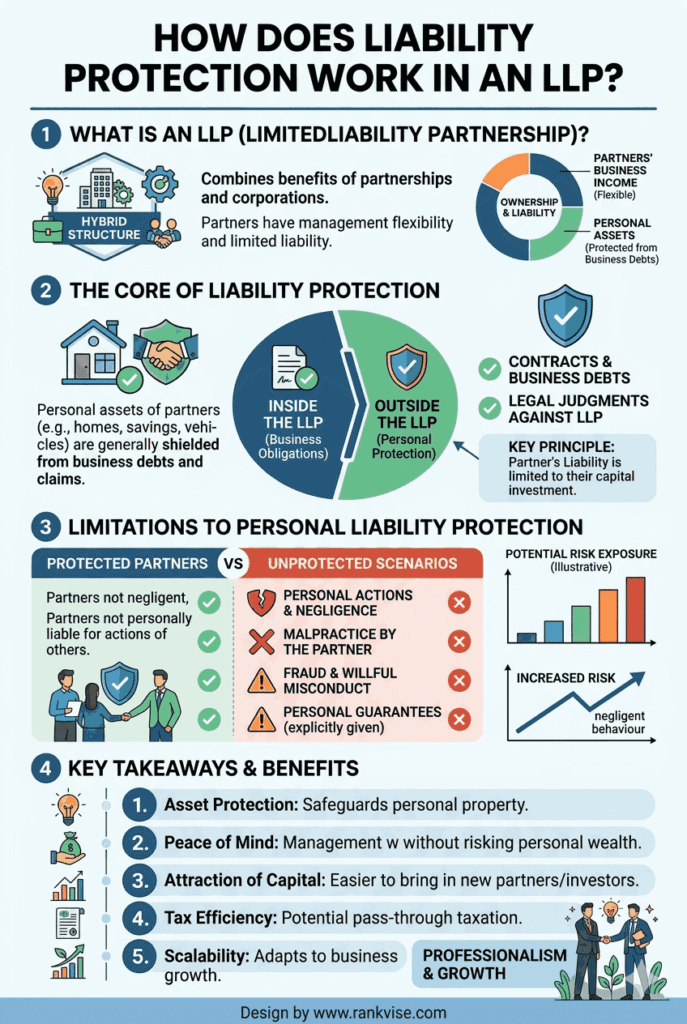
Limited liability partnership protection creates a legal wall between the business and each partner’s personal finances. The LLP exists as its own legal entity, separate from the people who own it.
When the partnership takes on debt or faces a lawsuit, creditors can only pursue assets belonging to the LLP itself. They cannot seize a partner’s personal bank accounts, real estate, or other individual property to satisfy business obligations.
However, this protection applies specifically to debts and liabilities created by other partners or by the business as a whole. Each partner remains personally responsible for their own actions. This distinction is critical and often misunderstood.
The Core Liability Rule
Think of it this way. Partner A and Partner B run an LLP together. Partner A makes a negligent decision that causes financial damage to a client. Under LLP partner liability rules:
- Partner A faces personal liability for their own negligent actions
- Partner B does not face personal liability for Partner A’s negligence
- The LLP itself may also face liability as an entity
- Both partners risk losing their capital contribution to the LLP
This individual accountability model protects innocent partners while holding negligent ones responsible.
LLP Partner Liability vs General Partnership: Key Differences
Understanding how liability works across different partnership structures helps you choose the right one. The differences between an LLP and a general partnership are significant.
| Factor | General Partnership | Limited Liability Partnership |
|---|---|---|
| Personal liability for business debts | Unlimited for all partners | Limited to capital investment |
| Liability for another partner’s actions | Full personal exposure | No personal exposure |
| Liability for own negligence | Full personal exposure | Full personal exposure |
| Creditor access to personal assets | Yes, for all business debts | Only for personal misconduct |
| Legal entity status | Not a separate entity in most cases | Separate legal entity |
| Registration requirement | Minimal in most states | Must register with the state |
The general partnership exposes every partner to every risk. The LLP isolates risk to the partner who created it. This is why professionals in high-liability fields overwhelmingly prefer the LLP structure over general partnerships.
When Can an LLP Partner Still Face Personal Liability?
Limited liability partnership protection is strong but not absolute. Several situations can pierce this protection and expose a partner’s personal assets. Every LLP partner should understand these exceptions clearly.
Personal Negligence and Misconduct
LLP negligence liability follows the person who committed the negligent act. If you personally make an error that harms a client, your liability protection does not shield you. The LLP structure protects you from other people’s mistakes, not your own.
For example, an accountant in an LLP who files a fraudulent tax return faces personal liability for the resulting damages. Their partners do not share this exposure. But the negligent accountant cannot hide behind the LLP shield.
Personal Guarantees on Business Debts
Many lenders require individual partners to sign personal guarantees when the LLP borrows money. The moment you sign a personal guarantee, you voluntarily waive your liability protection for that specific debt. Banks frequently require this from smaller or newer LLPs.
Before signing any loan document, read every clause carefully. A personal guarantee on an LLP debt responsibility effectively transforms your limited liability into unlimited liability for that obligation.
Fraudulent or Criminal Activity
No business structure protects partners who engage in fraud, criminal conduct, or intentional wrongdoing. Courts consistently pierce liability protections when partners act dishonestly or illegally. The LLP shield was designed for honest business operations, not for concealing misconduct.
Failure to Maintain LLP Registration
An LLP must maintain active registration with the state to preserve its liability protections. If registration lapses or the firm fails to meet annual filing requirements, courts may treat the business as a general partnership. This retroactively exposes all partners to unlimited personal liability.
Stay current on all state filings. This administrative task protects millions of dollars in personal assets.
What Are an LLP Partner’s Financial Obligations?
Liability protection does not mean zero financial risk. LLP partner obligations include several important responsibilities that directly affect your financial exposure.
- Each partner risks losing their entire capital contribution if the business fails or faces large claims
- Partners must contribute to the LLP according to the terms outlined in the partnership agreement
- Tax obligations flow through to individual partners, who report their share of profits and losses on personal tax returns
- Partners may owe fiduciary duties to each other, including duties of loyalty and care
- Some states require LLPs to carry minimum levels of professional liability insurance
Your capital investment in the LLP is always at risk. Limited liability means your exposure stops at your investment. It does not mean you risk nothing.
How Does LLP Liability Vary by State?
LLP regulations differ across states. Some states offer full-shield protection. Others provide only partial protection. This distinction matters enormously when choosing where to register your LLP.
Full-Shield States
Full-shield states protect partners from all business debts and obligations, not just those arising from another partner’s negligence. Most states now follow the full-shield model, including New York, California, Texas, and Illinois.
In these states, creditors of the LLP cannot pursue individual partners for contract-based debts like unpaid rent, vendor invoices, or loan defaults. Only the LLP’s own assets are available to satisfy these claims.
Partial-Shield States
A few states still limit LLP protection to negligence and malpractice claims only. In these jurisdictions, partners may still face personal liability for general commercial debts of the partnership. Louisiana and certain other states maintain variations of this partial-shield approach.
Check your state’s specific LLP statutes before forming your partnership. The level of protection you receive depends entirely on where you register.
Selling a Business With a Seller-Financed Note
A business owner does not always need to receive the full purchase price at closing. With seller financing, the buyer pays part of the price upfront and signs a business note for the remaining balance, which can also apply when selling only a division, location, or ownership stake. This structure may attract more buyers and generate interest income, but it also exposes the seller to the risk of missed payments. Sellers who prefer immediate liquidity may later be able to sell the business note for a lump-sum payment, depending on the note terms, payment history, buyer creditworthiness, and strength of the business.
How to Maximize Your Liability Protection as an LLP Partner
Forming an LLP creates a strong foundation. But maintaining that protection requires ongoing attention to several practical steps.
- Draft a comprehensive partnership agreement that clearly defines each partner’s roles, capital contributions, and decision-making authority
- Maintain separate business bank accounts and never commingle personal funds with LLP finances
- Carry adequate professional liability insurance to cover claims that exceed the LLP’s assets
- Keep all state registrations, annual reports, and filing fees current without exception
- Document major business decisions in writing to demonstrate proper governance
- Avoid signing personal guarantees unless absolutely necessary and fully understood
The partnership agreement serves as your most important protective document. It governs internal disputes, profit distribution, exit procedures, and liability allocation among partners. Invest in a well-drafted agreement before you begin operations.
Is an LLP the Right Structure for Your Business?
An LLP works best for professional service firms where multiple practitioners collaborate but want individual liability protection. Law firms, accounting practices, consulting groups, and architecture studios commonly choose this structure.
The LLP may not suit businesses that need to raise outside investment capital. Investors generally prefer corporations or LLCs because those structures offer clearer ownership and transfer mechanisms. Retail businesses, manufacturing companies, and tech startups typically benefit more from an LLC or corporate structure.
Consider your industry, your state’s regulations, your risk profile, and your growth plans before deciding. LLP partner liability rules offer powerful protection, but only when the structure matches your business reality.
Consult a qualified business attorney and tax advisor before forming any business entity. The right structure saves far more than it costs.
FAQs
In full-shield states, LLP partners are not personally liable for business debts. Their exposure is limited to their capital contribution to the partnership.
Both limit personal liability, but LLPs are designed for professional partnerships while LLCs serve broader business types. LLCs offer more flexibility in management structure and ownership.
No, LLP partner liability rules protect innocent partners from personal liability caused by another partner’s negligence or misconduct.
Many states require LLPs to carry minimum professional liability insurance. Even where not required, insurance provides essential protection beyond the LLP’s own assets.
If registration lapses, courts may treat the LLP as a general partnership, exposing all partners to unlimited personal liability for business debts and obligations.