Most founders build the product first. Then they wonder why nobody is signing up. The reason is simple: many of them believe selling starts after the product is finished. It sounds logical. Build something amazing. Launch it. Customers will come.
The problem? The market rarely works that way. The most successful startups validate demand, create content, optimize for search, and establish credibility while the product is still being developed. By launch time, potential customers already know who they are and what the product can do.
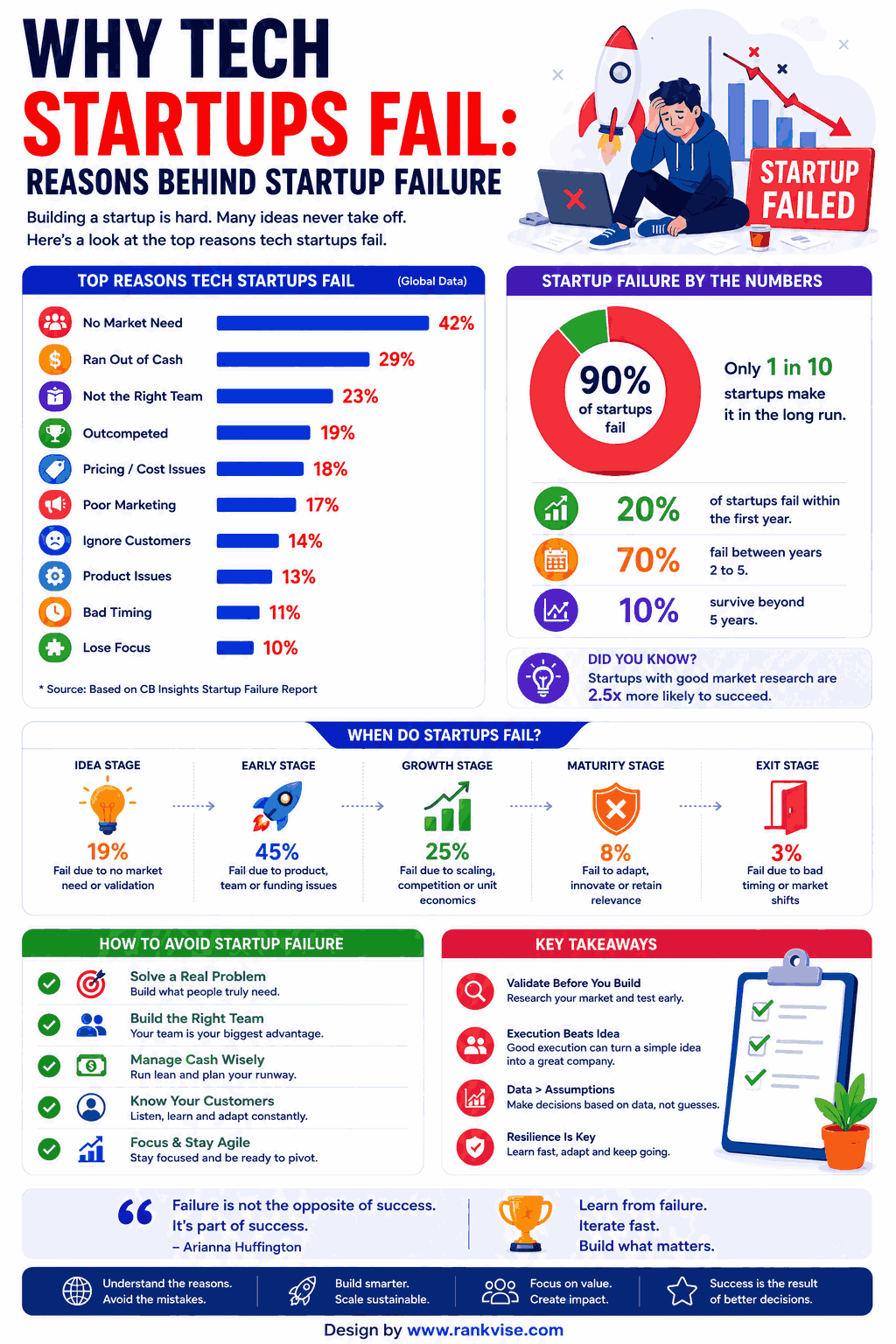
This matters because, according to a 2023 startup failure analysis by CB Insights, 70% of startups fail because they run out of cash. Interestingly, running out of money was often just a symptom. The root case was usually a lack of demand.
This article looks at some of the reasons for a lack of demand, which makes so many promising tech startups hit a brick wall.
Poor Market Positioning
Poor market positioning is when a startup fails to carve out a desirable impression in the mind of customers compared to competitors. This usually happens when messaging is generic or misaligned with what the audience needs.
Take the AI tools industry, for example. Founders in this space may not know how to sell the message of their product properly to real end users. They talk about machine learning models and API speeds. The customers? They just want to save two hours of manual work every day.
If a startup can properly position itself and its product in the mind of its target audience, it won’t sell. It’s that simple.
Humane’s AI Pin shutdown in 2024 illustrates how even heavily funded startups can struggle when their value proposition isn’t clear or well-received. Many consumers wanted to know: “Why would I use this instead of my phone?” That confusion contributed to the startup’s eventual collapse.
So, what’s the likely way out? A good idea is for young startups to think about building a name in the market early enough. For startups in the AI niche, this could mean considering PR for AI innovators.
The goal here is to attract the right user audience and even investors by making the complex technology value proposition easily understandable.
Lack of SEO Strategy
A lack of SEO strategy occurs when a business has no clear plan on how to be found by search engines.
Many founders make this mistake. They spend months, sometimes years, building software without asking a simple question:
How will customers find it? They treat SEO as an afterthought, something to “figure out later.” This is a critical mistake.
Modern search has changed. It’s no longer just about Google. Over 20% of product discovery now involves non-traditional search engines. People are asking questions to AI chatbots like ChatGPT. They’re searching on Reddit. They’re watching YouTube videos to find solutions.
Startups have to be visible in these places, where their target customers are looking. Anything else, and they’re to all intents and purposes invisible.
A solid SEO strategy for startups does more than generate traffic. It helps validate whether real people are searching for a problem in the first place.
Weak Brand Awareness
Weak brand awareness is when a business lacks market visibility and fails to come to mind when people are ready to buy. This is a problem many founders have, and it gives competitors a massive advantage in the industry.
Weak brand awareness by startups happens because founders spend months and years building a digital product without thinking of how to put their startup in the minds of potential customers before launch.
People are unlikely to buy from a company they’ve never heard of. That’s why brand awareness matters. It’s not just about being online. It’s about building credibility.
Just like with market positioning, a good way to build brand awareness is through tech PR. The idea here is to increase awareness of a startup and its products through media coverage, thought leadership, industry publications, and strategic storytelling.
As PR agency ReBlonde notes, the success of any technology company depends not only on advanced products but also on the ability to communicate innovation, credibility, and trust. That’s exactly what building brand awareness through digital PR entails.
Failing to Generate Demand Before Launch
Many founders assume demand exists. They’ve built something they believe in, so they assume others will want it. But assuming that demand exists is risky. In fact, according to current data, a staggaring 43% of startups failed because of poor product-market fit. In simple English, there was no demand for their product.
So, how can startups determine demand before launch?
They use:
- Landing pages
- Waitlists
- Customer interviews
- SEO research
- Content campaigns
The results can be remarkable. Take OpenAI, for example. Before rolling out its AI-powered search tool to the public, the company first introduced a prototype called SearchGPT with a waitlist of 10,000 test users.
This allowed them to test interest and gather feedback before scaling. Today, that technology powers ChatGPT Search. OpenAI didn’t simply assume people wanted it; they validated demand first and scaled from there.
Why Tech Startups Fail: Summary of Key Challenges and Solutions
| Challenge | Problem | Solution |
| Lack of SEO Strategy | Customers can’t find the product | Use SEO to improve visibility and validate demand |
| Poor Market Positioning | Customers don’t understand the value | Focus on outcomes, not features |
| Weak Brand Awareness | Nobody knows or trusts the brand | Build credibility through Tech PR and thought leadership |
| No Demand Validation | Founders assume demand exists | Test interest with waitlists, landing pages, and interviews |
Turning Code Into Revenue
There you have it. Some of the real reasons startups fail even though they have a great product. As you can see, even though building a great product is important. It’s just not enough.
The startups that survive and thrive? They’re the ones that treat creating awareness as a core part of the product itself. Not afterthoughts. Not tasks to deal with post-launch.
They start selling long before the product leaves the assembly line. They validate demand before investing months in development. They build audiences deliberately, consistently, and early. And they invest in long-term SEO.
They make sure the people who matter can find, trust, and understand their product and brand.
FAQs
Why do tech startups fail if their product is genuinely good?
Startups fail because having a great product is practically useless if nobody knows about it. A lack of proper visibility will kill a good startup or product even before it launches, because only people involved in the project will know about it. No outside knowledge.
When should a tech startup start marketing?
A tech start-up should start marketing long before launch, preferably during development. Once a tech startup has gotten a clear direction of what their digital product will look like, it makes sense to start letting potential users know about both the product and the startup itself.
Can a startup survive without an SEO strategy?
It’s highly unlikely for any business to survive today without search engine optimization. Of course, the startup can let people know about their product through paid targeted ads or outbound sales. But these are expensive options and quite difficult to scale over time.