A security token is a digital representation of a real-world financial asset on a blockchain. It functions like a traditional security—stocks, bonds, or real estate shares—but exists in digital form on a distributed ledger.
Think of it as a digital certificate of ownership. When you hold a security token, you own a verifiable stake in an underlying asset. That asset could be company equity, a piece of commercial property, or a share of an investment fund.
Unlike cryptocurrencies such as Bitcoin or Ethereum, security tokens derive their value from external, tradable assets. They fall under securities regulations and must comply with laws governing financial instruments in their jurisdiction.
How Does a Security Token Work?
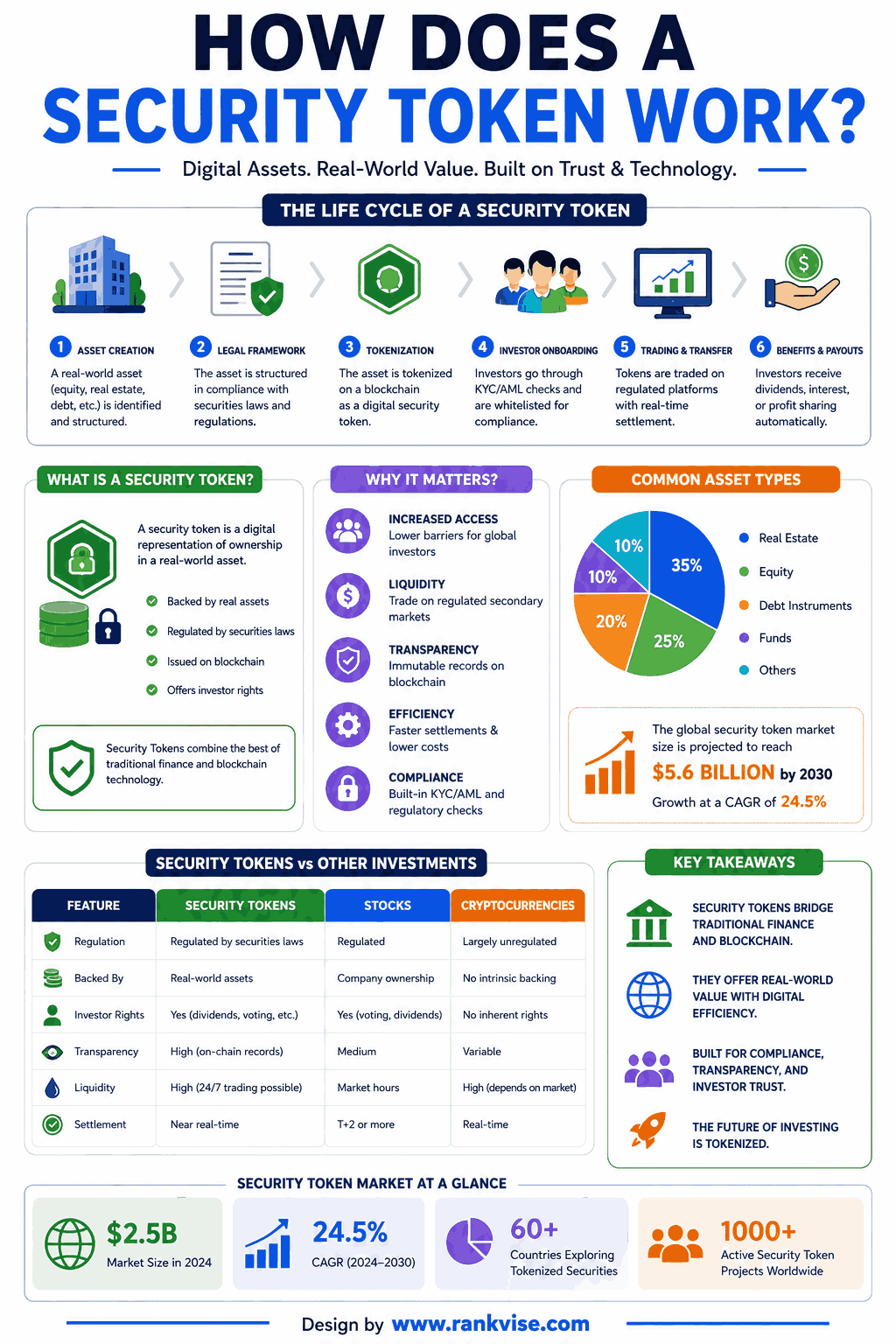
Security tokens use blockchain technology to record ownership and automate compliance. The process starts when an issuer creates tokens representing fractional ownership of an asset. Smart contracts govern how these tokens behave.
Smart contracts are self-executing programs on the blockchain. They enforce rules automatically—who can buy, when dividends pay out, and how transfers happen. No intermediary needs to approve each transaction manually.
Here is the typical lifecycle:
- An issuer tokenizes an asset (real estate, equity, debt)
- The token undergoes a security token offering (STO) to raise capital
- Investors purchase tokens through compliant platforms
- Smart contracts manage dividends, voting rights, and transfer restrictions
- Token holders trade on regulated secondary markets
Every transaction records permanently on the blockchain. This creates a transparent, auditable ownership trail that traditional paper-based systems cannot match.
Security Token vs Utility Token: What Is the Difference?
People frequently confuse security tokens with utility tokens. The distinction carries significant legal and financial implications.
| Feature | Security Token | Utility Token |
|---|---|---|
| Represents | Ownership in an asset | Access to a product or service |
| Regulation | Subject to securities laws | Generally less regulated |
| Value source | Underlying asset performance | Platform demand and usage |
| Income potential | Dividends, profit sharing | No inherent income rights |
| Examples | Tokenized real estate, equity tokens | Gaming tokens, platform credits |
| Legal test | Passes the Howey Test | Typically fails the Howey Test |
The Howey Test determines whether something qualifies as a security under US law. If investors put money into a common enterprise expecting profits from others’ efforts, it is a security. Most tokenized investment products meet this definition clearly.
Types of Security Tokens
Security tokens come in several forms depending on what they represent. Each type serves different investment purposes and carries unique characteristics.
Equity Tokens
Equity tokens represent ownership shares in a company. They function similarly to traditional stock but exist on a blockchain. Holders may receive voting rights and dividend distributions, just like conventional shareholders.
Debt Tokens
Debt tokens represent loans or bonds. They pay interest to holders at predetermined rates. The smart contract automates interest payments and principal repayment at maturity without manual processing.
Asset-Backed Tokens
These tokens represent fractional ownership of physical assets. Real estate, fine art, precious metals, and commodities all qualify. A 10 million USD building could become 10,000 tokens worth 1,000 USD each, opening access to smaller investors.
Revenue-Share Tokens
Revenue-share tokens entitle holders to a percentage of business revenue. They do not convey ownership but provide income rights. Companies use them to raise capital without diluting equity.
Benefits of Security Tokens for Investors and Issuers
Tokenized securities offer advantages that traditional financial instruments struggle to match. Both sides of the transaction benefit from the technology.
For Investors
- Fractional ownership lowers minimum investment thresholds dramatically
- 24/7 trading availability on secondary markets (no exchange hours)
- Faster settlement times (minutes instead of days)
- Transparent ownership records visible on the blockchain
- Global access to investments previously limited by geography
- Reduced counterparty risk through automated smart contracts
For Issuers
- Lower issuance costs compared to traditional IPOs or private placements
- Access to a broader, global investor base
- Automated compliance reduces ongoing legal and administrative expenses
- Programmable dividends and distributions eliminate manual processing
- Faster capital raising timelines
Real-World Examples of Security Tokens
Tokenized securities are not theoretical. Real businesses and assets operate on this model today.
Commercial real estate firms tokenize properties to sell fractional shares to global investors. A single apartment building in Manhattan can attract hundreds of investors contributing as little as 500 USD each. Traditional real estate investing required far larger minimums.
Private companies issue equity tokens instead of traditional shares during fundraising rounds. This approach provides investors with liquidity options through secondary markets—something private equity historically lacked entirely.
Government bonds in several countries now exist in tokenized form. These digital bonds settle faster and cost less to administer than their paper-based predecessors.
Regulatory Landscape for Security Tokens
Security tokens operate within existing securities frameworks. They are not unregulated like many cryptocurrency projects. This regulatory clarity actually benefits the market by building institutional trust.
In the United States, the SEC oversees security token offerings. Issuers typically use exemptions like Regulation D, Regulation S, or Regulation A+ to offer tokens legally. Each exemption carries specific requirements regarding investor eligibility and disclosure.
European markets follow MiFID II and the EU’s Markets in Crypto-Assets (MiCA) regulation. Asian markets including Singapore and Hong Kong have developed their own licensing frameworks for digital securities platforms.
Compliance is not optional. Platforms that facilitate security token trading must register as broker-dealers or alternative trading systems. This regulatory burden limits participation but protects investors from fraud.
Risks and Challenges to Consider
Despite clear advantages, security tokens carry risks that investors should understand fully.
- Regulatory uncertainty in some jurisdictions creates compliance complexity
- Limited secondary market liquidity compared to traditional stock exchanges
- Smart contract vulnerabilities could expose tokens to technical exploits
- Platform dependency means exchange shutdowns affect access to holdings
- Technology adoption remains early-stage for many institutional participants
The market is maturing rapidly, but it has not reached the depth or liquidity of traditional financial markets yet. Early adopters accept these tradeoffs for the structural benefits tokenization provides.
How to Invest in Security Tokens
Purchasing security tokens requires using regulated platforms designed for digital securities. The process differs from buying cryptocurrency on exchanges like Coinbase or Binance.
Steps to get started:
- Choose a regulated security token platform (tZERO, Securitize, INX)
- Complete identity verification and accreditation checks
- Fund your account through bank transfer or approved methods
- Browse available token offerings and review disclosures
- Purchase tokens and hold them in your platform wallet
Many offerings restrict participation to accredited investors. Accreditation typically requires annual income above 200,000 USD or net worth exceeding 1 million USD (excluding primary residence). Some Regulation A+ offerings allow non-accredited investors to participate with lower limits.
The Future of Security Tokens in 2026 and Beyond
Institutional adoption continues accelerating. Major financial firms including JPMorgan, BlackRock, and Franklin Templeton have launched tokenized fund products. This signals mainstream acceptance of the underlying technology.
The total market for tokenized real-world assets is projected to reach trillions within this decade. As regulatory frameworks solidify and secondary markets deepen, liquidity concerns will diminish. More retail investors will gain access to asset classes previously reserved for the wealthy.
Interoperability between blockchains remains a technical challenge. However, cross-chain solutions are advancing rapidly. Eventually, security tokens will trade as seamlessly across platforms as traditional stocks move between brokerages today.
FAQs
No. A security token represents ownership in a real asset and falls under securities regulations. Cryptocurrency like Bitcoin functions as a medium of exchange or store of value without representing external assets.
Security tokens offer access to diversified assets with lower minimums and greater transparency. However, limited liquidity and regulatory complexity mean they suit investors comfortable with early-stage markets and longer holding periods.
A security token offering (STO) complies with securities laws and requires regulatory approval. Initial coin offerings (ICOs) were largely unregulated, leading to widespread fraud that prompted the current compliance-focused approach.
Access depends on the offering structure. Many require accredited investor status. However, Regulation A+ offerings in the US allow non-accredited investors to participate with investment limits based on income and net worth.
Your ownership rights exist on the blockchain independently of any single platform. Tokens can typically transfer to another compliant platform, though the process may involve delays and administrative steps.