A sequence detection system identifies specific patterns within a stream of data or signals. It monitors inputs continuously and triggers an output when a predefined order appears. Think of it as a digital watchdog trained to spot exact combinations.
- Finite state machine uses states and transitions to track progression and reach a final state that signals a completed pattern.
- Overlapping detection reuses bits for faster repeated matches, while non-overlapping resets after each match, simplifying state logic.
- Common applications include communications framing, cybersecurity signatures, manufacturing sequence control, financial fraud monitoring, and genomic pattern searches.
- Design best practices: define sequence precisely, choose hardware or software, test state diagrams with real data, and refine continuously.
These systems operate across industries. From digital electronics to cybersecurity, they ensure the right sequence triggers the right response. Without them, automated processes would lack precision and reliability.
The core idea is simple. You define a target pattern. The system watches every incoming signal. When the pattern matches, it acts. This principle drives everything from circuit design to fraud detection.
How Does a Sequence Detection System Work?
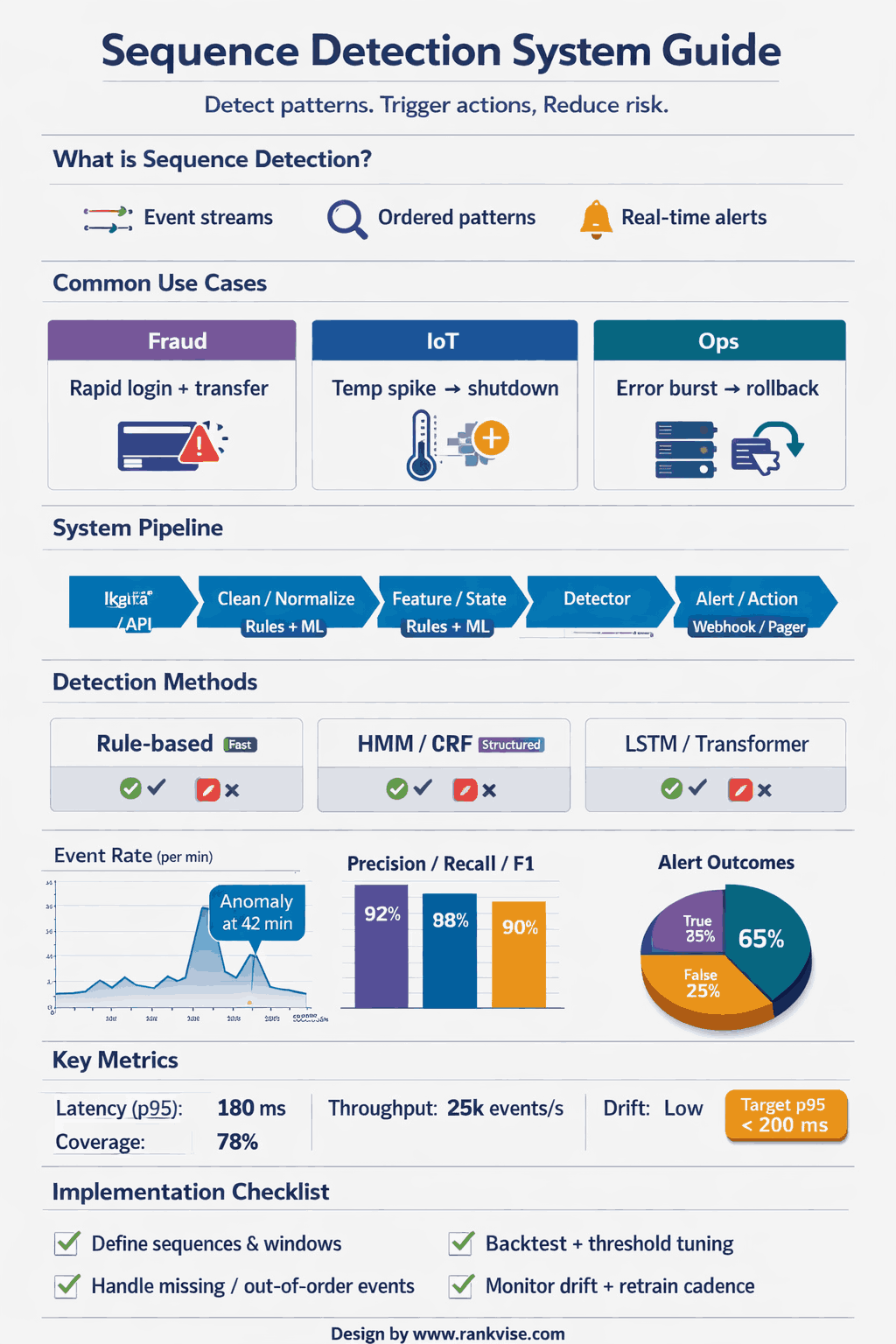
Every sequence detection system follows a structured logic. It uses states to track progress toward recognizing a full pattern. Each new input either advances the system closer to detection or resets it.
State Machine Architecture
Most systems rely on a finite state machine. This machine transitions between defined states based on each input received. When it reaches the final state, it confirms the sequence.
Here is a simplified flow:
- The system starts in an idle state
- Each correct input moves it to the next state
- An incorrect input may reset it partially or fully
- The final state triggers an output or alert
This architecture ensures accuracy. It eliminates false positives by requiring every element in the correct order.
Overlapping vs Non-Overlapping Detection
Two primary detection methods exist. Understanding both helps you choose the right approach.
| Feature | Overlapping Detection | Non-Overlapping Detection |
|---|---|---|
| Reuse of inputs | Yes, shares bits with next sequence | No, starts fresh after detection |
| Detection speed | Faster for repeated patterns | Slightly slower |
| Complexity | Higher state transitions | Simpler state logic |
| Use case | Continuous signal monitoring | Discrete event tracking |
Overlapping detection reuses part of the detected sequence for the next match. Non-overlapping detection resets completely after each successful match.
Key Components of a Pattern Recognition Engine
A sequence detection system depends on several critical components working together. Each plays a distinct role in ensuring accurate pattern identification.
- Input buffer – Temporarily holds incoming data for analysis
- State register – Stores the current position within the detection sequence
- Transition logic – Determines the next state based on current input
- Output generator – Produces a signal when the full sequence appears
- Clock mechanism – Synchronizes all operations for timing accuracy
These components form the backbone of any reliable detection circuit or software module. They ensure that no input goes unchecked and every valid sequence gets flagged.
Where Are Sequence Detection Systems Used?
The applications span far beyond textbook electronics. Businesses and engineers deploy these systems wherever pattern matching drives decisions.
Digital Communication Networks
Communication protocols rely on sequence detectors to identify frame boundaries. They locate start and stop patterns within data streams. This ensures that receivers interpret transmitted messages correctly.
Without sequence detection, data packets would lack structure. Receivers would struggle to distinguish meaningful content from noise.
Cybersecurity and Intrusion Detection
Security systems monitor network traffic for suspicious patterns. A sequence detection system flags known attack signatures. It identifies brute-force login attempts, malware communication sequences, and unauthorized access patterns.
This application protects organizations from threats in real time. The system responds faster than any human analyst could.
Industrial Automation and Quality Control
Manufacturing lines use pattern detection to monitor product sequences. Sensors detect whether items pass through stations in the correct order. Any deviation triggers an immediate alert.
This prevents defective products from reaching customers. It also reduces waste and downtime on production floors.
Financial Transaction Monitoring
Banks and payment processors monitor transaction sequences for fraud indicators. Specific patterns of withdrawals, transfers, or purchases signal potential unauthorized activity.
The detection system flags these sequences instantly. Compliance teams can then investigate before losses escalate.
Bioinformatics and Genomic Research
Researchers use sequence detection to identify specific gene patterns in DNA strands. The system scans billions of base pairs to find target sequences. This accelerates drug discovery and genetic research significantly.
Types of Sequence Detectors You Should Know
Different scenarios demand different detector designs. Here are the primary types used across applications.
Mealy Machine Detector
A Mealy machine produces output based on both the current state and the current input. This makes it faster because it responds during the transition itself.
Key characteristics:
- Output depends on state and input together
- Fewer states required overall
- Faster response time
- Ideal for timing-sensitive applications
Moore Machine Detector
A Moore machine produces output based solely on the current state. The output changes only when the system enters a new state. This creates more predictable, stable behavior.
Key characteristics:
- Output depends only on the state
- More states needed compared to Mealy
- Outputs remain stable between transitions
- Better suited for noise-sensitive environments
Software-Based Detectors
Not all sequence detection happens in hardware. Software implementations use algorithms to scan data streams. Regular expressions, sliding window techniques, and machine learning models all serve this purpose.
Software detectors offer flexibility. You can update detection patterns without redesigning physical circuits. This makes them ideal for evolving threat landscapes in cybersecurity.
Benefits of Implementing a Sequence Detection System
Organizations gain measurable advantages when they deploy effective detection systems.
- Speed – Identifies patterns in microseconds or less
- Accuracy – Eliminates human error in repetitive monitoring tasks
- Scalability – Handles increasing data volumes without proportional cost increases
- Automation – Removes manual oversight from routine pattern checks
- Cost reduction – Prevents losses from undetected anomalies or defects
These benefits compound over time. Early detection saves money, protects reputation, and improves operational efficiency across departments.
How to Design an Effective Sequence Detection System
Building a reliable system requires careful planning. Follow these steps to ensure your implementation succeeds.
Step 1: Define the Target Sequence Clearly
Document every element of the pattern you want to detect. Ambiguity at this stage causes failures later. Be precise about order, timing, and acceptable variations.
Step 2: Choose the Right Architecture
Decide between hardware and software implementation. Consider speed requirements, budget constraints, and scalability needs. Hardware suits fixed, high-speed applications. Software suits flexible, evolving requirements.
Step 3: Build and Test the State Diagram
Map every possible input scenario. Identify where resets occur. Test edge cases where partial matches overlap with new sequences. Thorough testing here prevents false detections in production.
Step 4: Validate with Real-World Data
Simulated data rarely captures every anomaly. Test your system against actual operational data. Measure detection rates, false positive rates, and response times under load.
Step 5: Monitor and Refine Continuously
No detection system remains perfect forever. Patterns evolve. New sequences emerge. Schedule regular reviews to update detection logic and improve accuracy over time.
Common Challenges and How to Overcome Them
Every implementation faces obstacles. Anticipating them helps you respond faster.
| Challenge | Solution |
|---|---|
| High false positive rates | Refine state transitions and add validation layers |
| Missed detections | Expand state coverage for edge cases |
| Performance bottlenecks | Optimize clock cycles or use parallel processing |
| Pattern evolution | Implement adaptive or machine-learning-based updates |
| Integration complexity | Use modular design with standard interfaces |
Addressing these challenges early ensures your system delivers consistent value without constant manual intervention.
Future Trends in Sequence Detection Technology
The field continues evolving rapidly. Several trends will shape how detection systems operate in the coming years.
Artificial intelligence now enhances traditional state machines. Machine learning models identify new patterns without manual programming. This makes detection systems adaptive rather than static.
Edge computing brings detection closer to data sources. Instead of sending all data to central servers, local devices perform detection instantly. This reduces latency and bandwidth requirements.
Quantum computing promises exponential speed improvements for complex pattern matching. While still emerging, it will eventually transform genomic and cryptographic sequence detection.
FAQs
It identifies specific patterns in data streams or signals, triggering actions when a predefined order appears in applications like security, electronics, and automation.
A Mealy detector outputs based on state and input together, while a Moore detector outputs based only on the current state, making Moore more stable but slower.
Yes, hardware-based detectors operate in microseconds, and optimized software systems handle real-time data streams for cybersecurity and financial monitoring.
Overlapping detection reuses part of a matched sequence for the next detection attempt, while non-overlapping resets completely after each successful match.
No, traditional finite state machines work effectively for known patterns. Machine learning adds value when patterns evolve or when you need to detect unknown sequences automatically.