“Agentic AI” is one of those terms that arrived fast and got overused immediately.
Every AI vendor with a chatbot and a few API calls started calling their product “agentic.” The word lost meaning before most people had a clear picture of what it actually described.
Here’s the distinction that matters: agentic AI systems don’t just respond to inputs — they pursue goals. They plan. They take sequences of actions. They use tools. They handle interruptions and failures and adjust their approach based on what they encounter. The difference between a standard AI integration and an agentic AI system is the difference between a calculator and a junior analyst.
That difference changes what the software development work involves — significantly.
Agentic AI vs Standard AI Integration: What’s Actually Different
Most AI software development involves integrating a language model into an existing application. A user sends a message, the model generates a response, the response is displayed. The model is a component — powerful, but passive.
Agentic AI is architecturally different.
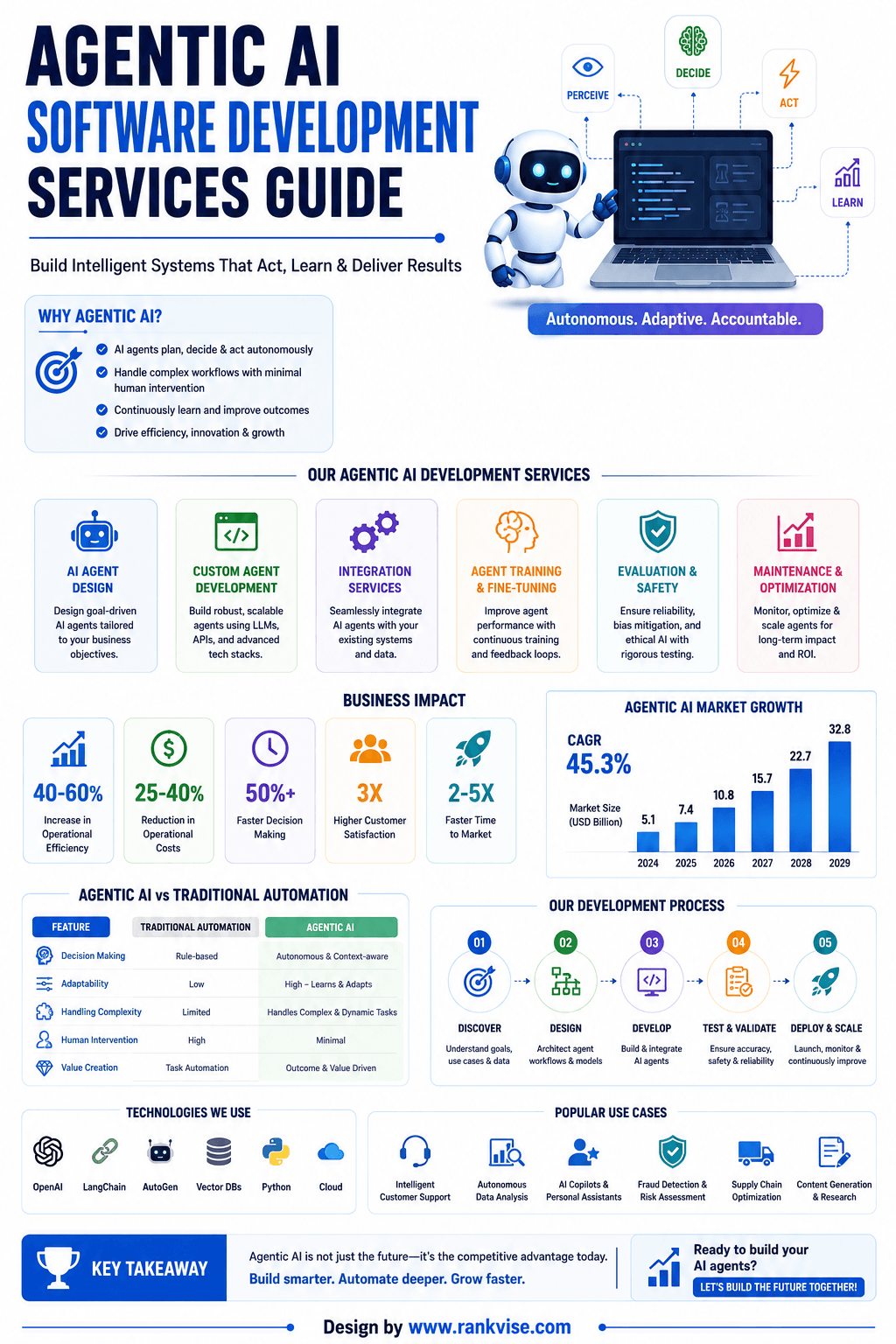
| Dimension | Standard AI Integration | Agentic AI System |
| Goal structure | Respond to a single input | Pursue a multi-step objective |
| Action scope | Generate text or structured output | Use tools, trigger actions, modify state |
| Decision making | Single inference | Sequential decisions with feedback loops |
| Error handling | Return error or fallback response | Detect failure, retry, reroute, escalate |
| Memory | Conversation context only | Short-term + long-term + episodic memory |
| Human interaction | Turn-by-turn conversation | Autonomous execution with defined oversight points |
| Monitoring requirements | Output quality | Behavior, decision chains, tool usage, outcome tracking |
Building an agentic AI system requires engineering decisions that don’t exist in standard AI integration. Each of these dimensions adds complexity — and each represents a place where inadequate design produces production failures.
What Agentic AI Software Development Actually Involves
Goal and Task Boundary Definition
The starting point for any agentic system is defining precisely what the agent is trying to achieve — and equally importantly, what it’s not trying to achieve.
Agentic systems can cause real-world effects. They send emails. They update databases. They make API calls that charge money. They take actions that are difficult to reverse. The task boundary isn’t just a design constraint — it’s a safety boundary.
Good agentic AI software development services invest significant time at this stage. What goals is the agent authorized to pursue? What actions is it authorized to take? What requires human approval? What should never happen without explicit confirmation? These questions need documented answers before any code gets written.
Planning and Orchestration Architecture
Standard AI integration doesn’t need a planning layer. Agentic systems do.
Planning is the mechanism by which an agent breaks a goal into steps, sequences those steps, and adapts the sequence when something unexpected happens. The orchestration layer manages the execution of that plan — calling tools, handling responses, detecting failures, deciding whether to retry or escalate.
The architectural choices here have significant downstream consequences:
| Architecture Approach | Strengths | Weaknesses | Best For |
| ReAct (Reason + Act) | Simple, transparent reasoning | Can loop on hard problems | Well-defined sequential tasks |
| Plan-and-Execute | Better for complex multi-step work | Higher latency, more expensive | Research, analysis workflows |
| Multi-agent | Specialized agents for different subtasks | Complex coordination overhead | Large-scale, parallel workflows |
| Hierarchical | Manager agent + specialist agents | Complex to debug | Enterprise operations automation |
Choosing the right architecture for the specific use case is an engineering judgment that requires both AI expertise and understanding of the business problem. Generic architecture applied to every project produces systems that work for some use cases and fail for others.
Tool Layer Engineering
The tools available to an agentic system define what it can actually do in the world. Each tool is a capability — and a risk surface.
Building the tool layer for an agentic AI system is not just connecting APIs. Each tool needs:
- Input validation — ensuring the agent is calling the tool with appropriate parameters
- Authorization checks — ensuring the agent is permitted to take this action in this context
- Error handling — defining what happens when the tool fails, returns unexpected results, or times out
- Idempotency — ensuring that retrying a failed tool call doesn’t produce duplicate effects
- Logging — creating an audit trail of every tool call for debugging and oversight
The difference between a tool layer built with these considerations and one built without them is the difference between an agent that fails gracefully and one that creates operational incidents.
Memory Architecture
Agentic systems need different kinds of memory for different purposes.
Working memory — the context available during a single task execution. Limited by the model’s context window. Needs to be managed carefully for long-running tasks.
Episodic memory — records of past task executions. Allows the agent to learn from experience, avoid repeating mistakes, and maintain continuity across sessions.
Semantic memory — structured knowledge the agent can retrieve. Usually implemented as a vector store with retrieval-augmented generation. Allows the agent to access large knowledge bases without loading everything into context.
Procedural memory — learned workflows and patterns. How to handle specific situations that have been encountered before.
Most agentic AI software development services implement some combination of these. The right combination depends on the use case, the expected task duration, and the performance requirements.
Human Oversight Integration
Agentic systems take actions with real-world consequences. Human oversight isn’t optional — it’s a design requirement.
The oversight model needs to be deliberate:
- What actions require pre-approval? High-consequence, irreversible, or high-cost actions should require explicit human confirmation before execution.
- What triggers escalation? When the agent encounters a situation outside its defined scope, it needs a path to a human rather than a guess.
- What gets reviewed after the fact? Not everything can be reviewed in real time. Sampling of completed tasks, anomaly detection on agent behavior, and periodic audits of outcomes are the monitoring layer.
- What’s the kill switch? Every production agentic system needs a mechanism to halt execution immediately if something is going wrong.
Designing this layer properly is as important as designing the agent itself.
The Development Lifecycle for Agentic AI
| Phase | Key Deliverables | Common Mistakes |
| Discovery | Task boundary doc, tool inventory, oversight model | Skipping this to start building faster |
| Architecture | System design, memory model, orchestration approach | Choosing architecture before understanding the problem |
| Tool development | Validated tool layer with error handling | Building tools without authorization and logging |
| Agent development | Core agent with planning and execution | Building without evaluation framework |
| Evaluation | Test suite, performance benchmarks, failure analysis | Evaluating on clean data only |
| Production hardening | Edge case handling, monitoring, documentation | Treating this as a sprint rather than a phase |
| Deployment | Monitoring infrastructure, alerting, human oversight | Deploying without oversight mechanisms |
What Separates Agentic AI Services That Deliver
The vendors doing this well share a few characteristics that are easy to verify.
They can describe the architecture of a production agentic system they’ve deployed — including the tool layer design, the memory architecture, the orchestration approach, and the human oversight model. Not in general terms — specifically, for a real system that’s handling real work.
They have a defined approach to task boundary definition before development begins. This produces a document, not just a conversation.
They treat evaluation as a phase, not an afterthought. The test suite for an agentic system covers not just “does it complete the task” but “does it behave correctly when it can’t complete the task.”
They’ve thought carefully about the oversight model. Not as a feature to add — as a core architectural requirement.
At instinctools.com, agentic AI software development services are structured around these requirements. Discovery produces the task boundary document and oversight model design before development begins. Architecture is chosen to fit the specific use case, not applied generically. The tool layer is engineered with authorization, logging, and error handling from the start. And the evaluation framework is designed before the agent is built, not after.
Agentic AI is genuinely different from standard AI integration — in what it can do, in what can go wrong, and in what the development work involves.
The services that deliver production-ready agentic systems are the ones that treat this difference seriously from the beginning — not as a late-stage concern when something breaks.