You ask a question. You get a one-word answer. The conversation dies right there.
- Open ended questions invite detailed responses using what, how, why, describe, or tell me about.
- They contrast with closed questions by expanding dialogue and revealing qualitative insights rather than yes/no or short answers.
- In business they uncover customer motivations, improve feedback quality, and strengthen relationships.
- Ask effectively: start with the right words, stay specific, ask one question at a time, then allow silence.
- Follow up with curiosity and dig deeper to clarify answers, then use closed questions to confirm key details.
That frustrating scenario plays out in meetings, sales calls, and surveys every single day. The problem is not the person answering. The problem is the question itself. When you learn to ask open ended questions, you unlock deeper conversations and better insights.
This guide explains exactly what an open ended question is. You will also get 10 practical examples you can use immediately across different business situations.
What Is an Open Ended Question?
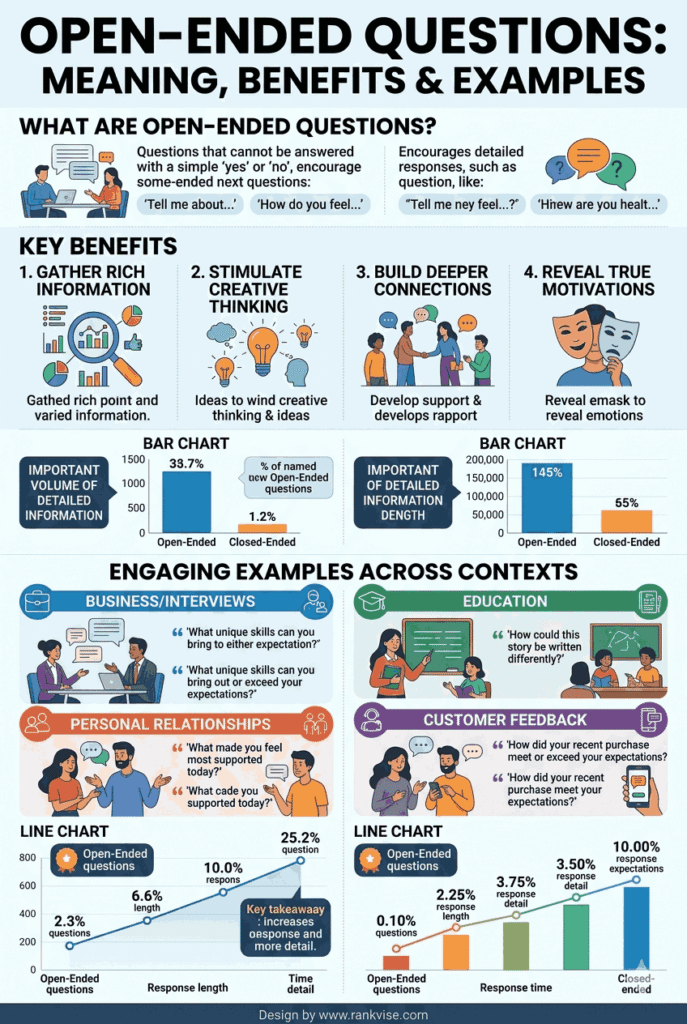
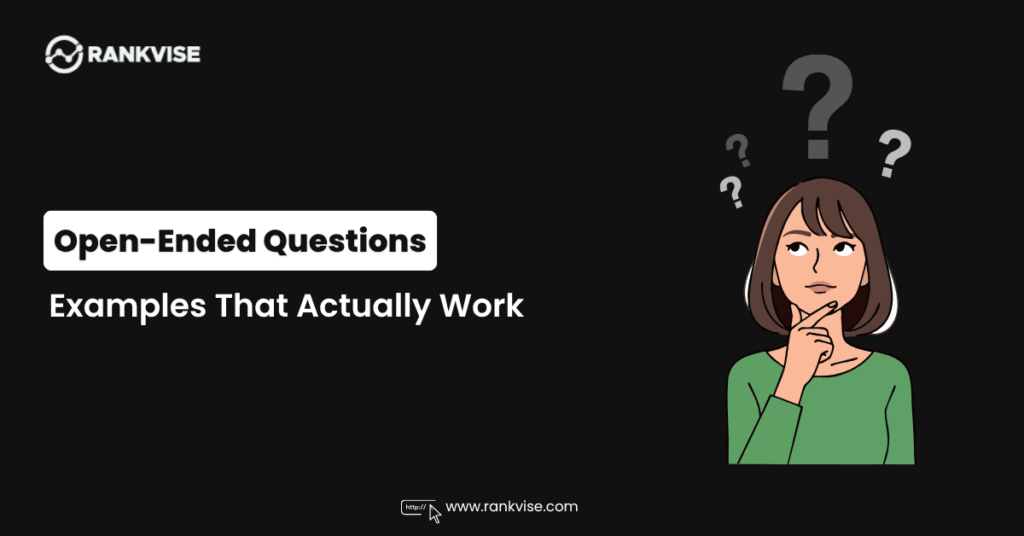
An open ended question is any question that cannot be answered with a simple “yes,” “no,” or one-word response. It invites the other person to think, reflect, and share a detailed answer. These questions typically begin with words like “what,” “how,” “why,” or “tell me about.”
Compare these two approaches. A closed ended question asks, “Did you like the product?” The answer is yes or no. An open ended question asks, “What did you enjoy most about using the product?” That second version encourages a fuller, more useful response.
Open ended questions work because they hand control to the respondent. Instead of limiting choices, they create space for honest and meaningful answers.
Open Ended Questions vs Closed Ended Questions
Understanding the difference between open ended and closed ended questions is essential. Each type serves a different purpose. Using the wrong one at the wrong time costs you valuable information.
Closed ended questions narrow the response to a fixed set of options. They are useful for collecting quantitative data or confirming specific facts. Think of survey scales, yes/no checkboxes, or multiple choice formats.
Open ended questions expand the conversation. They are ideal for qualitative research, discovery calls, interviews, and feedback sessions. They help you understand the “why” behind someone’s behaviour or decision.
| Feature | Open Ended Questions | Closed Ended Questions |
|---|---|---|
| Response length | Detailed, multi-sentence | One word or short phrase |
| Starts with | What, how, why, describe | Do, is, are, did, will |
| Best for | Exploration and insight | Confirmation and data |
| Data type | Qualitative | Quantitative |
| Conversation flow | Expands dialogue | Narrows dialogue |
The strongest communicators use both types strategically. They open with open ended questions to explore. Then they follow up with closed ended questions to confirm key details.
Why Open Ended Questions Matter in Business
Open ended questions are not just a communication technique. They are a business advantage. Teams that ask better questions consistently make better decisions.
They Reveal Customer Motivations
Customers rarely tell you what they actually need unless you ask the right way. An open ended question like “What challenges are you facing right now?” uncovers pain points that a yes/no question would completely miss. This is especially valuable in sales conversations and customer interviews.
They Build Stronger Relationships
People feel heard when you give them space to share their perspective. Asking open ended questions in meetings and one-on-one conversations signals genuine interest. That builds trust and strengthens professional relationships over time.
They Improve Survey and Feedback Quality
Surveys filled with only closed ended questions give you numbers but not context. Adding a few well-placed open ended questions helps you understand the reasoning behind customer scores. You move from knowing what happened to understanding why it happened.
They Drive Better Team Collaboration
Managers who ask open ended questions in team settings encourage creative thinking. Instead of asking, “Is the project on track?” try asking, “What obstacles could slow us down this quarter?” The second question opens the door to proactive problem-solving.
How to Ask Open Ended Questions Effectively
Knowing the definition is one thing. Asking open ended questions well is another skill entirely. Here are practical guidelines to sharpen your approach.
Start with the right words. Begin your questions with “what,” “how,” “why,” “describe,” or “tell me about.” These words naturally prompt longer responses. Avoid starting with “do,” “is,” or “are” since those lead to short answers.
Keep questions focused. A vague question produces a vague answer. Instead of asking “How is everything going?” ask “What part of this project has been the most challenging so far?” Specificity drives better responses.
Ask one question at a time. Stacking multiple questions into one confuses the respondent. They will usually only answer the last question or the easiest one. Give each question its own moment.
Stay silent after asking. Resist the urge to fill the pause. Silence gives the other person time to think. The best answers often come after a few seconds of quiet reflection.
Follow up with curiosity. When someone gives you a good answer, dig deeper. Ask “Can you tell me more about that?” or “What led you to that conclusion?” Follow-up questions show you are genuinely listening.
10 Practical Open Ended Question Examples
These examples cover real business scenarios. Each one is ready to use in your next meeting, interview, sales call, or survey.
- “What prompted you to start looking for a solution like ours?” Use this in sales discovery calls. It reveals the trigger event behind a prospect’s decision to explore options.
- “How would you describe your experience with our service so far?” Use this in customer feedback conversations. It gives customers freedom to highlight what matters most to them.
- “What does a successful outcome look like for your team this quarter?” Use this in client onboarding or project kickoff meetings. It aligns expectations from the very start.
- “What challenges are you currently facing in your day-to-day workflow?” Use this in needs assessments or consulting calls. It uncovers operational pain points that drive purchasing decisions.
- “How do you typically evaluate whether a new tool is worth the investment?” Use this in B2B sales conversations. It helps you understand the buyer’s decision-making criteria before you pitch.
- “What would you change about how we communicate project updates?” Use this in internal team retrospectives or client check-ins. It invites constructive and specific feedback.
- “Why did you choose our product over the other options you considered?” Use this in win analysis interviews. It tells you exactly what competitive advantages resonate with buyers.
- “How has this issue affected your team’s productivity or morale?” Use this in stakeholder interviews or employee surveys. It connects a problem to its real business impact.
- “What advice would you give someone just starting in this role?” Use this in mentoring conversations or exit interviews. It draws out practical wisdom and institutional knowledge.
- “Tell me about a time when this process did not work as expected.” Use this in process improvement discussions. It surfaces specific failure points without sounding accusatory.
Common Mistakes to Avoid with Open Ended Questions
Even well-intentioned professionals make errors when asking open ended questions. Here are pitfalls to watch for.
Asking leading questions disguised as open ones is a frequent mistake. “Don’t you think our onboarding could be better?” is not truly open ended. It pushes the respondent toward a specific answer. A better version would be “How would you improve our onboarding process?”
Another mistake is asking open ended questions when you actually need a direct answer. If you need a deadline confirmed, a closed ended question is the right tool. Matching question type to your goal saves everyone’s time.
Finally, avoid asking open ended questions without genuinely listening to the response. If you ask a thoughtful question and then immediately jump to your next talking point, you waste the opportunity. Listen, acknowledge, and build on what you hear.
FAQs
An open ended question is one that requires more than a yes or no answer. It encourages the respondent to explain, describe, or share their thoughts in detail.
The most effective starting words are “what,” “how,” “why,” “describe,” and “tell me about.” These naturally prompt longer, more thoughtful responses from the other person.
Use open ended questions when you want to explore ideas, gather qualitative feedback, or understand motivations. Use closed ended questions when you need specific data or quick confirmation.
Yes, but use them sparingly in surveys. One or two open ended questions paired with closed ended ones give you both measurable data and rich qualitative context.
They help salespeople uncover buyer pain points, understand decision criteria, and build rapport. Prospects share more when they feel genuinely heard rather than interrogated.