The percentage of Internet pages receiving visits from Google is just 3.45%, with 96.55% totally hidden. The shocking statistic shows how difficult it is to generate search demand today.
- Use competitor analysis to learn successful strategies, reduce guesswork, and target effective traffic sources for sustainable digital growth.
- Turn competitive intelligence into SEO decisions: prioritize technical fixes, competitor-based keywords, and content aligned with user intent.
- Perform keyword gap and content performance analysis to capture high-intent terms and build conversion-focused content quickly and efficiently.
- Measure link profiles, SERP authority, and visibility; run structured audits and safe automation, updating tracking regularly for proactive growth.
In cases of rapid growth, a thorough competitor analysis will help your brand avoid falling into the trap and guide you to the most successful traffic sources. A lot of marketers believe that there’s just a ton of guesswork involved in ranking for search.
Growth comes from learning from successful leaders, however. This guide demonstrates how businesses use competitive metrics to gain a market share.
The Importance of Competitor Analysis for Digital Growth
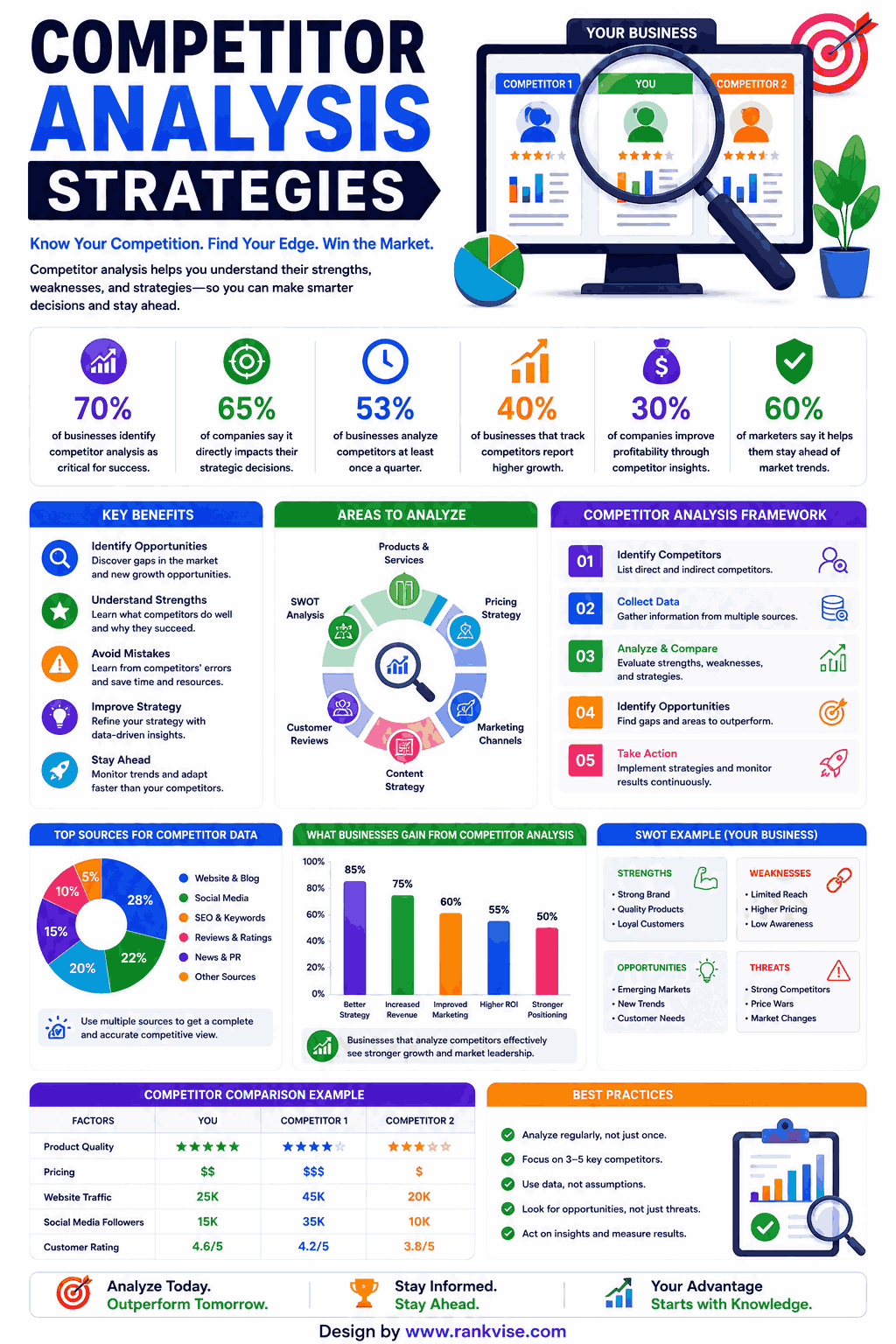
When you begin a competitor analysis, you’re required to look at the specific strategies of effective brands in your niche. If you don’t have this blueprint, your digital marketing budget can quickly be lost to unoptimized campaigns.
Knowing your competitors’ game helps you reduce duplication and define product positioning. You need to understand your online competitors’ tactics to find out what is working in real time. This process eliminates the guesswork and provides actual facts about behaviors.
Analyzing industry leaders can be of direct benefit to building your online presence:
- Identifies customer complaints you didn’t know about and your brand can solve.
- Analyzes competitors’ strengths and weaknesses.
- Recognizes successful marketing avenues.
- Avoids the costly trial-and-error of product positioning.
By carefully observing customers’ buying habits, you will know exactly why they choose other brands over yours. That’s why these patterns remain the cornerstone of enduring commercial success.
From Basic Audits to Competitive Intelligence
There is a difference between observing and researching, and many business owners don’t realize it. Rank tracking only shows the current positions in search engines. However, investing in competitive intelligence changes the game from reacting to proactively making changes to achieve dominance.
This way, it monitors structural changes, product innovations, and price adjustments. It allows you to predict moves rather than just react to them.
Modern organizations use structured methods to deal with this information:
- To categorize threats as immediate and secondary threats.
- Pricing matrices that track live promotions.
- Use feature mapping to contrast capabilities of products.
This is a more in-depth look at the rankings beyond the daily shifts. It reveals the essence of a competitor’s digital strategy. This is why top marketing departments invest significant resources in this particular area.
Matching Competitive Intelligence to Your Main SEO Strategy
A strong digital reputation needs to be built on a strong base. Understanding these details first gives you valuable information to inform your overall SEO approach, allowing you to target the most effective opportunities.
Rather than going after too general keywords, you create campaigns based on the proven conversion paths. This means that each piece of published content is geared toward a definite business goal.
To start your product positioning on a strong foundation that stands the test of time, it’s smart to first take a look at your current situation. A thorough SEO audit gives you a detailed overview.
There are three specific pillars to an aligned optimization plan:
- Technical changes to align with industry speed benchmarks.
- Optimized, validated competitor performance-based targeting of keywords.
- Content alignment to user intent patterns at the structure level.
If these two aren’t aligned, the optimization process is disjointed and very inefficient. However, when you tie competitor insights to your roadmap, you’ll ensure you are continuously moving forward in your search results.
Identifying Opportunities for High-Value Search Visibility and Organic Traffic
To find out whether your brand is lacking in certain areas, pay attention to specific visibility scores. A lot of times, successful brands appear at the top of search results because they are the first to recognize and fill gaps. By comparing your search visibility with market leaders, you identify ranking opportunities that you can take advantage of right now. This action will directly boost your organic traffic percentage.
A detailed competitor analysis will show you exactly how competitors have a monopoly. It will tell you which words are their main keywords for customers. This gap identification process will be based on impressions, CTR rates, and seasonal industry changes.
These metrics are separate so that your team can focus on high-converting terms. That’s why the best digital agencies always begin campaigns with a thorough gap analysis.
Performing a Keyword Gap Analysis
This comprehensive keyword gap analysis identifies high-intent keywords your competitors rank for, but you don’t. This activity uncovers content targets that are likely to be of commercial value as immediate content targets. These competitor keywords save months of keyword testing. It is the foundation of growth marketing today, with efficiency over volume.
You can address these gaps and create content that will take market share right from them. However, to be successful in this process, it is important to do it correctly and avoid including keywords with low value and a high number of impressions.
Breaking Down the Content Performance
Just because you are published doesn’t mean you will be ranked. If you want to be successful, you need to understand the editorial standards and analyze content strategy. It also shows you the exact formats that are engaging users. Tracking rivals’ content performance avoids wasted production time/money on topics that don’t convert.
You compare several elements of competitor material to your own:
- Word count and structure of the most relevant pages.
- Incorporation of multimedia such as customized diagrams and videos.
- High-performing layout readability scores & structural design.
These patterns help you form your own writing style and schedule. It guarantees that your resources ensure pieces are of standard quality or better.
Measuring Link Profiles and SERP Authority
Off-page signals are among the most important factors in determining search engine ranking authority. A thorough backlink analysis will show you where your competitors are getting their authoritative links. This process helps identify high-quality directories, media outlets, and industry partners. It is like a map for your link-building strategies.
And a detailed SERP analysis makes it clear what domain strength you need to outcompete:
- Finds the average domain authority of the top 10 positions.
- Identifies the ratio of homepage links to inner-page links.
- Shows the existence of image carousels, local packs, and rich snippets.
This assessment helps your business avoid competing against other businesses in a too-competitive auction. But it also shows you opportunities available to you that you can optimize a bit and see a huge ranking boost.
Safe Scraping: Public Competitors Analysis
Automating your metric gathering speeds up research for thousands of keywords. Businesses use custom scrapers to track product inventories, search rankings, or public market data.
But often search engines throttle back repetitive requests from any given network. Digital teams route requests through multiple gateways to run a continuous competitor analysis without interruptions. They opt to buy proxy solutions to spread this retrieval workload across multiple networks. This keeps the scraping speed steady and will avoid automated CAPTCHAs from blocking your scripts.
This technical infrastructure carries out important scanning activities:
- Monitoring price changes of public products on e-commerce platforms.
- Collecting search engine results pages from the public in various places.
- Scraping public listings of industry contacts.
Being ethical in your queries shows respect for the platform. It ensures you don’t waste resources while maintaining easy access to public information. But make sure your automation does not collect any personally sensitive information and follows best practices.
Practical Framework to Run Your Competitor Audit
A structured audit will avoid information overload. First, identify your main direct competitors. You perform a detailed traffic analysis of their main digital channels. This helps explain where they are acquiring their customers. It also reveals the industry trends which will determine the direction of consumer demand. At the same time, their audience insights can be gleaned from their customer reviews.
To do a successful review, you should plan the actions you need to take:
- Choose 5 direct competitors selling the same product as you.
- Choose 3 indirect competitors targeting the same customer base as you.
- Record their fundamental pricing structures and levels of service.
- Use professional traffic analytics tools to extract their main traffic sources.
This systematic approach encompasses a competitor analysis broken down into doable tasks. It will prevent you from spending hours on data points that don’t matter. However, the most important element is that it establishes a process your internal marketing team can repeat.
How to Do Competitor Analysis Step by Step
For your competitor analysis to be very effective, stick to a straightforward execution plan. Raw numbers are useless without a well-planned and well-executed approach. Using cutting-edge SEO tools simplifies the information collection process and lets you generate reports within moments rather than hours. However, your team needs to be familiar with how to use these reports.
This step-by-step breakdown will help you “walk through” your implementation:
- Extract organic ranking terms of your top three rivals.
- Narrow down the results to commercial keywords.
- Identify content areas your website doesn’t cover.
- Use the successful templates to restructure on-page elements.
- Check your performance weekly to see if your rank has changed.
This way, your team can respond to insights on the fly. It eliminates the hesitation that can be a stumbling block in digital campaigns. That is why a structured workflow is more successful than unstructured analysis.
High-Performance Professional Tools: Comparison
Specialized platforms are needed to obtain high-quality market metrics. Professional software offers depth that many business owners can’t get from free trials. Choose from these three analytics tools (prices listed for their starter packages).
| Platform | Starting Price | Primary Benefit |
| SEMrush | $139.95 / month | All-encompassing organic research and gap tracking |
| Ahrefs | $129.00 / month | Exceptional link index and keyword difficulty |
| Moz Pro | $99.00 / month | Clean user interface and trustworthy domain authority metrics |
The platform you choose is dependent on your campaign goal and budget. For deeper off-page audits, Ahrefs provides unparalleled visibility. SEMrush offers more tools for holistic research. Using these platforms takes your competitor analysis from tracking to research.
Takeaways for Sustainable Digital Growth
Make it a part of your monthly routine to maintain an efficient workflow. Regular competitor analysis eliminates the element of guesswork – and becomes a growth plan. There is no need to reinvent the wheel to be successful. It requires you to learn about the wheel and to create a more efficient version.
Three key priorities to keep in mind during the implementation:
- Optimize content for high-intent commercial keywords.
- Acquire high-quality backlinks from trustworthy and related industry websites.
- Keep a competitive tracking sheet up to date every month or so.
This field helps safeguard your organic visibility from unexpected market declines. That’s why proactive companies always have a head start in search engine rankings.
Conclusion
To grow online, you need to be constantly aware of the industry. A periodic competitor analysis will keep your business profitable and competitive. Emphasize the gaps, develop improved content, and implement it systematically.
FAQs
Competitor analysis helps you identify competitors’ strengths and weaknesses to understand the opportunities your brand can exploit to grow.
Update it completely every quarter. Keep a weekly check on your core rankings and organic traffic to stay on top of sudden competitive changes.
Yes, it is based on the public search results, publicly available pricing tables, and open marketing data.