Choosing between Klaviyo and Mailchimp feels straightforward until you actually start comparing what each platform does inside a real Ecommerce environment. Both send emails, both have automation, come with segmentation tools, and reporting dashboards that look similar on a feature comparison page. The difference only becomes visible when you look at how each platform handles Ecommerce data, behavioural triggers, and revenue attribution in practice.
For a business where email is a serious revenue channel rather than a newsletter tool, that difference is significant and gets more expensive to ignore as the list and the business grow together over time. This difference becomes even more important when brands start scaling their automation strategy and need proper setup, optimisation, and ongoing management through Klaviyo email marketing.
What Is the Core Difference Between Klaviyo and Mailchimp?
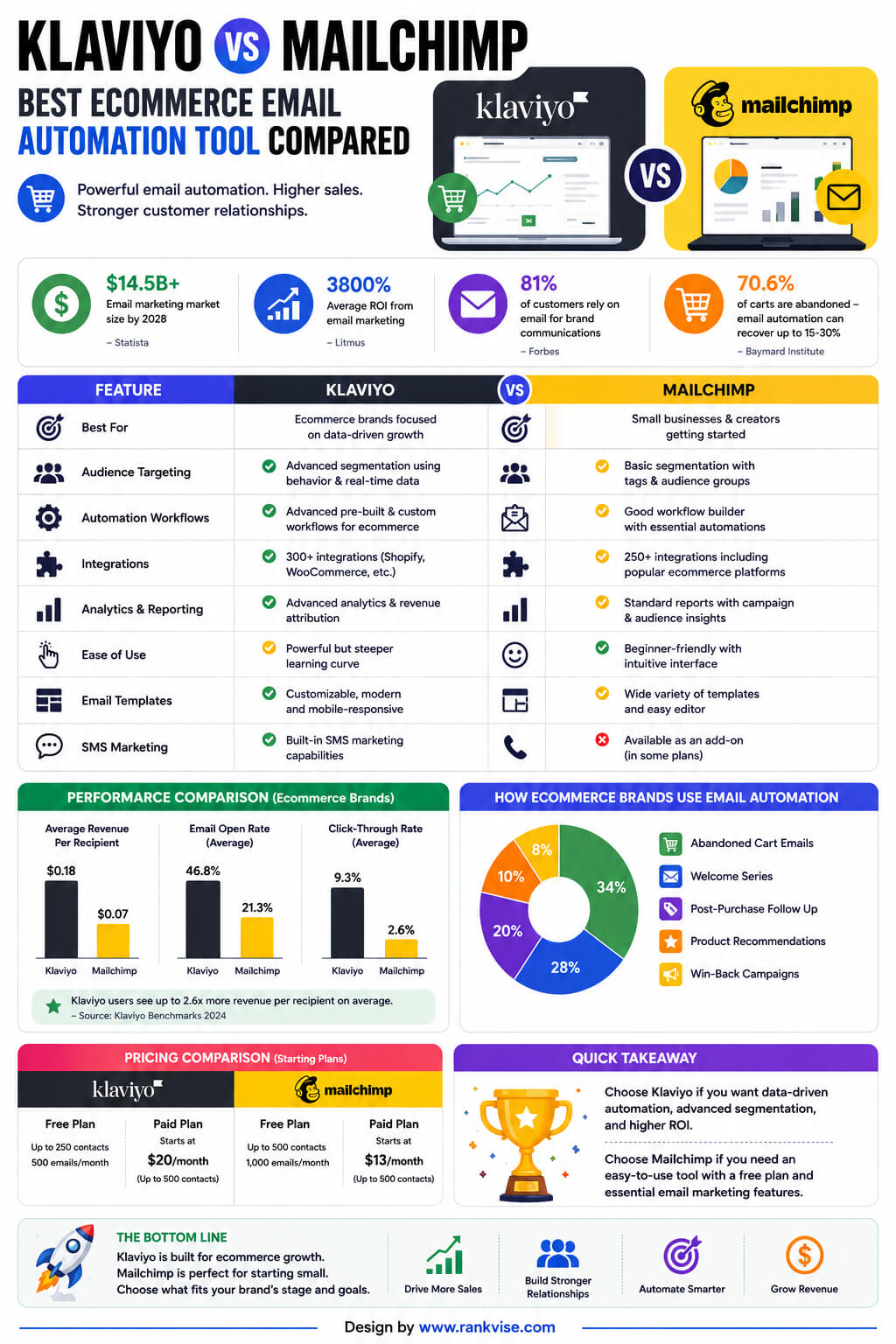
Klaviyo was built specifically for Ecommerce. Every feature, every data model, and every automation logic inside the platform assumes that the user is running an online store and needs to connect customer behaviour to email communication in real time without workarounds.
Mailchimp was built as a general email marketing platform for a wide range of business types. Over the years, it has added Ecommerce features, integrations, and automation tools. Those additions work reasonably well for businesses with basic email needs, but the underlying architecture was not designed with Ecommerce behavioural data at its core from the beginning.
That architectural difference shapes everything else about how the two platforms perform in a real Ecommerce environment, where customer data, purchase history, and browsing behaviour all need to drive communication automatically and accurately.
How Do Klaviyo and Mailchimp Handle Ecommerce Data?
Klaviyo’s Data Approach
Klaviyo connects to an Ecommerce store and pulls real-time behavioural data directly into the platform without requiring manual exports or third-party middleware to bridge the gap between systems.
Every customer action, including product views, cart additions, purchases, and return visits, creates an event inside Klaviyo that can trigger an automation, update a segment, or inform a personalised email in real time. The customer profile inside Klaviyo grows richer with every interaction the customer has with the store and the emails they receive from the brand.
Mailchimp’s Data Approach
Mailchimp connects to Ecommerce platforms through integrations that sync customer and purchase data on a scheduled basis, rather than in real time for most setups. The contact records inside Mailchimp can store purchase information, but the behavioural depth and the speed of data updates are more limited than what Klaviyo provides natively for Ecommerce use cases.
For basic purchase-triggered emails and simple segmentation by purchase history, Mailchimp works adequately. For real-time behavioural triggers, predictive analytics, and deep segmentation based on multiple overlapping Ecommerce signals, the data architecture starts to show its limitations at any significant scale.
How Does Automation Compare Between the Two Platforms?
Automation is where the practical gap between Klaviyo and Mailchimp becomes most visible for Ecommerce brands managing customer communication across multiple touchpoints simultaneously using Klaviyo automation services.
Klaviyo Automation
- Flow builder: Klaviyo’s visual flow builder allows complex multi-step sequences with conditional splits, time delays, and branching logic based on real-time customer behaviour data pulled directly from the connected store.
- Behavioural triggers: Flows can trigger based on specific events like browse abandonment, cart abandonment, post-purchase behaviour, predicted churn risk, and predicted next purchase date, calculated automatically by the platform.
- Dynamic content: Each email inside a Klaviyo flow can populate with different products, recommendations, and content blocks based on the individual recipient’s specific history and behaviour, rather than a fixed template for everyone.
- A/B testing: Klaviyo allows split testing within flows, meaning different versions of automated emails can be tested against each other, and the winning version is applied automatically without manual intervention after the test concludes.
Mailchimp Automation
- Customer journeys: Mailchimp’s automation builder, called Customer Journey, handles common sequences like welcome series, abandoned cart, and post-purchase flows with a visual interface that is accessible for users without technical experience.
- Trigger options: Trigger options in Mailchimp are more limited than Klaviyo in terms of Ecommerce-specific behavioural events. Browse abandonment and predictive triggers are either unavailable or require additional setup that adds complexity to the workflow for Ecommerce teams.
- Content personalisation: Mailchimp supports merge tags and some dynamic content features, but the depth of Ecommerce-specific personalisation based on real-time behavioural data is considerably more limited than what Klaviyo handles natively for product-level personalisation within automated flows.
How Do Segmentation Capabilities Compare?
Segmentation is the foundation of relevant email marketing. Sending the right message to the right person at the right time depends entirely on how accurately and granularly the platform can divide a contact list based on meaningful customer characteristics and behaviours.
Klaviyo builds and updates segments automatically based on a combination of Ecommerce behavioural data, predictive metrics, and engagement history. A segment of customers who purchased in a specific category in the last sixty days, have a predicted lifetime value above a certain threshold, and have opened at least one email in the last thirty days can be built in Klaviyo in minutes and updates automatically as customer behaviour changes throughout the day.
Mailchimp offers segmentation based on contact data, purchase history, and engagement metrics. For most standard segmentation use cases, Mailchimp works well enough. The gap opens when Ecommerce brands need to combine multiple behavioural and predictive data points into a single dynamic segment that updates in real time as customers interact with the store.
How Does Reporting and Revenue Attribution Work in Each Platform?
Understanding which emails are actually generating revenue is not straightforward in either platform, but Klaviyo handles Ecommerce revenue attribution more precisely and more transparently than Mailchimp does for most Ecommerce use cases.
Klaviyo Reporting
Klaviyo attributes revenue directly to the campaigns and flows that influenced each purchase within a configurable attribution window. The reporting shows revenue per recipient, revenue per flow, conversion rate by email, and attributed revenue by segment with enough granularity to make informed decisions about where to focus optimisation efforts next.
Mailchimp Reporting
Mailchimp provides revenue reporting through its Ecommerce integrations, showing total revenue attributed to campaigns and basic conversion metrics for connected stores. The attribution methodology and the granularity of the reporting are less detailed than Klaviyo for brands that want to understand performance at the individual flow or segment level in meaningful depth.
Conclusion
Klaviyo and Mailchimp are both capable email platforms, but they are not competing for the same customers in practice. Mailchimp serves a broad range of business types with general email marketing needs across many different industries and use cases. Klaviyo serves Ecommerce brands that need their email platform to function as an intelligent, data-driven revenue system rather than a broadcast tool with some automation features added around the edges. For any Ecommerce business serious about using email to drive measurable revenue growth, the comparison between the two platforms is less close than it appears on a feature list before the real work of building and optimising the programme actually begins.