Instagram search query optimization is the process of making your profile and content discoverable through Instagram’s search function. When users type words into the Instagram search bar, the platform returns profiles, hashtags, places, and content that match those queries. Your goal is to appear in those results.
- Optimize your profile: include primary keywords in username, display name, and bio to boost search relevance.
- Make every post searchable: place keywords early in captions, use focused hashtags, write custom alt text, and optimize Reels audio and on-screen text.
- Track search impressions and profile visits, test keywords regularly, and refine your strategy based on analytics every two weeks to quarterly.
This concept mirrors traditional SEO but applies specifically to Instagram’s internal search engine. The platform analyzes usernames, bios, captions, hashtags, and alt text to determine relevance. Optimizing these elements increases your chances of appearing when potential followers search for topics you cover.
Instagram has evolved far beyond a simple photo-sharing app. It now functions as a visual search engine where millions of users discover brands, products, and creators daily. Ignoring search optimization on Instagram means leaving visibility and growth on the table.
How Does Instagram Search Actually Work?
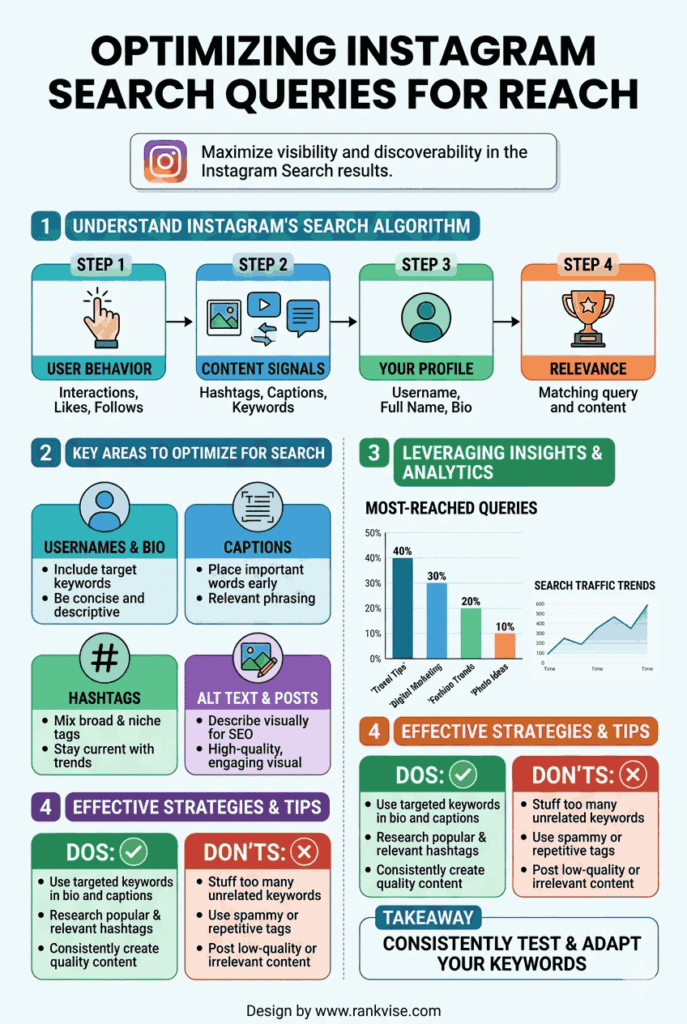
Understanding Instagram’s search algorithm helps you optimize with precision. The platform uses several ranking signals to decide which results appear first.
The Role of Keywords in Instagram Search
Instagram confirmed that keyword search plays a central role in content discovery. The algorithm scans specific text fields across your profile and posts to match user queries. These fields include your username, display name, bio, captions, and hashtags.
When someone searches “vegan meal prep,” Instagram looks for accounts and content containing those words. Profiles with “vegan meal prep” in their name or bio rank higher than those that only mention it in a caption. Placement matters as much as presence.
Ranking Signals Instagram Prioritizes
Instagram weighs multiple factors when ordering search results. Not every signal carries equal importance.
| Ranking Signal | What It Means | Impact Level |
|---|---|---|
| Text relevance | How closely your content matches the search query | High |
| User activity | Your posting frequency and engagement levels | High |
| Search popularity | How often users search for and engage with similar terms | Medium |
| Profile authority | Follower count, verification, and account history | Medium |
| User relationship | Whether the searcher already interacts with your content | Medium |
The algorithm also considers the searcher’s own behavior. Instagram personalizes results based on accounts a user follows, content they engage with, and past search history. You cannot control this factor, but you can control every other element on this list.
Optimizing Your Instagram Profile for Search
Your profile is the most powerful asset for Instagram search query optimization. Every text field on your profile influences whether you appear in relevant searches.
Username and Display Name Optimization
Your username and display name carry the most weight in Instagram search rankings. Include your primary keyword or niche descriptor in one of these fields. A fitness coach named Sarah might use “@sarahfitcoach” as her username and “Sarah | Strength Training Tips” as her display name.
Avoid stuffing both fields with identical keywords. Use your username for brand identity and your display name for keyword relevance. This combination signals both credibility and topical focus to the algorithm.
Writing a Keyword-Rich Instagram Bio
Your bio offers 150 characters to communicate who you are and what you offer. Treat it as prime search real estate. Include relevant keywords that describe your niche, services, or expertise naturally.
A travel photographer might write: “Travel photographer capturing hidden destinations across Southeast Asia. Prints and licensing available.” This bio contains searchable terms like travel photographer, hidden destinations, and Southeast Asia without feeling forced or robotic.
Avoid wasting bio space on motivational quotes or vague descriptions. Every word should either describe your value or contain a term someone might search for.
Instagram SEO for Captions and Content
Your captions directly influence whether individual posts appear in search results. Instagram now indexes caption text for keyword matching, making every word count.
Writing Search-Friendly Captions
Place your most important keywords within the first two lines of your caption. Instagram gives more weight to text that appears early. A skincare brand posting about retinol should mention “retinol serum” in the opening sentence rather than burying it in paragraph three.
Write captions that combine keyword relevance with genuine value. Teach something. Share an insight. Offer a perspective your audience cannot find elsewhere. Captions that earn saves and shares signal quality to the algorithm, which boosts your search visibility further.
Using Hashtags Strategically
Hashtags remain a core part of Instagram content discovery, though their role has shifted. They now function more like keyword tags than community links. Instagram uses hashtags to categorize and surface your content in relevant searches.
- Mix hashtag sizes wisely: Combine broad hashtags (500K+ posts) with niche-specific ones (10K–100K posts) to balance reach and competition.
- Use three to five highly relevant hashtags: Research shows that a focused selection outperforms the old strategy of using all 30 allowed hashtags.
- Place hashtags in the caption itself: Instagram has indicated that caption placement may carry slightly more weight than comment placement for indexing.
- Rotate hashtags across posts: Using identical hashtag sets repeatedly can limit your reach. Vary your selections based on each post’s specific topic.
Treat hashtags as search keywords, not popularity contests. A hashtag with 200 million posts buries your content instantly. A specific hashtag with 50,000 posts gives you a realistic chance of ranking near the top.
Leveraging Alt Text for Instagram Search Visibility
Alt text is one of the most overlooked tools in Instagram search query optimization. Instagram automatically generates alt text for images using machine learning. However, custom alt text gives you direct control over how the platform categorizes your content.
How to Add Custom Alt Text
When creating a post, navigate to advanced settings and select “Write Alt Text.” Describe the image using natural language that includes relevant keywords. For a photo of handmade ceramic mugs, write: “Handmade ceramic coffee mugs in earth tones displayed on a wooden shelf.”
This description helps Instagram understand your content at a deeper level. It also improves accessibility for visually impaired users, which aligns with platform guidelines. Custom alt text serves both discoverability and inclusivity.
Optimizing Instagram Reels and Stories for Search
Reels now dominate Instagram’s discovery ecosystem. The platform actively pushes Reels to users through the Explore page, search results, and the dedicated Reels tab. Optimizing your Reels for search dramatically expands your reach.
Reels SEO Best Practices
Include keywords in your Reels captions, on-screen text, and even spoken audio. Instagram transcribes audio content and uses that text for search indexing. A creator discussing email marketing tips should say “email marketing” out loud during the Reel.
On-screen text overlays serve double duty. They keep viewers engaged and provide additional keyword signals for the algorithm. A Reel titled “3 Instagram Growth Tips for Small Businesses” with matching on-screen text sends strong relevance signals for multiple search terms.
Stories and Search Optimization
Instagram Stories do not appear directly in search results. However, Stories saved as Highlights remain visible on your profile and contribute to overall engagement metrics. Name your Highlights with descriptive, keyword-relevant titles.
A marketing agency might create Highlights named “Case Studies,” “SEO Tips,” “Client Results,” and “About Us.” These titles help visitors find relevant content quickly and reinforce your topical authority to the algorithm.
Tracking and Measuring Your Instagram Search Performance
Optimization without measurement is guesswork. Instagram provides native analytics that reveal how users discover your content.
Key Metrics to Monitor
Instagram Insights breaks down your reach by source. Look for the percentage of impressions coming from search and Explore. A growing share from these sources indicates your optimization efforts are working.
Track profile visits from non-followers specifically. This metric reflects how effectively your search presence converts curiosity into engagement. Monitor follower growth rate alongside search impressions to identify correlations between optimization changes and audience growth.
Adjusting Your Strategy Based on Data
Review your analytics biweekly. Identify which keywords, hashtags, and content formats drive the most search visibility. Double down on what performs and retire tactics that show no traction after consistent testing.
Compare your top-performing posts against underperformers. Look for patterns in caption structure, keyword placement, hashtag selection, and content format. These patterns reveal what your specific audience responds to within Instagram search results.
Common Instagram Search Optimization Mistakes to Avoid
Small errors can undermine even a well-planned Instagram SEO strategy. Watch for these frequent missteps.
- Ignoring your display name field: Many accounts leave this as a duplicate of their username. Use it for a keyword-rich descriptor that tells both users and the algorithm what you offer.
- Writing captions without keywords: Entertaining captions that contain no searchable terms limit your discoverability. Balance creativity with strategic keyword inclusion.
- Using only popular hashtags: Competing against millions of posts guarantees invisibility. Prioritize niche-specific hashtags where your content can realistically surface.
- Skipping custom alt text: Relying on Instagram’s auto-generated descriptions means losing control over how the platform categorizes your visual content.
- Optimizing once and forgetting: Instagram’s algorithm evolves constantly. Review and refresh your profile keywords, hashtag strategy, and caption approach at least quarterly.
Building a Long-Term Instagram Search Strategy
Instagram search query optimization is not a one-time project. It requires ongoing attention as the platform updates its algorithm and user behavior shifts.
Start with your profile. Lock in your username, display name, and bio with clear, relevant keywords. Then build consistent content habits that reinforce your topical authority. Every caption, hashtag, alt text entry, and Reel contributes to how Instagram categorizes your account.
The accounts that win on Instagram search treat every post as an opportunity to strengthen their relevance signals. Over months, this discipline compounds into sustained visibility that paid ads cannot replicate.
FAQs
Instagram search query optimization is the practice of using keywords strategically across your profile, captions, hashtags, and alt text so your content appears when users search relevant terms on Instagram.
Use Instagram’s search bar to see auto-suggestions for your niche terms. Combine this with keyword research tools and competitor analysis to identify high-opportunity phrases your audience actually searches.
Hashtags still contribute to content discovery and categorization on Instagram. However, caption keywords and profile optimization now carry more weight than hashtags alone for search rankings.
Most accounts notice measurable changes in search-driven reach within four to eight weeks of consistent optimization. Profile changes often show faster results than content-level adjustments.
Small businesses benefit significantly because niche-specific keyword optimization lets them compete for targeted search terms without needing large follower counts or advertising budgets.