Selling to businesses is fundamentally different from selling to consumers. The buying cycle is longer. Multiple decision-makers weigh in. Deals carry higher stakes. Your search engine optimization strategy needs to reflect all of this.
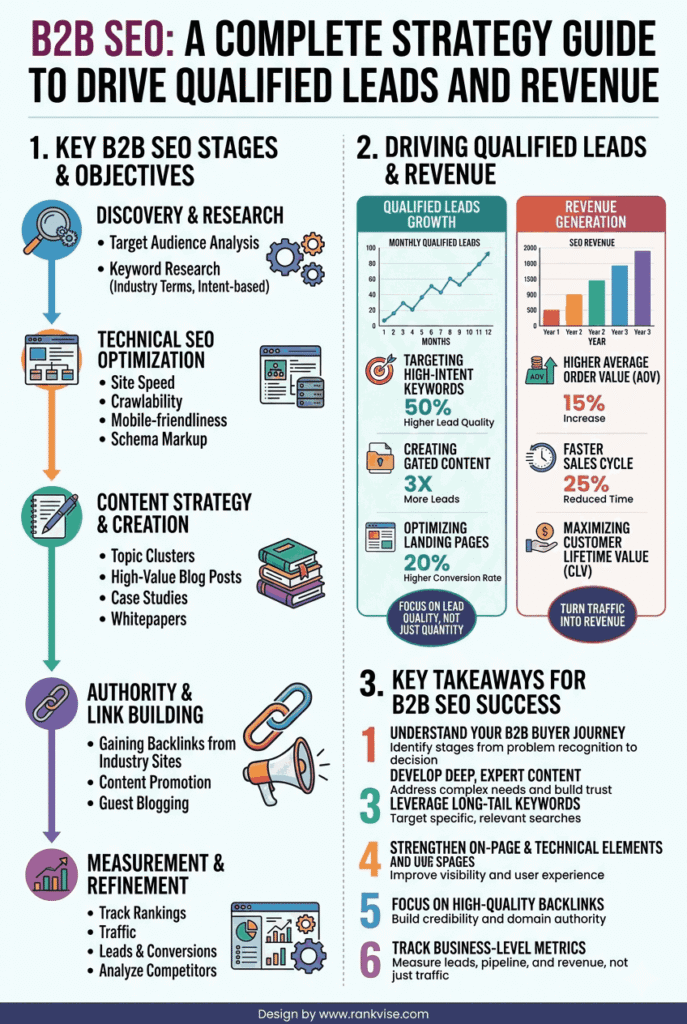
- Start with deep buyer research and intent mapping, then align keywords and content to specific personas and their search behavior.
- Create long-form, stage-specific content: awareness guides, comparative resources, and bottom-funnel pages that target high-intent keywords and convert.
- Optimize technical SEO and authority: site speed, crawlable architecture, schema, plus strategic link building and EEAT to drive qualified organic pipeline.
B2B SEO helps companies attract the right buyers at the right stage of their decision-making process. It is not about chasing massive traffic volumes. It is about reaching a smaller, highly qualified audience that converts into revenue over time.
This guide breaks down how b2b search engine optimization works, why it differs from B2C, and what strategies actually move the needle in competitive business markets.
What Is B2B SEO and How Does It Work?
B2B SEO is the practice of optimizing a business website to rank in search engines for terms that other businesses search for. The goal is to attract decision-makers — procurement managers, founders, marketing directors, and department heads — who are researching solutions to business problems.
Unlike consumer-focused SEO, where one person searches and buys, B2B involves a buying committee. A single deal might require buy-in from three to ten people. Your content must speak to each role in that group at different stages.
The strategy combines technical optimization, keyword research, high-value content creation, and authority building. Each element works together to increase visibility in search results where your ideal clients are looking for answers.
How B2B SEO Differs From B2C SEO
Many marketers assume SEO is the same regardless of the audience. That assumption leads to strategies that attract the wrong traffic. Understanding the differences helps you invest in what actually works.
| Factor | B2B SEO | B2C SEO |
|---|---|---|
| Audience | Decision-makers and buying committees | Individual consumers |
| Sales cycle | Weeks to months | Minutes to days |
| Search volume | Lower, more specific keywords | Higher, broader keywords |
| Content depth | Long-form, educational, data-driven | Short-form, emotional, visual |
| Conversion goal | Lead generation, demo requests | Direct purchases |
| Keyword intent | Research and comparison focused | Transactional and impulse driven |
B2B keywords typically have lower search volume but dramatically higher value per conversion. A single enterprise lead can be worth thousands or even millions in lifetime revenue. Your organic search strategy should prioritize quality over quantity.
Building a B2B SEO Strategy That Drives Revenue
A successful strategy does not start with keywords. It starts with understanding your buyer. Map out your ideal customer profile, their pain points, and the questions they ask at every stage of the buying journey.
Step 1: Define Your Ideal Buyer and Their Search Behavior
Before touching any SEO tool, identify who you are trying to reach. Document their job titles, industries, company sizes, and common challenges. Then research how they search for solutions. A CFO searches differently than a marketing manager. Align your keyword strategy with each persona.
Step 2: Conduct B2B Keyword Research
B2B keyword research focuses on intent, not just volume. Prioritize terms that signal a prospect is evaluating solutions. Keywords like “best CRM for manufacturing” or “enterprise project management software comparison” indicate active buying research.
Group keywords by funnel stage for maximum impact:
- Top of funnel — Educational and awareness terms like “what is supply chain automation.”
- Middle of funnel — Comparison and evaluation terms like “ERP software vs custom solution.”
- Bottom of funnel — High-intent decision terms like “HubSpot pricing for enterprise” or “request a demo.”
Use tools like Ahrefs, SEMrush, or Google Search Console to find keywords your competitors rank for that you currently miss. This gap analysis reveals immediate opportunities.
Step 3: Create Content That Matches Each Buying Stage
Content is the engine of any b2b content marketing strategy tied to SEO. Each piece should serve a specific purpose and target a specific audience segment.
For top-of-funnel awareness, publish blog posts, industry reports, and educational guides. These attract prospects who are just beginning to recognize a problem. Middle-of-funnel content like comparison pages, case studies, and webinars helps prospects evaluate their options. Bottom-of-funnel content — product pages, pricing breakdowns, and demo landing pages — converts prospects into leads.
Every piece of content should target a clear keyword cluster and answer a specific question your buyer is asking. Thin, generic content wastes crawl budget and fails to build authority.
Step 4: Optimize Technical SEO for B2B Websites
Technical SEO ensures search engines can crawl, index, and rank your content efficiently. B2B websites often have complex architectures — multiple product lines, resource libraries, gated content, and subdomain structures. These require careful optimization.
Focus on these technical priorities:
- Site speed — Compress images, enable caching, and minimize code bloat to keep load times under three seconds.
- Mobile responsiveness — Even B2B buyers research on phones during commutes and conferences.
- Crawlable site architecture — Use a logical URL structure and internal linking to help search engines discover every important page.
- Schema markup — Implement structured data for FAQs, articles, products, and organization details to enhance search result appearance.
- Secure HTTPS — A non-negotiable ranking signal and trust factor for business buyers.
Run regular site audits using Screaming Frog or Sitebulb to catch broken links, duplicate content, and indexation issues before they impact rankings.
Step 5: Build Authority Through Strategic Link Building
Backlinks remain one of the strongest ranking factors. In B2B, authority signals matter even more because buyers trust brands that appear credible and well-referenced across the web.
Effective b2b link building strategies include publishing original research and industry data that other sites want to cite, contributing guest articles to respected trade publications, building partnerships with complementary businesses for co-marketing content, and earning links through digital PR campaigns that highlight company milestones or unique insights.
Focus on earning links from industry-relevant domains. One link from a respected trade publication outweighs dozens from unrelated blogs.
Measuring B2B SEO Success: Metrics That Matter
Traffic alone does not prove SEO value in a B2B context. Track metrics that connect organic search performance directly to revenue.
- Organic qualified leads — How many leads from organic search match your ideal customer profile.
- Keyword rankings for high-intent terms — Monitor movement on bottom-of-funnel keywords that drive conversions.
- Organic pipeline contribution — Measure the revenue value of deals sourced from organic traffic.
- Content engagement — Track time on page, scroll depth, and conversion rates for key landing pages.
- Indexed pages and crawl health — Ensure search engines access and rank your full content library.
Report these metrics monthly. Tie every data point to a business outcome. This keeps leadership invested in the long-term SEO strategy even when results take time to materialize.
B2B SEO Trends Shaping Strategy in 2026
The B2B search landscape continues to evolve. Strategies that worked two years ago may not deliver the same results today. Stay ahead by adapting to these current trends.
Search engines now prioritize experience, expertise, authority, and trust — commonly known as EEAT. B2B brands that publish genuinely expert content from credible authors outperform those relying on generic keyword-targeted pages. AI-generated search overviews are changing how results appear, making brand visibility and topical authority more critical than ever. Companies that focus on exposure across multiple touchpoints rather than single ranking positions will capture more of the buyer’s attention throughout their research journey.
FAQs
B2B SEO optimizes a business website to rank for search terms used by other businesses. It drives qualified leads from decision-makers who are actively researching solutions in your industry.
Most B2B SEO strategies take three to six months to show measurable improvements. Competitive industries with longer sales cycles may require six to twelve months for significant pipeline impact.
Focus on high-intent, low-competition keywords that match each stage of the buying journey. Comparison terms, solution-specific queries, and industry niche phrases typically deliver the strongest qualified leads.
B2B SEO targets longer sales cycles, smaller but higher-value audiences, and buying committees rather than individual consumers. Content tends to be more in-depth, data-driven, and education-focused.
Yes, smaller companies can outperform larger competitors by targeting niche keywords, publishing deeply specialized content, and building authority within a focused industry segment where big brands produce only surface-level content.