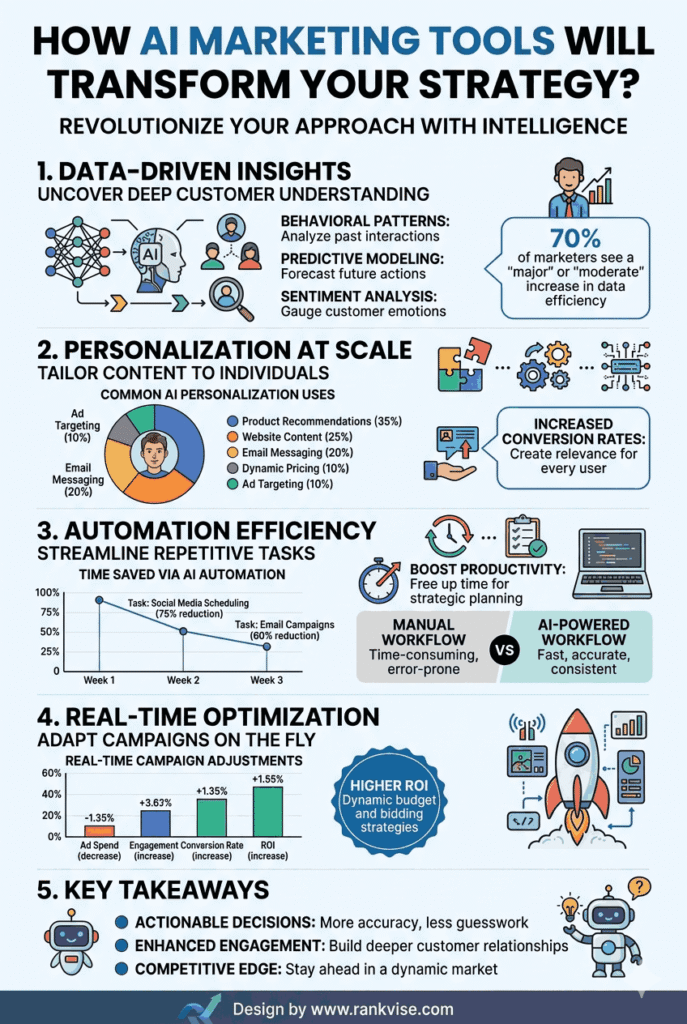
Marketing teams face growing pressure to produce more content, reach larger audiences, and prove ROI faster. AI marketing tools solve this challenge by automating repetitive tasks and delivering data-driven insights at speed. They free your team to focus on strategy and creativity instead of manual execution.
- Select AI tools matched to your main channel, team size, budget, integrations, and output quality before investing.
- Start with one or two tools solving your biggest bottlenecks; test, measure, then scale your AI stack.
- Adopt specialized AI tools for content, SEO, ads, email, social, and automation to cover the full marketing funnel.
- Treat AI as an assistant: maintain human oversight for brand voice, strategy, and quality control.
- Measure impact within 30 days; track time saved, content quality, and campaign performance to validate ROI.
These tools now handle everything from writing blog posts to optimizing ad spend. The technology has matured significantly. Today’s marketing automation platforms powered by artificial intelligence deliver reliable, measurable results across channels. Businesses that adopt them gain a clear competitive edge over those still relying on manual workflows alone.
How to Choose the Right AI Tools for Marketing?
Not every tool fits every business. Choosing wisely starts with understanding your specific marketing challenges and goals.
Consider these factors before investing:
- Your primary marketing channel: Focus on tools that strengthen your most important platform first.
- Team size and skill level: Solo marketers need all-in-one platforms. Larger teams benefit from specialized tools.
- Budget range: Many tools offer free tiers. Start small and scale as you see results.
- Integration needs: Ensure the tool connects with your existing CRM, email platform, or analytics stack.
- Output quality: Test each tool’s results before committing to a paid plan.
Start with one or two tools that address your biggest bottleneck. Add more as your team builds confidence with AI-assisted workflows.
15 Best AI Marketing Tools Worth Using Right Now
The following list covers the top AI marketing tools across content creation, SEO, advertising, email marketing, social media, and automation. Each tool solves a specific problem and has earned its reputation through real-world performance.
AI Content Creation Tools
1. Jasper AI
Jasper remains one of the most popular AI writing tools for marketing teams. It generates blog posts, ad copy, product descriptions, and social media captions. The platform includes brand voice settings that keep all content consistent with your messaging guidelines.
Jasper works best for teams producing high volumes of written content. Its templates accelerate the drafting process significantly.
2. Claude by Anthropic
Claude excels at nuanced marketing tasks that require deeper thinking. It handles content strategy, competitive analysis, long-form writing, and brainstorming with impressive accuracy. Many marketers use it for research-heavy projects that demand careful reasoning and structured outputs.
3. Copy.ai
Copy.ai focuses on short-form marketing copy. It generates email subject lines, social media posts, product descriptions, and ad headlines quickly. The platform includes workflow automation that connects content generation to publishing pipelines.
AI SEO and Content Optimization Tools
4. Surfer SEO
Surfer SEO analyzes top-ranking pages and provides real-time optimization recommendations. It scores your content against competitors and suggests keyword usage, heading structure, and content length. Writers use the content editor to hit target scores before publishing.
This tool bridges the gap between content creation and search engine optimization effectively.
5. Semrush AI Features
Semrush has integrated AI capabilities across its keyword research, content marketing, and competitive analysis modules. The AI writing assistant helps draft SEO-friendly articles. The platform’s keyword clustering tool groups terms by intent automatically, saving hours of manual research.
6. Clearscope
Clearscope helps content teams create articles that rank well on search engines. It analyzes search results and provides a list of terms and topics your content should cover. The readability grading system ensures your writing remains accessible to your target audience.
AI Advertising and Paid Media Tools
7. Albert AI
Albert automates digital advertising across Google, Facebook, Instagram, and YouTube. It manages budget allocation, audience targeting, and creative testing without manual intervention. The platform continuously optimizes campaigns based on real-time performance data.
Albert works best for businesses running multi-channel paid campaigns at scale.
8. Adzooma
Adzooma simplifies paid advertising management for small and mid-sized businesses. It connects to Google Ads, Facebook Ads, and Microsoft Advertising. The AI engine identifies optimization opportunities and suggests actionable improvements weekly.
9. Pattern89
Pattern89 uses predictive analytics to recommend creative elements before you launch a campaign. It analyzes colors, images, copy length, and call-to-action placement. Marketers use its insights to build higher-performing ads from the start rather than relying solely on post-launch testing.
AI Email Marketing Tools
10. Seventh Sense
Seventh Sense optimizes email send times for each individual subscriber. It integrates with HubSpot and Marketo to analyze engagement patterns. Emails arrive when each recipient is most likely to open and click, improving open rates and conversions consistently.
11. Phrasee
Phrasee generates and optimizes email subject lines, push notifications, and SMS messages using natural language generation. It A/B tests language variations at scale and learns which tones and phrases drive the best engagement for your specific audience.
AI Social Media Marketing Tools
12. Blaze AI
Blaze AI helps solopreneurs and small teams create, schedule, and repurpose social media content efficiently. It transforms a single blog post into multiple platform-specific formats. The tool handles LinkedIn posts, Instagram captions, X threads, and more from one dashboard.
13. Lately AI
Lately analyzes your existing long-form content and automatically generates dozens of social media posts from it. The AI learns which messaging patterns resonate with your audience over time. This tool dramatically reduces the time needed to maintain an active social media presence.
AI Marketing Automation and Analytics Tools
14. HubSpot AI
HubSpot has embedded AI across its entire marketing, sales, and service platform. The AI assistant drafts emails, creates workflows, generates reports, and scores leads automatically. Its ChatSpot feature lets users query their CRM data using natural language.
HubSpot AI suits businesses that want an integrated platform rather than assembling separate point solutions.
15. Gumloop
Gumloop enables marketers to build custom AI automation workflows without coding. It connects multiple AI models and marketing tools into seamless pipelines. You can automate tasks like content research, competitor monitoring, lead enrichment, and report generation through visual workflow builders.
Comparison Table: All 15 AI Marketing Tools at a Glance
| Tool | Primary Use | Best For | Starting Price |
|---|---|---|---|
| Jasper AI | Content writing | Marketing teams | 39 USD/mo |
| Claude | Strategy and long-form writing | Research-heavy tasks | Free tier available |
| Copy.ai | Short-form copy | Quick ad and email copy | Free tier available |
| Surfer SEO | Content optimization | SEO-focused writers | 79 USD/mo |
| Semrush | SEO and competitive analysis | Full-funnel SEO teams | 129 USD/mo |
| Clearscope | Content grading | Editorial teams | 170 USD/mo |
| Albert AI | Ad campaign automation | Multi-channel advertisers | Custom pricing |
| Adzooma | PPC management | Small business ads | Free tier available |
| Pattern89 | Ad creative prediction | Performance marketers | Custom pricing |
| Seventh Sense | Email send optimization | HubSpot/Marketo users | 80 USD/mo |
| Phrasee | Email copy generation | Enterprise email teams | Custom pricing |
| Blaze AI | Social content creation | Solopreneurs | 25 USD/mo |
| Lately AI | Social content repurposing | Content-heavy brands | Custom pricing |
| HubSpot AI | All-in-one marketing | Growing businesses | Free tier available |
| Gumloop | Workflow automation | Technical marketers | Free tier available |
Pricing reflects publicly available information and may vary. Check each provider’s website for current plans.
How to Get Started With AI Marketing Tools
Adopting AI tools does not require overhauling your entire marketing stack overnight. A phased approach delivers better results and avoids team overwhelm.
- Identify your biggest time drain. Start with the task that consumes the most hours each week.
- Pick one tool that addresses it. Test it with a free trial or starter plan.
- Measure the impact after 30 days. Track time saved, output quality, and performance metrics.
- Add a second tool once the first is integrated. Build your stack gradually.
- Train your team properly. AI tools perform best when users understand their capabilities and limitations.
Treat these tools as assistants, not replacements. Human oversight ensures brand consistency, strategic alignment, and quality control across all AI-generated outputs.
FAQs
Copy.ai, HubSpot AI, and Canva’s AI features offer generous free plans. These tools cover content creation, CRM management, and visual design without requiring upfront investment.
No. AI marketing tools automate repetitive tasks and enhance productivity. You still need human marketers for strategy, brand voice, creative direction, and relationship building.
Blaze AI and Lately AI are the strongest options for social media. Blaze suits solo creators, while Lately works better for teams repurposing long-form content into social posts.
Costs range from free to several hundred dollars monthly. Most tools offer tiered pricing starting between 25 and 130 USD per month depending on features and usage limits.
Reputable AI marketing platforms follow strict data privacy standards including GDPR and SOC 2 compliance. Always review a tool’s security policies and data handling practices before connecting customer data.