Skip to content
Video has become the dominant format online, but its effectiveness still depends on a basic assumption: that everyone can see, hear, and process it in the same way. In reality, that assumption is wrong — and costly.
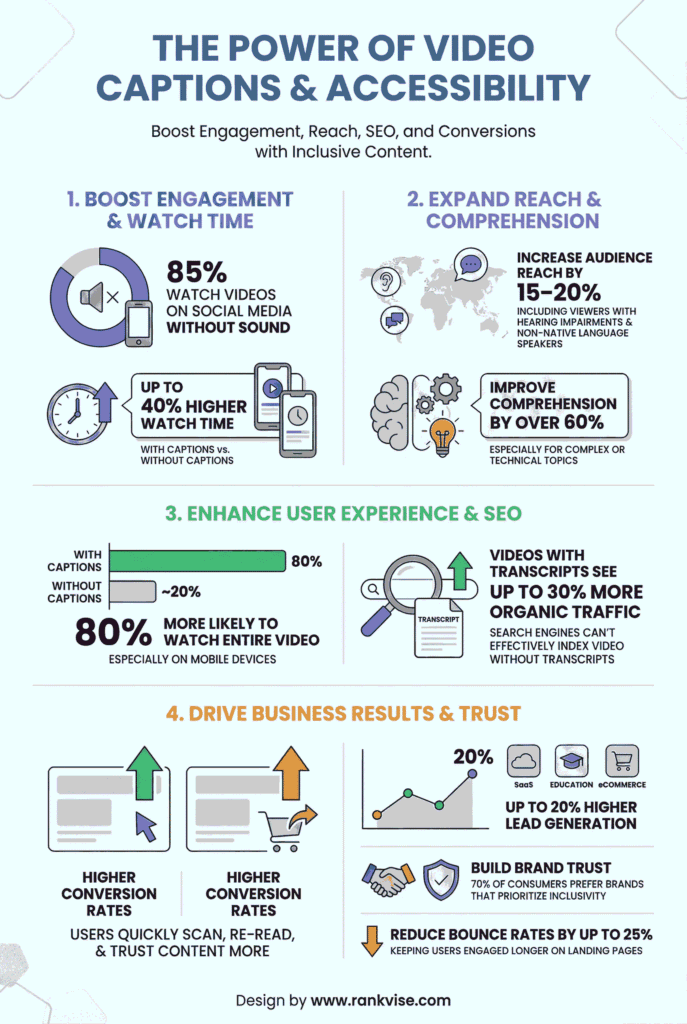
- Captions and transcripts expand audience reach by aiding viewers with hearing, language, cognitive, or situational limitations.
- Captions boost early retention by giving immediate context, reducing friction when sound is off or unclear.
- Transcripts turn video into searchable, reusable text assets that improve comprehension, repurposing, and content lifespan.
- Accurate, reviewed captions signal higher content quality and support discoverability across languages and platforms.
Accessibility is often framed as a legal checkbox or a “nice-to-have” feature for inclusive brands. For creators and platforms, however, captions and transcripts are far more than that. They influence discoverability, retention, comprehension, and long-term content performance. Ignoring accessibility does not just exclude part of the audience — it quietly limits growth.
This article explains what video accessibility actually means, why captions and transcripts matter in practice, and how experienced creators use them as a strategic advantage rather than an obligation.
What Video Accessibility Really Means
Video accessibility refers to making video content usable for people with different physical, cognitive, linguistic, or situational limitations. While accessibility includes visual design, contrast, and navigation, captions and transcripts are its foundation.
They address several real-world scenarios:
- viewers who are deaf or hard of hearing
- non-native speakers
- people watching without sound
- users with cognitive or attention-related challenges
Accessibility is not a niche concern. It affects how content is consumed across devices, environments, and audiences — often in ways creators underestimate.
Captions vs Transcripts: What’s the Difference?
Although often used interchangeably, captions and transcripts serve different functions.
Captions are time-synchronized text displayed alongside the video. They follow the audio in real time and may include speaker identification or sound cues. Captions support viewers who watch with sound off or cannot fully rely on audio.
Transcripts are full text versions of the spoken content, typically presented separately from the video. They allow readers to scan, search, quote, and revisit content without watching it linearly.
From an accessibility standpoint, captions support real-time consumption, while transcripts support comprehension, navigation, and reuse. Together, they create a more flexible and inclusive viewing experience. Creators who want to streamline their workflow as soon as possible often start by transcribing YouTube videos to text for free to quickly turn spoken content into searchable, reusable text.
Why Accessibility Is a Growth Issue?
Many creators assume accessibility only matters if they are legally required to provide it. This mindset misses the bigger picture.
Captions and transcripts expand the usable audience of a video. They make content accessible across noisy or silent environments, global audiences with varying language proficiency, and different learning styles.
Each of these factors directly affects how long viewers stay, how well they understand the message, and whether they return for more content. In practice, accessibility improves performance — even for viewers who technically do not “need” it.
How Captions Improve Viewer Retention?
One of the most measurable effects of captions is their impact on early retention. Many viewers decide whether to continue watching within the first few seconds, often before turning the sound on or without turning it on at all. Captions allow viewers to immediately understand:
- what the video is about
- whether it is relevant to them
- whether the pacing and tone match their expectations
This clarity reduces friction at the most critical stage of the viewing session. Even small improvements in early retention can significantly affect how YouTube and other platforms distribute a video.
Captions also support comprehension throughout the video. When viewers miss a phrase or struggle with pronunciation, on-screen text prevents confusion from turning into abandonment.
Why Transcripts Matter Beyond Accessibility?
While transcripts are often introduced as an accessibility feature, their real value extends far beyond inclusive viewing. At their core, transcripts transform video from a linear, time-bound format into flexible, searchable content.
For viewers, transcripts offer an alternative way to engage with long or information-dense videos. Not everyone wants — or needs — to watch a full video from start to finish. Some viewers prefer to scan, jump directly to relevant sections, or revisit a specific explanation without scrubbing through the timeline. Transcripts make this behavior effortless, reducing frustration and increasing the likelihood that the content will be used rather than abandoned.
From a creator’s perspective, transcripts dramatically increase the lifespan and utility of a video. Spoken ideas become text assets that can be indexed, referenced, quoted, and repurposed. This allows a single piece of video content to support blog articles, newsletters, documentation, and search-driven pages without additional production costs. Over time, this turns video from a one-off publishing event into a long-term content resource.
Transcripts also improve clarity and accountability. When content is written down, gaps in logic, vague explanations, or unclear phrasing become more visible — encouraging better structure and more deliberate communication. In this way, transcripts do not just document content; they actively raise its quality.
Accessibility and Non-Native Audiences
For global platforms, language is one of the most underestimated barriers to engagement. Even viewers who are comfortable in English often rely on captions or transcripts when content moves quickly, includes unfamiliar accents, or uses industry-specific terminology.
Captions and transcripts give non-native audiences an extra layer of confidence. They reduce the mental effort required to follow along and help viewers confirm meaning without rewinding or replaying sections. This is especially important in educational, technical, or business-focused videos, where misunderstanding a single term can disrupt comprehension of the entire message.
Accessibility tools also make content more forgiving. Viewers are less likely to abandon a video due to minor comprehension issues when text support is available. Over time, this leads to higher retention, stronger satisfaction signals, and greater loyalty among international audiences.
For creators targeting global reach, captions and transcripts function as a lightweight form of localization. They do not replace translation, but they significantly widen the audience that can comfortably consume the content — often with minimal additional effort.
Automatic vs Manual Captions: What Actually Works?
Most platforms, including YouTube, provide automatic captions by default. These are useful, but not perfect.
Automatic captions tend to struggle with:
- Proper names
- Technical terms
- Acronyms
- Overlapping speech
Manual captions and transcripts improve accuracy and readability, but they require additional effort. For many creators, the most effective approach is hybrid: generate automatic captions, then review and correct key errors, especially in high-value or evergreen content.
Accuracy matters not only for viewers, but also for platforms that rely on text to understand and classify content.
Accessibility as a Signal of Content Quality
Well-structured captions and transcripts often reflect deeper qualities of good content:
- clear pacing
- logical structure
- intentional messaging
Creators who invest in accessibility usually speak more clearly, organize ideas better, and respect their audience’s time. These qualities translate into better engagement metrics — regardless of whether viewers consciously notice the accessibility features.
In this sense, accessibility is less about adding something extra and more about refining the core experience.
Common Myths About Video Accessibility
Accessibility only matters for disabled users.
In reality, most viewers benefit from captions and transcripts at least occasionally.
Automatic captions are enough.
They are a starting point, not a final solution for professional content.
Captions hurt engagement.
Data consistently shows the opposite when captions are relevant and accurate.
Short videos don’t need accessibility.
Short-form content is often consumed without sound, making captions even more important.
Accessibility as Part of a Sustainable Content Strategy
As platforms evolve, accessibility increasingly intersects with:
- SEO and discoverability
- watch time and session duration
- cross-platform distribution
Creators who treat captions and transcripts as a strategic layer — rather than an afterthought — build content that performs longer and adapts better to algorithm changes.
This is why many professional creator teams now integrate accessibility into their production workflow from the start, rather than adding it retroactively.
Captions and transcripts are not about checking boxes or following trends. They are about respecting how real people consume content across languages, devices, and environments.
In a crowded video landscape, accessibility quietly becomes a competitive advantage. It makes content clearer, more flexible, and more resilient over time. For creators who care about long-term growth rather than short-term spikes, accessibility is not optional. It is foundational.