Surveys only work when the questions do. Ask the wrong type, and you get messy data that leads nowhere. Ask the right type, and patterns emerge fast.
- Closed ended questionnaires use predefined answer choices for fast, consistent, and easily quantifiable responses.
- Key benefits: faster completion, higher response rates, consistent data, and simple statistical analysis.
- Common formats: multiple choice, dichotomous, Likert, rating, ranking, and checklist; choose by research goal.
- Write clear, single-concept questions, exhaustive options, neutral wording, consistent scales, randomize order, and pretest surveys.
- Watch pitfalls: overlapping ranges, missing options, survey fatigue, and assuming respondent knowledge; keep surveys concise and relevant.
A closed ended questionnaire gives respondents a fixed set of answers to choose from. No guessing. No interpreting handwriting. Just clean, structured data you can analyze in minutes.
This guide walks you through real closed ended questionnaire examples across industries. You will learn when to use them, how to write them, and which formats produce the best response rates.
What Is a Closed Ended Questionnaire?
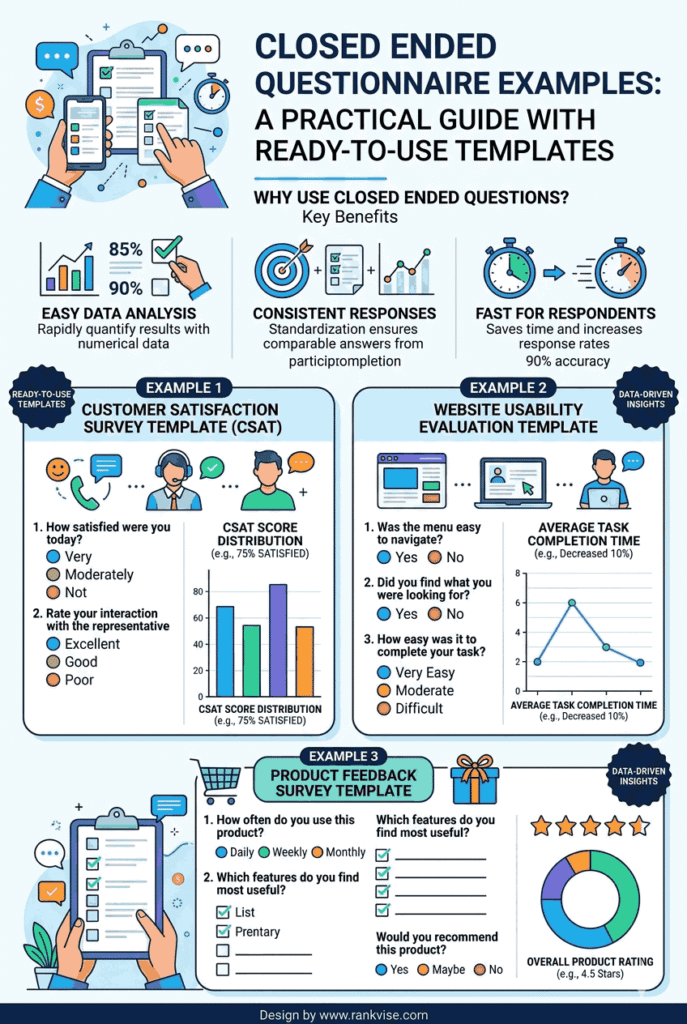
A closed ended questionnaire is a survey where every question comes with predefined answer choices. Respondents pick from the options provided instead of writing their own responses.
Think of it as a multiple choice test for research. The participant reads the question, reviews the options, and selects the one that fits best. There is no room for elaboration.
This format works well when you need quantifiable results. Businesses use closed ended surveys to measure satisfaction, track preferences, and benchmark performance. Researchers rely on them for large-scale studies where consistency matters.
The opposite approach uses open ended questions, which let people answer freely. Both have their place, but closed ended formats win when speed and scalability are priorities.
Why Use Closed Ended Questions in Surveys?
Closed ended questions solve several problems that open ended formats create. Understanding these advantages helps you decide when this approach fits your goals.
Speed of completion is the biggest benefit. Respondents finish closed ended surveys faster because they select answers instead of composing them. This directly improves completion rates.
Data consistency is another major advantage. When everyone chooses from the same options, you eliminate interpretation issues. A “satisfied” rating means the same thing across all respondents.
Here are the core benefits at a glance:
- Faster survey completion times
- Higher response rates due to lower effort
- Easy to quantify and compare results
- Reduced bias from inconsistent phrasing
- Simple to analyze with charts and statistics
- Ideal for tracking trends over time
These advantages make closed ended questionnaires the default choice for customer feedback, employee engagement, market research, and product evaluations.
Types of Closed Ended Questions With Examples
Not all closed ended questions look the same. Each type serves a different purpose. Choosing the right format depends on what information you need to collect.
Multiple Choice Questions
Multiple choice questions offer three or more answer options. Respondents select one or sometimes multiple answers from the list.
This is the most versatile closed ended format. It works for almost any topic where you can anticipate the likely responses.
Example: How did you hear about our company?
- Search engine
- Social media
- Friend or colleague
- Online advertisement
- Industry event
Dichotomous Questions
Dichotomous questions offer exactly two answer choices. They produce the clearest, most decisive data possible.
Use them when you need a definitive yes or no, true or false, or agree or disagree response.
Example: Have you purchased from us in the last 12 months?
- Yes
- No
Likert Scale Questions
Likert scale questions measure the intensity of someone’s opinion. They typically use a five-point or seven-point scale ranging from one extreme to another.
This format captures nuance without the complexity of open ended responses. It tells you not just what people think, but how strongly they feel.
Example: How satisfied are you with our customer support?
| Rating | Label |
|---|---|
| 1 | Very dissatisfied |
| 2 | Dissatisfied |
| 3 | Neutral |
| 4 | Satisfied |
| 5 | Very satisfied |
Rating Scale Questions
Rating scale questions ask respondents to evaluate something on a numerical scale. The most familiar version is the 1 to 10 format.
These work well for benchmarking and tracking scores over time. Net Promoter Score surveys use this exact approach.
Example: On a scale of 1 to 10, how likely are you to recommend our product to a friend?
Ranking Questions
Ranking questions ask respondents to order items by preference or importance. They reveal priorities rather than just opinions.
Use these when you need to understand what matters most to your audience.
Example: Rank the following features by importance (1 being most important):
- Price
- Quality
- Customer support
- Delivery speed
- Brand reputation
Checklist Questions
Checklist questions let respondents select all options that apply. Unlike standard multiple choice, there is no limit to how many answers they can pick.
This format captures the full range of someone’s experience or preferences in one question.
Example: Which of the following devices do you use daily? (Select all that apply)
- Smartphone
- Laptop
- Tablet
- Desktop computer
- Smartwatch
Closed Ended Questionnaire Examples by Industry
Context matters when designing surveys. A question that works for retail may fall flat in healthcare. Here are practical closed ended questionnaire examples tailored to specific industries.
Customer Satisfaction Survey
- How would you rate your overall experience? (Very poor / Poor / Average / Good / Excellent)
- Did our product meet your expectations? (Yes / No / Partially)
- How likely are you to purchase from us again? (Very unlikely / Unlikely / Neutral / Likely / Very likely)
- How would you rate the value for money? (1–5 scale)
- Would you recommend us to a friend or colleague? (Yes / No)
Employee Engagement Survey
- Do you feel valued at work? (Strongly disagree / Disagree / Neutral / Agree / Strongly agree)
- How satisfied are you with your current role? (1–5 scale)
- Does your manager provide clear feedback? (Always / Often / Sometimes / Rarely / Never)
- Would you recommend this company as a great place to work? (Yes / No)
- How well does leadership communicate company goals? (Very poorly / Poorly / Adequately / Well / Very well)
Market Research Survey
- How often do you purchase products in this category? (Daily / Weekly / Monthly / Rarely / Never)
- Which brand do you associate most with quality? (Brand A / Brand B / Brand C / Other)
- What factor most influences your buying decision? (Price / Quality / Reviews / Brand / Convenience)
- Have you seen advertising for this product in the last 30 days? (Yes / No / Not sure)
- How satisfied are you with your current provider? (1–10 scale)
How to Write Effective Closed Ended Questions
Writing good survey questions takes more care than most people expect. Poorly worded questions produce misleading data, no matter how well you structure the survey.
Keep questions simple and specific. Each question should address one idea only. Double-barreled questions like “How satisfied are you with our price and quality?” force respondents to answer two things at once.
Make answer options exhaustive. If respondents cannot find an option that fits, they will either skip the question or choose inaccurately. Always include an “Other” or “Not applicable” choice when appropriate.
Avoid leading language. A question like “How much did you enjoy our amazing new feature?” pushes respondents toward a positive answer. Neutral phrasing produces honest data.
Follow these best practices for stronger results:
- Use consistent scales throughout the survey
- Randomize answer order to reduce position bias
- Limit each question to one concept
- Test your survey with a small group before launching
- Keep the total number of questions under 15 for higher completion rates
Closed Ended vs Open Ended Questions: When to Use Each
Choosing between closed and open ended formats depends on your research goals. Neither is universally better. Each excels in different situations.
| Factor | Closed Ended | Open Ended |
|---|---|---|
| Data type | Quantitative | Qualitative |
| Analysis speed | Fast | Slow |
| Response effort | Low | High |
| Completion rates | Higher | Lower |
| Depth of insight | Limited | Rich |
| Best for | Trends and metrics | Opinions and ideas |
Use closed ended questions when you need measurable, comparable data from a large audience. Use open ended questions when you want to explore motivations, feelings, or ideas you have not anticipated.
Many effective surveys combine both formats. Start with closed ended questions to capture key metrics. Then add one or two open ended questions at the end for deeper context.
Common Mistakes to Avoid in Closed Ended Surveys
Even experienced researchers make errors that compromise data quality. Knowing these pitfalls saves you from collecting unreliable results.
Overlapping answer ranges confuse respondents. If your income brackets are “20,000–30,000” and “30,000–40,000,” someone earning exactly 30,000 does not know which to choose. Use non-overlapping ranges like “20,000–29,999” and “30,000–39,999.”
Missing answer options frustrate participants. If you ask about favorite social media platforms but exclude a popular one, respondents feel forced into inaccurate choices.
Survey fatigue kills completion rates. Long questionnaires with repetitive questions cause people to abandon the survey or rush through answers carelessly. Respect your respondent’s time by keeping surveys focused and concise.
Assuming knowledge is another trap. Do not ask about features or services the respondent may never have used. Include a “Not applicable” or “I have not used this” option where relevant.
FAQs
A common example is a Likert scale survey asking participants to rate agreement from “Strongly disagree” to “Strongly agree” on specific statements.
Most closed ended questions work best with three to seven options. Too few limits nuance, while too many overwhelm respondents and slow completion.
Yes, and it is often recommended. Use closed ended questions for measurable data and add one or two open ended questions for richer qualitative insights.
Multiple choice is one type of closed ended question. Closed ended questions also include Likert scales, rating scales, dichotomous questions, and ranking formats.
Avoid them when you need to explore new ideas, understand complex emotions, or gather feedback on topics where you cannot predict the possible answers.