Starting a business does not always require partners, investors, or a complicated legal structure. Millions of business owners operate as sole proprietors every day. It is the simplest and most common business structure in the world.
- One-person business with no legal separation between owner and business; owner keeps profits and bears all risks.
- No personal liability protection; creditors can pursue personal assets if business faces debts or lawsuits.
- Very low startup cost and minimal paperwork; start operating without state formation in most cases.
- Business income reported on Schedule C; pay self-employment tax and estimated quarterly payments.
- Common for freelancers, tutors, photographers, lawn care, and Etsy sellers; start by choosing name, obtaining permits, separating bank account, and tracking finances.
But what does a sole proprietorship actually look like in practice? This guide walks you through real sole proprietorship examples across different industries. You will see why this structure works, who it suits best, and what to consider before launching your own.
What Is a Sole Proprietorship?
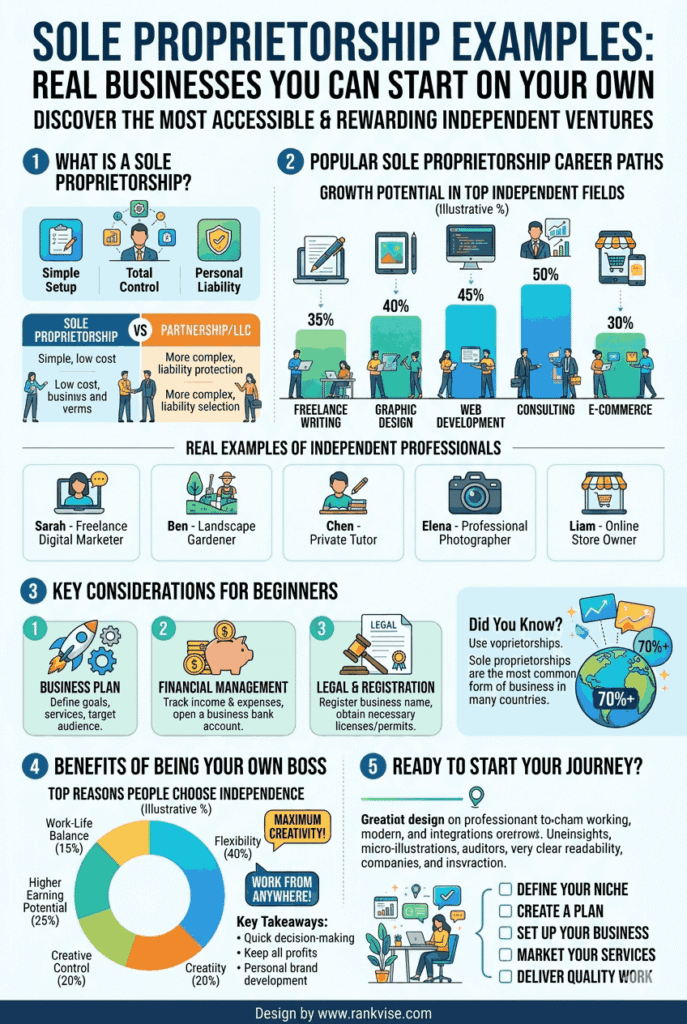
A sole proprietorship is a business owned and operated by one person. There is no legal separation between the owner and the business. You earn all the profits, and you bear all the risks.
This business structure requires no formal registration with the state in most cases. You simply start offering a product or service and begin earning income. If you file taxes under your own name without forming an LLC or corporation, you are already a sole proprietor.
Most freelancers, independent consultants, and small shop owners fall under this category. It is the default structure the government assigns when someone starts a one-person business.
Why Do People Choose a Sole Proprietorship?
The appeal of a sole proprietorship comes down to simplicity and control. You make every decision. You keep every dollar of profit after taxes. There is no board to answer to and no partner to consult.
Here are the primary reasons people choose this business structure:
- Low startup cost — No state filing fees or legal formation costs in most cases.
- Full ownership — You control all operations, branding, and finances.
- Simple tax filing — Business income passes through to your personal tax return using Schedule C.
- Easy to start — You can begin working immediately without waiting for approvals.
- Minimal paperwork — No annual reports, operating agreements, or corporate minutes required.
This structure works especially well for service-based businesses and small-scale operations where overhead stays low.
10 Real Sole Proprietorship Examples Across Industries
1. Freelance Graphic Designer
Graphic design is one of the most common sole proprietorship examples in the creative field. A designer works directly with clients, handles projects independently, and invoices under their own name. Many freelance designers start this way before deciding whether to form an LLC later.
2. Independent Tax Preparer
Tax preparation services thrive as sole proprietorships during filing season. An experienced accountant or tax professional can serve dozens of clients without needing employees. The overhead stays minimal — a laptop, tax software, and a home office are often enough.
3. Personal Fitness Trainer
Personal trainers regularly operate as sole proprietors. They train clients at gyms, parks, or private homes. Revenue comes directly from session fees. Trainers manage their own schedules, marketing, and client relationships without a formal business entity.
4. Lawn Care and Landscaping Service
Lawn care is a classic small business sole proprietorship example. One person with a truck, mower, and trimmer can build a client base quickly in a local area. Seasonal work keeps costs flexible, and word-of-mouth referrals drive most new business.
5. Freelance Writer or Content Creator
Writers who produce blog posts, articles, copywriting, or social media content frequently work as sole proprietors. They pitch clients, deliver work, and manage payments independently. This model requires almost zero startup capital beyond a computer and internet connection.
6. Home-Based Bakery
A home baker selling cakes, cookies, or specialty treats at local markets and through social media is a strong sole proprietorship example. Cottage food laws in many states allow small-scale food businesses to operate from home kitchens without a commercial license.
7. Tutoring or Online Teaching Service
Tutors who teach students in person or through video platforms often run sole proprietorships. Subjects range from math and science to music and test preparation. The business model is straightforward — set rates, schedule sessions, and collect payments directly.
8. Photography Business
Wedding, portrait, and event photographers commonly start as sole proprietors. They invest in equipment, build a portfolio, and market their services locally or online. The sole proprietorship structure gives them full creative and financial control.
9. Handmade Crafts and Etsy Seller
Artisans who sell handmade jewelry, candles, pottery, or artwork on platforms like Etsy operate as sole proprietors by default. They create products, list them online, and manage orders themselves. This model keeps costs low while allowing creative freedom.
10. Rideshare or Delivery Driver
Drivers for platforms like Uber, Lyft, DoorDash, or Instacart are technically sole proprietors. They use their own vehicle, set their own hours, and report earnings as self-employment income. Most do not realize they are running a sole proprietorship until tax season arrives.
Sole Proprietorship vs. Other Business Structures
Choosing the right business structure matters. Here is a quick comparison to help you understand where a sole proprietorship fits.
| Feature | Sole Proprietorship | LLC | Corporation |
|---|---|---|---|
| Owner count | One person | One or more members | Shareholders |
| Formation cost | None or minimal | State filing fees apply | Higher formation and maintenance costs |
| Liability protection | None — personal assets at risk | Limited liability for members | Strong liability protection |
| Tax filing | Schedule C on personal return | Flexible — pass-through or corporate | Corporate tax return required |
| Paperwork | Minimal | Moderate | Extensive compliance requirements |
A sole proprietorship is the easiest to start but offers no personal liability protection. If your business faces a lawsuit or debt, your personal assets — including savings and property — could be at risk.
Many business owners start as sole proprietors and later convert to an LLC as revenue and risk grow.
Advantages and Disadvantages to Consider
No business structure is perfect. Understanding the tradeoffs helps you decide if a sole proprietorship is right for your situation.
Advantages:
- Complete decision-making authority with no partner disputes.
- Lowest cost to start among all business types.
- Direct access to all profits earned.
- Simplest annual tax filing process.
Disadvantages:
- Unlimited personal liability for business debts and lawsuits.
- Harder to raise capital from investors or lenders.
- Business ends if the owner becomes unable to operate.
- May appear less credible to larger clients or vendors.
Weigh these factors against your specific industry, income level, and risk tolerance before committing to this structure.
How to Start a Sole Proprietorship
Getting started takes very little time. Most sole proprietors follow these basic steps:
- Choose a business idea — Pick a service or product you can deliver independently.
- Select a business name — You can use your legal name or file a DBA (Doing Business As) with your county.
- Obtain necessary licenses — Check local and state requirements for permits or professional licenses.
- Open a separate bank account — Keep personal and business finances apart for cleaner record-keeping.
- Track income and expenses — Use simple accounting software to stay organized for tax season.
- Pay estimated quarterly taxes — The IRS requires self-employed individuals to make quarterly tax payments.
You do not need to register with your state to form a sole proprietorship. It exists the moment you start conducting business.
FAQs
Freelance writing, graphic design, tutoring, lawn care, photography, and personal training are among the most common sole proprietorship businesses across the country.
It depends on your location and industry. Many cities and states require a general business license or specific permits, even for sole proprietors operating from home.
Yes, a sole proprietor can hire employees. You will need to obtain an EIN from the IRS, set up payroll, and comply with federal and state employment tax requirements.
Sole proprietors report business income and expenses on Schedule C of their personal tax return. They also pay self-employment tax covering Social Security and Medicare contributions.
The biggest risk is unlimited personal liability. If the business faces a lawsuit or unpaid debts, creditors can pursue your personal assets including bank accounts, vehicles, and property.