You create a great TikTok video. The hook is sharp. The editing is clean. You hit publish and wait. Nothing happens. Views trickle in. Engagement flatlines.
The problem might not be your content. It might be your timing.
Knowing the best times to post on TikTok dramatically affects how many people see your videos. The algorithm favors early engagement. If your post gains traction quickly after publishing, TikTok pushes it to more users. Post when your audience is asleep, and even brilliant content struggles to gain momentum.
This guide gives you a data-backed, day-by-day breakdown of the optimal TikTok posting times. You will also learn how to find your own best posting windows using analytics.
Why Does Posting Time Matter on TikTok?
TikTok’s algorithm evaluates content within the first 30 to 60 minutes after publishing. It measures watch time, likes, comments, shares, and replays during this initial window. Strong early engagement signals quality, which triggers wider distribution.
If you post when your followers are active, your video gets immediate interaction. That early momentum tells the algorithm to show it to more people on the For You page. Post at the wrong time, and your video may never escape the initial testing phase.
Timing alone does not guarantee virality. Content quality still comes first. But publishing at peak hours gives good content the best possible launchpad. Think of it as stacking the odds in your favor.
Best Times to Post on TikTok by Day of the Week
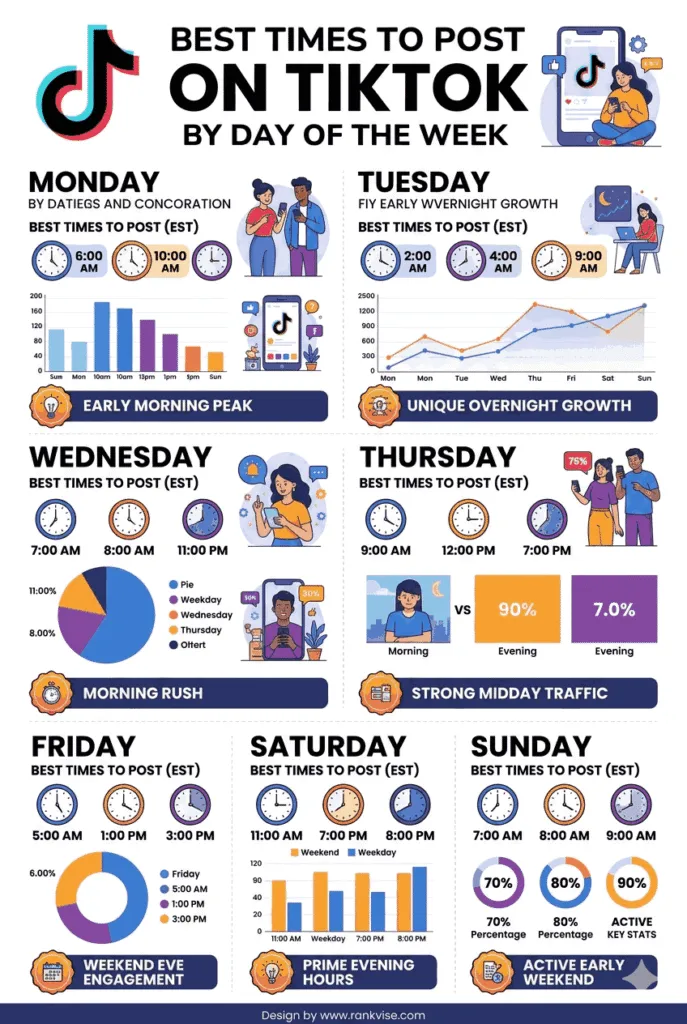
Research from Buffer’s analysis of over 7 million TikTok posts, combined with data from multiple social media studies, reveals clear patterns in engagement by day and time. All times listed below are in Eastern Standard Time. Adjust for your audience’s primary time zone.
| Day | Best Times to Post (EST) |
|---|---|
| Monday | 6:00 AM, 10:00 AM, 1:00 PM |
| Tuesday | 2:00 AM, 4:00 AM, 9:00 AM |
| Wednesday | 7:00 AM, 8:00 AM, 11:00 PM |
| Thursday | 9:00 AM, 12:00 PM, 7:00 PM |
| Friday | 5:00 AM, 1:00 PM, 3:00 PM |
| Saturday | 11:00 AM, 7:00 PM, 8:00 PM |
| Sunday | 7:00 AM, 8:00 AM, 9:00 AM |
Monday
Monday mornings perform well because users check their phones during commutes and early work breaks. The 6:00 AM slot catches early risers scrolling before their day begins. The 1:00 PM window aligns with lunch breaks across multiple time zones.
Tuesday
Tuesday shows an unusual pattern. The early morning hours between 2:00 AM and 4:00 AM perform surprisingly well. This likely reflects international audiences and night-shift workers. The 9:00 AM slot captures the standard morning scroll.
Wednesday
Midweek engagement peaks in the early morning and late evening. The 7:00 AM and 8:00 AM windows catch morning routines. The 11:00 PM slot reaches users winding down before bed, a prime time for casual browsing.
Thursday
Thursday delivers consistent engagement across the day. Morning, midday, and evening slots all perform strongly. The 7:00 PM window is particularly effective as users relax after work and spend more time on entertainment apps.
Friday
Friday engagement shifts earlier in the day. The 5:00 AM slot works well for audiences starting their weekend mindset early. The afternoon windows between 1:00 PM and 3:00 PM catch people mentally checking out of work.
Saturday
Weekends change the pattern entirely. Users wake up later and browse more in the evening. The 11:00 AM slot catches late risers. The 7:00 PM and 8:00 PM windows align with peak leisure time when screen usage spikes.
Sunday
Sunday mornings dominate. Data consistently shows 9:00 AM on Sunday as one of the single best times to post on TikTok across all days. Users scroll extensively during slow Sunday mornings, giving your content a longer engagement window.
How to Find Your Own Best Posting Times
General data provides a useful starting point. But your specific audience may behave differently. A fitness brand targeting early risers has different peak hours than a gaming account targeting teenagers.
Use TikTok Analytics
TikTok provides built-in analytics for business and creator accounts. Navigate to your profile, tap the menu, and select Creator Tools, then Analytics. The Followers tab shows when your audience is most active by day and hour.
This data reflects your actual followers, not a global average. It is the most reliable source for determining your personal best posting schedule.
Track Your Own Performance
Build a simple spreadsheet that logs every post along with its publish time, day, and engagement metrics after 24 and 48 hours. After 30 days, patterns emerge. You will see which time slots consistently outperform others for your specific content and audience.
Track these metrics for each post:
- Total views after 24 hours
- Like-to-view ratio
- Comment count
- Share count
- Average watch time
- Follower growth attributed to the post
Test Systematically
Avoid changing multiple variables at once. If you want to test posting times, keep your content style consistent. Post similar content types at different times across two weeks. Compare the results and let the data guide your schedule.
Does Posting Frequency Affect the Best Time Strategy?
Yes. How often you post interacts directly with when you post. TikTok rewards consistency. The algorithm favors accounts that publish regularly over those that post in bursts.
Most experts recommend posting one to three times per day. If you post once daily, choose your single strongest time slot. If you post three times, spread them across morning, afternoon, and evening to capture different audience segments.
Avoid posting multiple videos within the same hour. Each video competes with the others for your followers’ attention. Space your posts at least three to four hours apart to give each one a fair chance at early engagement.
Time Zones: How to Handle a Global Audience
If your audience spans multiple countries, a single posting time will not reach everyone at peak hours. This is where a multi-post strategy becomes essential.
Check your TikTok analytics to identify where most of your followers live. If 60 percent are in the United States and 25 percent are in the United Kingdom, prioritize US time zones but add a post timed for UK peak hours.
A practical approach for global accounts:
- Post once during your primary audience’s peak morning hours
- Post again during your secondary audience’s evening window
- Use scheduling tools to automate posts across time zones
Tools like Buffer, Later, and Hootsuite allow you to schedule TikTok posts in advance. This removes the burden of manually publishing at odd hours.
Common Mistakes That Waste Good Timing
Even perfect timing cannot save a post if you make these avoidable errors.
Ignoring your own analytics and relying solely on generic guides is the most common mistake. Global averages are starting points, not final answers. Your audience is unique.
Posting and disappearing hurts engagement. TikTok rewards creators who interact with comments shortly after posting. Stay active for at least 15 to 30 minutes after publishing. Reply to comments, engage with other content, and signal to the algorithm that you are present.
Chasing trends at the wrong time dilutes your strategy. A trending sound posted at 3:00 AM in your audience’s time zone misses the window. Align trending content with peak hours for maximum impact.
Neglecting content quality for timing is a trap. No posting schedule compensates for weak content. Prioritize creating videos that hook viewers in the first two seconds, deliver value, and encourage interaction. Timing amplifies good content. It cannot rescue bad content.
Should You Post at the Same Time Every Day?
Consistency helps, but rigidity does not. Posting at the same time daily trains your audience to expect content. Some followers will actively check your profile at those times. This predictability benefits engagement.
However, sticking to one time slot means you only reach one segment of your audience. Rotating between two or three proven time slots across the week gives you broader reach without sacrificing consistency.
The best approach combines both strategies. Pick two to three core posting times based on your analytics. Rotate between them on a weekly schedule. Review performance monthly and adjust.
FAQs
Sunday at 9:00 AM EST consistently ranks as the top-performing time slot based on engagement data from millions of posts analyzed in recent studies.
Yes. Different audiences have different browsing habits. A B2B account performs better during weekday mornings, while entertainment accounts peak during evenings and weekends.
One to three times daily works best. Post consistently and space videos at least three to four hours apart so each one gets a fair shot at early engagement.
Yes. Scheduling tools like Buffer and Later let you publish at optimal times without being online. They help maintain consistency, especially across different time zones.
No. Content quality always matters most. But posting at peak times gives strong content better initial engagement, which signals the algorithm to push it to a wider audience.