Skip to content
Counterfeit identification is not a new problem. But the sophistication behind it has changed dramatically. Few names in the fake ID world carry as much notoriety as IDGod, a platform that has pushed counterfeit document production into disturbingly advanced territory.
- Operating from overseas with cryptocurrency payments and stealth shipping keeps IDGod largely beyond U.S. enforcement and sustains its market presence.
- Employs sophisticated materials, printing, and encoding to replicate visual and machine-readable security features, defeating many casual visual inspections.
- Detection improves with database crosschecks, AI-powered analysis, multispectrum light inspection, and trained staff recognizing tactile and behavioral inconsistencies.
- Possessing or using counterfeit IDs carries serious legal penalties including felony charges, imprisonment, fines, and long-term impacts on education and employment.
- High-quality fakes enable identity theft, financial fraud, and national security threats; businesses must adopt layered verification and keep current with state ID changes.
This is not a guide for obtaining fake identification. It is an in-depth look at the technology, legal risks, security challenges, and detection methods surrounding IDGod and the broader counterfeit ID market. Whether you run a business that checks IDs, work in law enforcement, or simply want to understand this growing threat, this breakdown covers what you need to know.
What Is IDGod and How Did It Start?
IDGod is an online platform known for manufacturing and distributing counterfeit identification documents. It primarily targets young adults in the United States who seek fake IDs to bypass age verification at bars, clubs, and retail establishments.
The platform traces its roots back to the early 2000s. It emerged from an earlier operation called IDChief, which was based in China. After internal disputes fragmented IDChief, IDGod launched independently around 2004. The idgod.com domain was registered that year, marking the formal start of the operation.
Because IDGod operates from overseas, U.S. law enforcement has found it difficult to shut down. This geographic advantage has allowed the platform to remain active for over two decades, adapting to new security features and detection technologies along the way.
Why IDGod Became a Dominant Name in the Fake ID Market
Several factors contributed to IDGod becoming the most recognized name in counterfeit identification. Understanding these factors helps explain why the platform has been so difficult to eliminate.
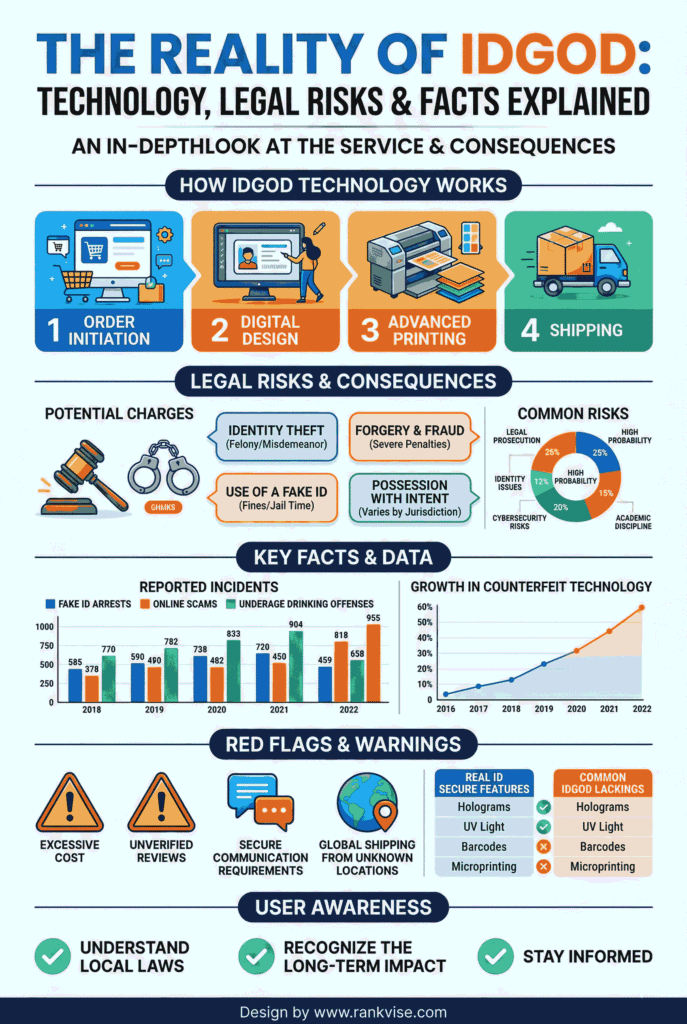
- IDGod produces IDs with scannable barcodes, holographic overlays, and UV-reactive ink that closely replicate genuine state-issued documents.
- The operation accepts cryptocurrency payments like Bitcoin and Monero, making transactions harder for authorities to trace.
- Stealth shipping methods disguise packages as ordinary mail, reducing the chance of interception at customs.
- Group discounts and active engagement on forums and social media have built a loyal customer base, particularly among college students.
- Operating from China places the platform largely outside the jurisdiction of American law enforcement agencies.
This combination of product quality, anonymity, and accessibility created a competitive moat that few rival counterfeit operations have matched.
The Technology Behind IDGod Fake IDs
The reason IDGod products are difficult to detect lies in the technology used to produce them. Each stage of the manufacturing process mirrors techniques used in legitimate document production.
Material Selection and Card Construction
Authentic government IDs use specialized substrates like polycarbonate and Teslin. IDGod sources similar materials to replicate the exact texture, flexibility, and weight of real cards. Polycarbonate supports laser engraving, while Teslin absorbs ink in ways that produce sharp, realistic prints. Holographic laminates are then applied to complete the physical feel.
High-Resolution Printing and Color Matching
Commercial-grade offset and laser printers handle the visual reproduction. These machines achieve the fine-line detail, gradient patterns, and microprinting found on genuine identification. Digital color-matching software ensures that state-specific palettes are replicated precisely, down to the UV ink layers visible under blacklight inspection.
Security Feature Replication
This is where IDGod separates itself from amateur counterfeiters. The platform replicates multiple security features that most businesses rely on for visual verification.
| Security Feature | How IDGod Replicates It |
|---|---|
| Holograms | Custom foils applied using hot-stamping or diffraction grating techniques |
| UV elements | UV-reactive inks printed in state-specific patterns using specialized printers |
| Laser engraving | CNC-controlled lasers create raised text and perforated symbols |
| Scannable barcodes | Software generates 1D/2D barcode data matching the visible card information |
| Magnetic stripes | Encoded data compatible with standard magstripe readers |
Digital Encoding and Data Matching
A convincing fake ID must pass more than a visual test. IDGod uses barcode and magnetic stripe encoding software that ensures scanned data matches the printed information on the card. Some operations have even explored RFID and NFC chip cloning, though this remains less common due to its complexity.
Template Design Through Reverse Engineering
IDGod teams use high-resolution scans of authentic IDs combined with graphic design software to recreate layouts, typefaces, and design elements. Crowdsourced data and monitoring of government security updates help keep templates current as states introduce new card designs.
How Fake IDs From IDGod Are Detected
Despite the sophistication, counterfeit IDs are not unbeatable. Detection methods have advanced alongside counterfeiting technology. Businesses and law enforcement rely on several approaches.
- Advanced ID scanners cross-reference barcode data against state databases in real time, flagging inconsistencies that visual inspection cannot catch.
- AI-powered verification tools analyze microprinting patterns, font spacing, and image quality at a level of detail beyond human capability.
- Trained staff look for tactile inconsistencies such as incorrect card thickness, uneven lamination edges, or holograms that do not shift correctly under light.
- Multi-spectrum light inspection reveals UV and infrared features that counterfeiters often fail to replicate perfectly.
- Behavioral cues during ID presentation, such as nervousness or rehearsed responses, also alert experienced bouncers and cashiers.
Businesses that invest in electronic verification systems rather than relying solely on visual checks dramatically reduce their exposure to counterfeit ID fraud.
Legal Consequences of Using or Possessing a Fake ID
The legal risks associated with counterfeit identification are severe. Many people underestimate the penalties, treating fake IDs as a minor offense. The reality is far more serious.
Possessing a fraudulent ID is a criminal offense in every U.S. state. In Florida, it qualifies as a third-degree felony carrying potential prison time. Under federal law, forging or misusing identity documents can result in up to fifteen years of imprisonment and substantial fines.
Beyond criminal charges, consequences extend into everyday life. States like Iowa can suspend a driver’s license for up to one year following a fake ID conviction. A criminal record from an ID-related charge can affect college admissions, employment background checks, and professional licensing for years afterward.
Businesses face liability too. Establishments that unknowingly accept counterfeit IDs risk fines, license revocation, and lawsuits. A Texas bar was penalized 10,000 USD in 2022 after serving underage patrons who used IDGod products.
The Broader Security Risks of Counterfeit Identification
The impact of fake IDs reaches far beyond underage drinking. Counterfeit identification documents create serious vulnerabilities across multiple sectors.
Identity theft becomes easier when criminals use fake IDs carrying stolen personal information. Fraudulent accounts, unauthorized loans, and credit card applications can devastate victims financially. The stolen identity may take months or years to fully recover.
National security is also at stake. High-quality counterfeit documents can help individuals evade law enforcement, cross borders illegally, or conceal involvement in criminal organizations. Intelligence agencies have flagged sophisticated fake IDs as tools used in human trafficking and terrorism-related activities.
Financial institutions face increased fraud exposure when counterfeit identification bypasses customer verification protocols. The downstream costs include regulatory penalties, customer compensation, and reputational damage.
The Future of Fake ID Technology and Verification
The arms race between counterfeiters and verification systems is accelerating. Several trends will shape the next phase of this battle.
Biometric integration into government IDs, including fingerprint data, facial recognition, and iris scans, will make physical replication far more difficult. Counterfeiters would need to spoof biological data, not just printed features.
Artificial intelligence will play roles on both sides. Governments are deploying AI-powered scanners that detect microscopic inconsistencies in counterfeit documents. Meanwhile, counterfeiters may use generative AI to create more convincing deepfake photos and document templates.
Blockchain-based digital identity systems could eventually reduce reliance on physical cards altogether. By storing verified identity credentials on decentralized networks, these systems eliminate many of the attack vectors that physical counterfeiting exploits.
Mobile ID systems, such as digital driver’s licenses stored in Apple Wallet or Google Wallet, represent another shift. As physical cards give way to digital credentials, fake ID operations may pivot toward hacking and spoofing digital identity platforms instead.
The organizations that invest early in multi-layered verification, combining physical inspection, electronic scanning, biometric checks, and AI analysis, will be best positioned to stay ahead of evolving counterfeiting methods.
How Businesses Can Protect Themselves Today
Organizations do not need to wait for future technology to improve their defenses. Practical steps are available right now.
- Deploy electronic ID scanners that validate barcode and magnetic stripe data against state databases rather than relying on visual checks alone.
- Train frontline staff to recognize common signs of counterfeit documents, including lamination irregularities, incorrect card thickness, and hologram defects.
- Invest in multi-spectrum light tools that reveal UV and infrared features, exposing flaws in counterfeit security layers.
- Establish clear protocols for handling suspected fake IDs, including documentation procedures and when to involve law enforcement.
- Stay informed about new state ID designs and security features so staff can identify outdated or inaccurate templates.
These measures significantly reduce the risk of accepting fraudulent identification while also demonstrating regulatory due diligence.
FAQs
It depends on the state. In many jurisdictions like Florida, possessing a counterfeit ID is a felony carrying potential prison time, fines, and a permanent criminal record.
They use electronic barcode scanners, AI-powered verification tools, UV light inspection, and trained staff who check for tactile and visual inconsistencies in the card.
Some IDGod products do pass basic barcode scanners because encoded data matches printed details. However, advanced scanners that cross-reference state databases often flag them.
Beyond fines and possible jail time, a conviction can affect college admissions, job background checks, professional licensing, and may result in driver’s license suspension.
IDGod operates from China, outside U.S. legal jurisdiction. It uses cryptocurrency payments, encrypted communications, and stealth shipping to avoid detection and interception.