Skip to content

Quitting a job feels personal. But how you resign is a professional decision that follows you long after you leave. Knowing how to write a 2 week notice properly protects your reputation, your references, and your future career options.
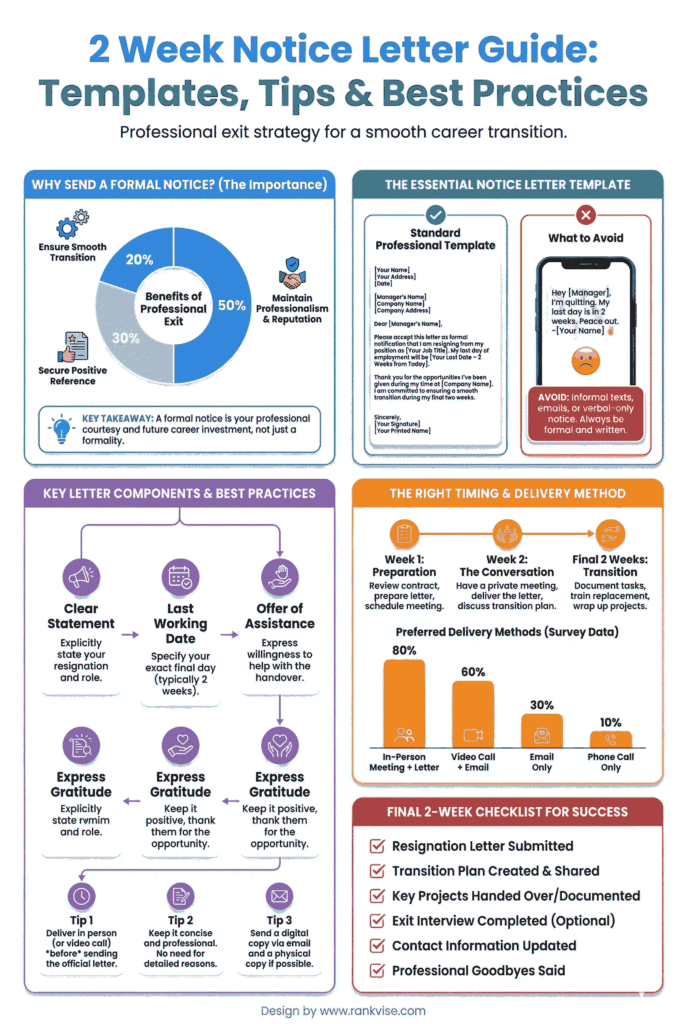
- Begin with a clear resignation statement including your job title, company, and exact last working day.
- Express genuine, specific gratitude for opportunities and mentorship received during your tenure.
- Offer concrete transition support like training, documentation, and completing critical projects.
- Deliver the news in a private conversation first, then submit a concise, proofread written notice.
A two week notice letter is not just paperwork. It signals maturity and respect for the people and organization you are leaving behind. Whether you are moving to a better opportunity, relocating, or simply ready for a change, a well-written resignation letter makes all the difference.
This guide gives you everything you need. You will find the exact format, ready-to-use templates, real examples, and expert advice on handling the conversation and the transition that follows.
What Is a 2 Week Notice Letter and Why Does It Matter?
A two week notice letter is a formal document you submit to your employer announcing your resignation. It states your intention to leave and specifies that your last working day will be two weeks from the submission date.
Most employers in the United States expect this courtesy, even though at-will employment does not legally require it. Submitting a professional resignation letter achieves three things simultaneously. It gives your employer time to plan. It protects your eligibility for rehire. And it preserves relationships you may need for references down the road.
According to a 2024 Robert Half survey, 86% of hiring managers said the way a candidate left a previous role influenced their hiring decision. That single statistic should motivate anyone to resign the right way.
What to Include in Your Resignation Letter
Every effective notice period letter contains a few essential components. Miss one, and the letter can feel incomplete or unprofessional. Here is what yours needs:
- Your full name, address, phone number, and email at the top
- The date you are writing the letter
- Your manager’s name, title, and company address
- A clear statement that you are resigning
- Your exact last working day (two weeks from submission)
- A brief expression of gratitude for the opportunity
- An offer to help with the transition
- A professional closing and your signature
Keep the letter to one page. Avoid lengthy explanations about why you are leaving. The goal is clarity, not storytelling.
Step-by-Step: How to Write a 2 Week Notice
Writing a resignation letter does not require fancy language. It requires structure, honesty, and a professional tone. Follow these steps to get it right.
Step 1 — Open With a Direct Resignation Statement
Do not bury your intention. The first sentence should state clearly that you are resigning. Include your job title and the company name. Specify your last working day so there is zero ambiguity.
Example: “I am writing to formally resign from my position as Marketing Coordinator at Apex Solutions. My last day of work will be March 3, 2026.”
Step 2 — Express Genuine Gratitude
Mention specific experiences, skills, or relationships that made your time valuable. Generic phrases like “thank you for everything” sound hollow. Personalizing this section leaves a stronger impression.
Example: “I sincerely appreciate the mentorship I received from you and the leadership team. The product launch experience I gained here shaped my approach to project management.”
Step 3 — Offer Transition Support
Volunteer to train your replacement, document your processes, or complete critical projects. This shows you care about the team’s continuity, not just your own exit.
Example: “Over the next two weeks, I am happy to document my workflows and train whoever takes over my client accounts.”
Step 4 — Close Professionally
End with a warm, forward-looking closing. Express your hope to stay connected. Then sign off with “Sincerely” or “Best regards” followed by your full name.
Ready-to-Use 2 Week Notice Letter Templates
Template A — Standard Professional Resignation Letter
[Your Name] [Your Address] [City, State, ZIP] [Email Address] [Phone Number] [Date]
[Manager’s Name] [Manager’s Title] [Company Name] [Company Address] [City, State, ZIP]
Dear [Manager’s Name],
I am writing to formally resign from my position as [Your Job Title] at [Company Name]. My last working day will be [Date — two weeks from today].
I am grateful for the opportunities I have had to grow professionally during my time here. Working with this team has been a genuinely rewarding experience.
I want to ensure a smooth transition and am happy to assist with training, documentation, or handover tasks over the next two weeks. Please let me know how I can be most helpful.
Thank you again for your support and guidance. I wish you and the team continued success.
Sincerely, [Your Name]
Template B — Short and Simple Resignation Letter
[Your Name] [Date]
Dear [Manager’s Name],
Please accept this letter as formal notice of my resignation from [Company Name], effective [Last Working Day].
Thank you for the experience and support during my time here. I am available to help with the transition over the next two weeks.
Best regards, [Your Name]
Template C — Resignation Email Template
Subject Line: Resignation — [Your Name]
Dear [Manager’s Name],
I am writing to inform you of my resignation from [Job Title] at [Company Name]. My last day will be [Date].
I appreciate the growth opportunities and experiences I have gained here. I am committed to making the transition as smooth as possible and am happy to help in any way over the coming two weeks.
Thank you for everything. I hope we stay in touch.
Best regards, [Your Name]
Many professionals now submit a resignation email before following up with a printed letter. Both carry equal weight as long as the format stays professional and the details remain clear.
How to Resign From a Job: The Conversation Before the Letter
Your resignation letter should never be the first time your manager hears the news. Schedule a private, in-person meeting (or a video call for remote roles) before you submit anything in writing.
Here is how to handle that conversation:
- Be direct. Open with your decision, not small talk.
- Stay positive. Focus on gratitude, not grievances.
- Keep it brief. Five to ten minutes is enough.
- Avoid over-sharing. You do not owe details about your next role or salary.
- Bring your letter. Hand it over at the end of the meeting or send it immediately after.
This approach shows respect and gives your manager time to process the news before the formal paperwork arrives.
Dos and Don’ts of Writing a Two Week Notice
| Do | Don’t |
|---|---|
| State your last day clearly and specifically | Leave the end date vague or open-ended |
| Keep the tone warm and professional throughout | Include complaints about management or coworkers |
| Offer to train your replacement or document tasks | Assume someone else will handle the transition |
| Proofread for typos and formatting errors | Send the letter without reviewing it at least twice |
| Submit the letter to your direct manager first | CC the entire team or post about it publicly |
| Follow up with HR if required by company policy | Skip HR procedures even if they feel unnecessary |
What Happens After You Submit Your Notice?
Most people focus entirely on writing the letter and forget about the two weeks that follow. How you behave during your notice period matters just as much.
Continue performing your duties at full capacity. Avoid mentally checking out or reducing your effort. Your coworkers and manager will remember these final days vividly.
Complete all pending projects or create detailed handover notes for whoever inherits them. Organize your files, clean your inbox, and return any company property before your last day.
Schedule a proper exit interview if your company offers one. Use it to share constructive feedback, not to settle scores. This final conversation often shapes the reference your former employer provides.
When You Might Not Need to Give Two Weeks
While quitting a job professionally usually means giving notice, certain situations justify a shorter timeline or immediate departure. These include hostile work environments, harassment, unsafe conditions, or a medical emergency.
If your employment contract specifies a different notice period — longer or shorter — that contractual obligation takes priority over the standard two-week convention. Always review your agreement before submitting your letter.
Some companies may also ask you to leave immediately after you resign, especially in sensitive roles. This is common in finance, technology, and competitive industries. Prepare for this possibility so it does not catch you off guard.
FAQs
Yes. A two week notice letter is simply a resignation letter that specifies your departure date as two weeks from submission. The terms are used interchangeably.
Absolutely. A resignation email is acceptable in most workplaces. Use a clear subject line, maintain formal tone, and include all essential details like your last working day.
You are not required to share your reason. If you choose to, keep it brief and positive. Focus on new opportunities rather than dissatisfaction with your current role.
This is within their rights under at-will employment. Some companies pay out the remaining two weeks; others do not. Check your employment agreement and local labor laws for clarity.
Technically, you can ask to withdraw your resignation. However, your employer is not obligated to accept. Have an honest conversation early if your circumstances change before your last day.