Before you run a contest or book a motivational speaker, ask one question: is this a motivation problem or a maths problem?
- Fix the fundamentals: set attainable quotas, ensure comp plans are clear, and make territory and lead distribution demonstrably fair.
- Remove friction: give back selling time, eliminate unnecessary admin, address burnout, and ensure fair lead routing.
- Build intrinsic motivation: coach to improve skills, map clear career paths, connect work to customer outcomes, and grant autonomy.
- Use recognition properly: publicly celebrate behaviors and progress, design inclusive contests, and make achievement visible frequently.
A Gartner peer survey found 67% of sales professionals believe their leadership is overly optimistic and disconnected from the reality sellers face. Average quota attainment across B2B sits well below half the team. When most of a team is missing target, the issue is rarely that they stopped caring in March.
Motivation tactics applied to a structural problem produce a brief lift followed by a deeper slump, plus quiet resentment that leadership does not understand the job. So the strategies below start with the fundamentals and only then move to the things most articles lead with.
The Diagnostic
Run these four checks before doing anything else.
- What percentage of the team hit quota last quarter? If it is under half, your targets are the problem.
- Can every rep explain their comp plan without looking it up? If not, it is not motivating anyone, because nobody optimises for something they cannot calculate.
- Is territory and lead distribution genuinely fair? Perceived unfairness demotivates faster than any incentive motivates.
- How much of the week goes on selling versus admin? Reps who spend most of their time in a CRM are not unmotivated. They are obstructed.
If any of these are broken, fix them first. Recognition programmes layered on top of unattainable quotas read as insulting.
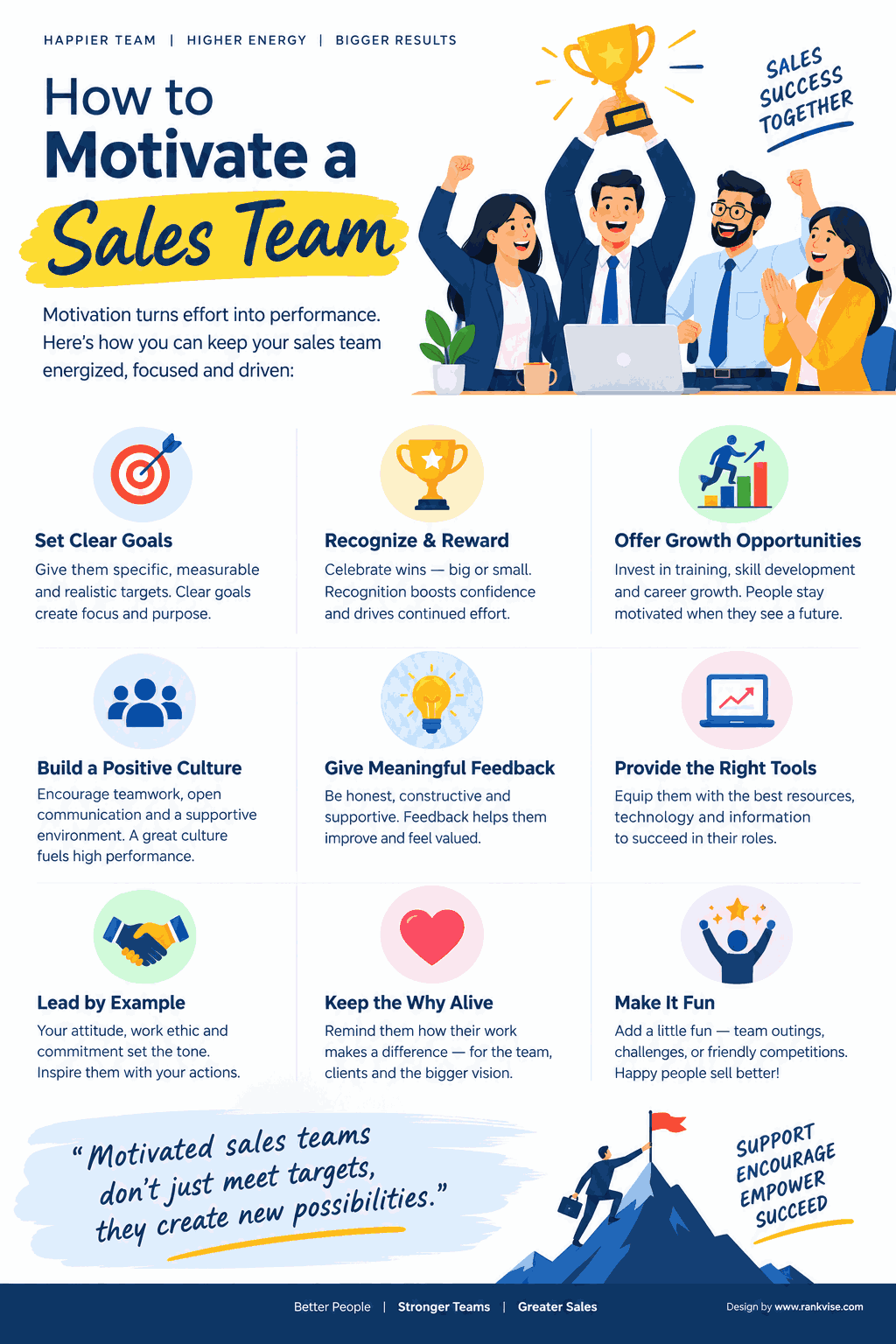
Fix the Fundamentals
1. Set quotas the majority can actually hit
Quotas that are too easy breed complacency; quotas that are unreachable breed disengagement and attrition. Aim for targets a clear majority of the team can achieve with strong effort, built from historical performance and territory potential rather than from the number finance needs.
2. Use two-tier targets
Set a baseline quota representing minimum acceptable performance, aligned to forecast and historical averages, plus a stretch target tied to higher payouts. This lets solid performers succeed while still giving top performers something to chase — rather than one number that is simultaneously too high for most and too low for a few.
3. Break the year into visible milestones
Annual quotas are psychologically abstract by February. Break them into monthly and weekly milestones so progress feels real and a bad month does not feel like a lost year.
4. Audit what your comp plan actually rewards
A comp plan is a statement of what the company values, whether or not you intended it that way. If it only rewards closed revenue, expect reps to cherry-pick easy wins and neglect pipeline health. Check what behaviour your plan produces, not what it was designed to produce.
Remove the Demotivators
This tier matters more than most managers expect, because removing friction usually outperforms adding incentives.
5. Give back selling time
Every hour of manual data entry, duplicate reporting, and internal meeting is an hour not spent with buyers. Audit where the week actually goes and cut the biggest offender. This is often the single highest-impact change available to a sales manager.
6. Make territory and lead distribution demonstrably fair
Reps compare. If one person is working inbound while another cold-calls the same quota, no amount of encouragement closes that gap. Show the logic behind distribution, and revisit it when it stops matching reality.
7. Address burnout explicitly
Sales is rejection-heavy by design, and that pressure either gets managed or it compounds. Encourage reasonable hours, protect time off properly, and watch workload rather than only watching output. Burnout destroys motivation faster than any external factor.
8. Make the comp plan comprehensible
If a rep cannot work out what a given deal earns them, the incentive is not functioning. Simplify the structure, publish worked examples, and give people a way to check their own numbers without asking finance.
Build Intrinsic Motivation
Extrinsic rewards — money, prizes, trips — produce real but short-lived lifts. Intrinsic drivers produce more durable performance, and cost less.
9. Coach rather than review
A pipeline review checks numbers. Coaching improves capability. Set aside protected time to work on one skill per rep per cycle, using real calls rather than abstractions. Reps who feel they are getting better stay engaged even in bad quarters.
10. Give people a visible path
Reps leave when the next step is invisible. Map out what progression looks like — senior AE, team lead, enablement, a different segment — and be specific about what each requires.
11. Connect the work to customer outcomes
Share what happened after the sale. A rep who hears that their client solved a real problem has a reason to care beyond the number, and that reason survives a slow month.
12. Give autonomy over how, not what
Set the outcome, then let experienced reps choose their approach. Prescribing both the target and the method removes the ownership that makes the target feel like theirs.
Use Recognition Properly
13. Make achievement publicly visible
Public recognition is the most cost-effective motivational tool available and among the most underused. Calling out good work in team meetings, a Slack channel, or a company-wide note costs nothing and signals that effort gets seen.
14. Recognise behaviours, not only outcomes
If only closed revenue gets celebrated, you get short-termism. Deliberately recognise consistent prospecting, strong discovery, knowledge sharing, and helping teammates — the inputs that produce next quarter’s results.
15. Design contests that do not demoralise the middle
A contest the same top rep always wins is demotivating for everyone else, which is most of your team. Use most-improved categories, team-based targets, randomised draws for hitting activity thresholds, or short sprints on a specific behaviour. The goal is broad participation, not another trophy for the person already winning.
Different Tiers Need Different Things
A single motivation strategy applied across the whole team will land well with roughly a third of it. The three groups need genuinely different management.
Top performers are usually motivated by autonomy, status, and the next challenge rather than by more encouragement. The fastest way to lose one is to micromanage them or to change their comp plan without warning. Give them harder problems, a stretch target worth chasing, and visible influence over how the team works.
Consistent middle performers are where most of your revenue sits and where most management attention does not. They respond best to coaching on a specific skill gap and to recognition that does not require beating the top rep. This group also leaves most quietly, so watch their engagement more closely than their numbers.
Strugglers need diagnosis, not motivation. Establish whether the gap is skill, territory, pipeline quality, or effort — those need four different responses, and applying the wrong one usually accelerates the exit. If it is effort and coaching does not shift it within a defined period, that is a performance conversation rather than a motivation problem.
The common management error is spending disproportionate time on the bottom tier, mild neglect on the middle, and nothing at all on the top because they seem fine.
What Actively Demotivates
Worth stating as its own list, because these undo the fifteen above.
- Unattainable quotas, especially when set without input from the field
- Changing the comp plan mid-period, which destroys trust in every future plan
- Asking what people need and then doing nothing. This is worse than never asking.
- Public criticism, which costs far more than the correction is worth
- Invisible favouritism in lead routing or account assignment
- Celebrating only the top 10%, which tells the other 90% they are scenery
- Managers who cannot sell and cannot explain why a deal stalled
How to Tell If It Is Working
Motivation is not directly measurable, so track its consequences instead.
- Quota attainment distribution, not just the average — a team where half hit target is healthier than one carried by two people
- Voluntary attrition, particularly among mid-performers, who leave quietly before they leave loudly
- Activity consistency across the month rather than a scramble in the final week
- Pipeline coverage, which falls first when reps disengage
- Participation in optional things — training, team sessions, knowledge sharing
Run anonymous pulse surveys, read exit interviews properly, and act on at least one thing you hear. Acting on one item builds more credibility than collecting feedback on twenty.
Final Thoughts
The highest-retention sales teams are not always the highest-paying ones. They tend to be the ones where the relationship with the organisation extends past the paycheque — where the manager is invested in the rep’s development, where achievement is visible, and where the targets are ones people believe they can hit.
Start with the maths. Then remove the friction. Recognition and contests come last, because they only work on a team that already believes the game is winnable.
FAQs
What is the best way to motivate a sales team?
Start by checking whether quotas are attainable and comp is comprehensible. Motivational tactics rarely fix structural problems, but they compound once the fundamentals work.
Do sales contests actually work?
Only when designed so most of the team can win something. Contests the same top performer always takes demotivate the majority they were meant to energise.
Is money the strongest motivator in sales?
It is necessary but not sufficient. Compensation gets people in the door; development, recognition, and manager quality determine whether they stay engaged.
How do I motivate a rep who is missing quota?
Diagnose before encouraging. Establish whether it is skill, territory, pipeline, or effort — each needs a different response, and the wrong one makes things worse.
How often should I recognise good performance?
Frequently and specifically. Weekly, naming the behaviour rather than only the result, so people learn what to repeat rather than only who won.