Skip to content

Every second your application takes to load costs you customers. Slow response times, unexpected downtime, and unbalanced server loads quietly erode user trust and revenue. An application control engine solves these problems by sitting between your users and your servers, directing traffic intelligently so applications stay fast, available, and reliable.
- An application control engine intelligently manages application traffic, optimizing performance and availability by routing requests and balancing loads across servers.
- Core features include smart load balancing, SSL offloading, caching, content switching, health monitoring, and automatic failover to maintain fast, reliable applications.
- Modern controllers evolved from hardware appliances to cloud native software and managed services, offering scalability, pay as you go pricing, and API driven automation.
- Pair application control engines with web application firewalls for threat protection; evaluate infrastructure, cost, scalability, and expertise before choosing a solution.
But this technology has evolved dramatically over the past decade. Understanding what an application control engine does today, and how modern alternatives have expanded its capabilities, gives you a strategic edge in building resilient digital infrastructure.
This guide breaks down how application control engines work, why they matter, and how to choose the right solution for your business.
What Is an Application Control Engine?
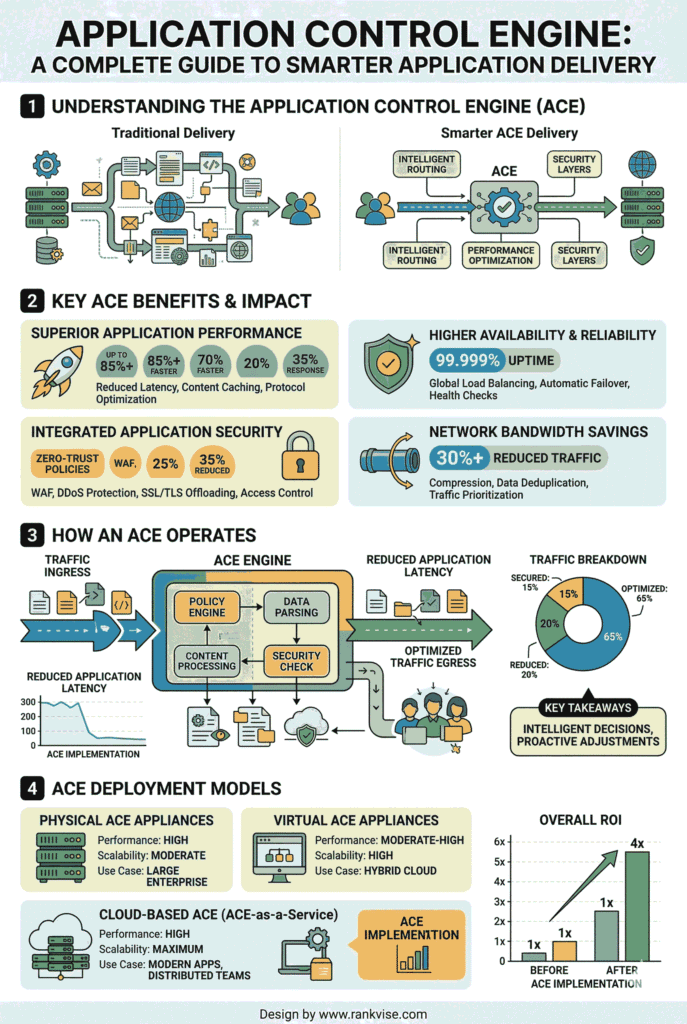
An application control engine is a specialized networking device that manages how application traffic flows between users and servers. Think of it as an intelligent traffic controller for your network. Instead of letting requests pile up on a single server, it distributes them across multiple servers to prevent overload.
Originally, Cisco popularized the term with its ACE module, a hardware-based application delivery controller designed for enterprise data centres. Cisco discontinued this product around 2018. However, the core concept lives on through modern application delivery controllers from vendors like F5, Citrix, and cloud-native platforms such as AWS and Microsoft Azure.
The primary goal remains the same: ensure applications perform at their best, even during heavy traffic.
How Does an Application Control Engine Work?
An application control engine operates between client devices and backend servers. When a user sends a request, such as loading a web page or completing a purchase, the engine intercepts that request before it reaches any server.
It then makes a real-time decision. Based on factors like server health, current load, geographic proximity, and the content being requested, it routes traffic to the best available server. This process happens in milliseconds, completely invisible to the end user.
Beyond routing, the engine can also terminate encrypted connections, compress data, and cache frequently requested content. These tasks reduce the processing burden on your actual application servers, freeing them to handle core business logic.
Core Features That Drive Performance
Smart Load Balancing
Load balancing is the foundation of every application control engine. It distributes incoming requests across a pool of servers using algorithms like round-robin, least connections, or weighted distribution. This prevents any single server from becoming a bottleneck.
For high-traffic environments like e-commerce platforms during seasonal sales, effective load balancing is the difference between a seamless checkout experience and a crashed website. Modern application delivery controllers extend this with predictive load balancing powered by real-time analytics.
SSL Offloading and Server Efficiency
Encrypting and decrypting secure connections (SSL/TLS) demands significant processing power. An application control engine handles this task on behalf of your servers through a process called SSL offloading. Your servers then focus entirely on running applications rather than managing encryption overhead.
This single feature can improve server response times by 30 to 50 percent in encryption-heavy environments. For businesses processing thousands of secure transactions daily, the performance gain is substantial.
Content Switching and Intelligent Routing
Content switching allows the engine to inspect application-layer data, such as URLs, HTTP headers, or cookies, and route requests accordingly. A request for a product image might go to one server pool, while an API call routes to another.
This granular network traffic management ensures each server group handles exactly the workload it was optimized for. The result is faster responses and more efficient resource utilization across your entire infrastructure.
Health Monitoring and Automatic Failover
Application control engines continuously check whether backend servers are healthy and responsive. If a server fails or becomes sluggish, the engine automatically reroutes traffic to healthy servers without any manual intervention.
This failover capability is critical for maintaining high availability. Businesses with uptime requirements of 99.99 percent or higher depend on this feature to meet their service level agreements.
Why Businesses Rely on Application Control Engines
The business case goes beyond raw technical performance. Here is why organizations invest in this technology:
- Revenue protection: Faster application response times directly correlate with higher conversion rates and lower abandonment.
- Operational efficiency: SSL offloading and caching reduce the number of servers needed, lowering hardware and energy costs.
- Scalability on demand: Load balancing makes it simple to add or remove servers as traffic patterns change, supporting growth without redesigning your architecture.
- Improved user experience: Consistent, fast performance builds trust and keeps users engaged, whether they access your app from London or Los Angeles.
- Reduced downtime risk: Automatic failover and health monitoring catch problems before users notice them.
For any business where application performance directly impacts revenue or reputation, an application control engine is not optional. It is foundational.
The Evolution: From Cisco ACE to Modern Application Delivery Controllers
Cisco’s original ACE module was a powerful but rigid hardware appliance. It required physical installation in data centres and offered limited flexibility for cloud or hybrid environments. When Cisco retired the product, it signaled a broader industry shift.
Modern application delivery controllers have absorbed and expanded upon every capability the original application control engine offered. Solutions like F5 BIG-IP, Citrix ADC, and cloud-native options such as AWS Application Load Balancer and Azure Application Gateway now deliver these features as software, virtual appliances, or fully managed cloud services.
This evolution brings several advantages:
- Cloud-native deployment eliminates hardware dependencies and reduces upfront capital costs.
- Pay-as-you-go pricing from providers like AWS makes enterprise-grade application delivery accessible to mid-sized businesses.
- Integrated security features, including built-in web application firewall capabilities, mean organizations no longer need entirely separate devices for performance and protection.
- API-driven automation allows DevOps teams to manage traffic policies programmatically, fitting naturally into CI/CD pipelines.
Organizations still running legacy ACE hardware should prioritize migration. Modern alternatives deliver superior performance, broader feature sets, and long-term vendor support.
Application Control Engine vs. Web Application Firewall
These two technologies often get confused because both handle application traffic. However, they serve fundamentally different purposes.
| Aspect | Application Control Engine | Web Application Firewall |
|---|---|---|
| Primary purpose | Optimizes application delivery and performance | Protects applications from security threats |
| OSI layer | Layer 4 (transport) and Layer 7 (application) | Primarily Layer 7 (application) |
| Key capabilities | Load balancing, SSL offloading, caching, content switching | Threat detection, SQL injection blocking, XSS prevention |
| Traffic approach | Distributes and accelerates traffic | Inspects and filters traffic for malicious activity |
| Performance impact | Improves speed and availability | May introduce minor latency due to deep inspection |
| Best for | High-traffic applications needing speed and uptime | Public-facing apps needing application security compliance |
The smartest approach combines both. An application control engine handles traffic distribution and performance, while a web application firewall screens that traffic for threats. Many modern application delivery controllers now bundle both capabilities into a single platform, simplifying deployment and management.
How to Choose the Right Solution for Your Business
Selecting the right application delivery solution depends on your specific priorities and environment. Consider these factors:
Assess your primary need. If application speed and uptime are your biggest concerns, prioritize a robust application delivery controller with strong load balancing and SSL offloading. If security threats keep you up at night, ensure your solution includes comprehensive web application firewall features.
Evaluate your infrastructure. On-premises data centres may benefit from virtual appliances or hardware-based solutions. Cloud-first organizations should explore native options from AWS, Azure, or Google Cloud for seamless integration.
Consider total cost of ownership. Hardware appliances carry significant upfront costs plus ongoing maintenance. Cloud-based solutions offer flexible subscription pricing but can accumulate costs at scale. Model both scenarios before committing.
Plan for growth. Your solution should scale horizontally without requiring architectural redesign. Cloud-native application delivery controllers excel here, allowing you to add capacity in minutes rather than weeks.
Factor in expertise. Both application control engines and firewalls require skilled configuration. Budget for training or consider managed services if your team lacks specialized networking and security experience.
Common Challenges and How to Overcome Them
Configuration complexity. Misconfigured load balancing rules or SSL certificates cause outages. Invest in thorough documentation and staged rollouts. Test every change in a non-production environment first.
Performance versus security trade-offs. Deep packet inspection adds latency. Modern solutions minimize this with hardware acceleration and optimized inspection engines. Choose vendors that publish transparent performance benchmarks.
Vendor lock-in. Proprietary features can make migration painful. Favour solutions that support open standards and provide API compatibility across platforms.
Monitoring blind spots. Without proper observability, you cannot optimize what you cannot measure. Integrate your application delivery controller with centralized monitoring tools and set alerts for latency spikes, server failures, and unusual traffic patterns.
FAQs
It manages and directs application traffic across servers to ensure fast performance, high availability, and efficient resource usage.
No. Cisco discontinued the ACE module around 2018. Modern alternatives include F5 BIG-IP, Citrix ADC, and cloud-native load balancers.
No. It optimizes performance but lacks advanced threat detection. Most businesses deploy both together for complete coverage.
A load balancer is one feature within an application control engine. The engine also provides SSL offloading, content switching, caching, and health monitoring.
Cloud-based options like AWS ALB use pay-as-you-go pricing starting at minimal monthly costs. Hardware appliances from F5 or Citrix can range from several thousand to six figures depending on capacity.