Skip to content

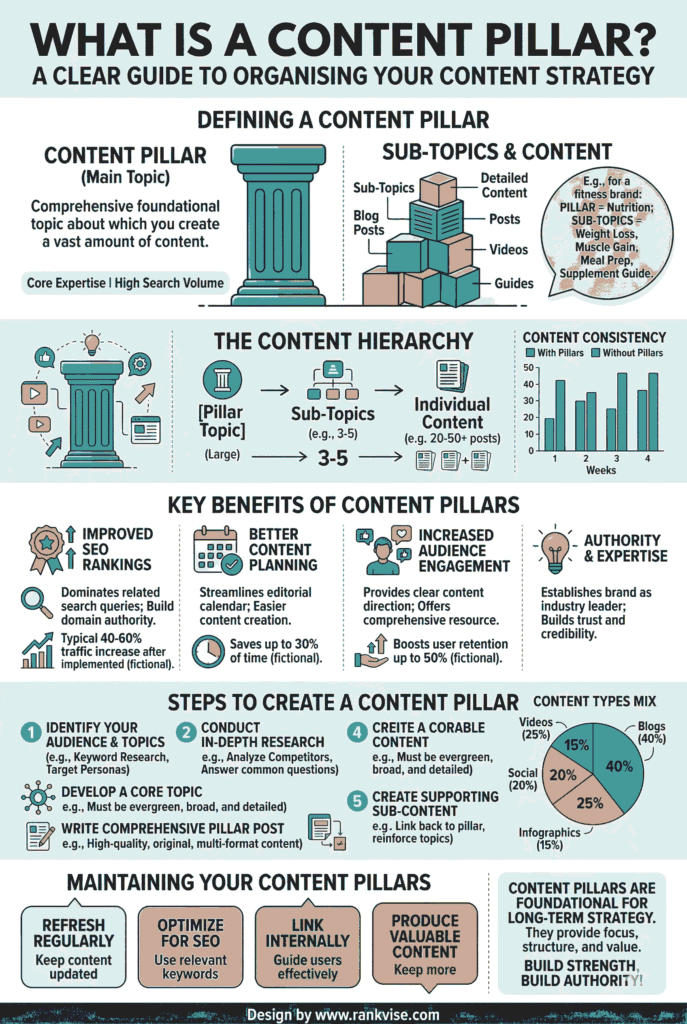
A content pillar is a core topic that anchors your entire content strategy. It represents a broad subject your brand consistently creates content around. Every blog post, video, social update, or guide you produce connects back to one of these central themes.
- Build a pillar page with linked cluster articles to create a topic cluster that signals topical authority to search engines and boosts rankings.
- Audit content, research audience questions and keywords, then choose three to five pillars and map ten to twenty cluster topics per pillar.
- Align pillars with business goals, maintain consistent internal linking, and refresh pillar pages regularly to preserve relevance and ranking.
Think of it as the foundation of a house. Without strong pillars, the structure collapses. Without defined content pillars, your marketing feels scattered and random. Audiences struggle to understand what your brand stands for, and search engines struggle to rank you as an authority.
This guide explains exactly how content pillars work, why they matter, and how to build them for your business.
Why Content Pillars Matter for Your Marketing Strategy
Publishing random content without a framework wastes time and budget. A content pillar strategy gives every piece you create a clear purpose. It ensures your content works together as a system rather than a collection of disconnected posts.
Search engines reward topical authority. When Google sees that your website covers a subject comprehensively through interconnected pages, it trusts your site more. That trust translates directly into higher rankings. Brands using a topic cluster model built around strong pillars consistently outperform those publishing ad hoc content.
Content pillars also simplify planning. When your team knows the three to five core topics your brand owns, brainstorming sessions become faster and more focused. You stop debating what to write about and start deciding how to cover your core topics more deeply.
How a Content Pillar Strategy Actually Works
The structure is straightforward. You choose a broad topic as your pillar. Then you create a comprehensive pillar page that covers that topic in depth. Around it, you build cluster content, which consists of shorter, more specific articles that explore subtopics in detail.
The Pillar Page
A pillar page is a long-form resource that covers a broad subject thoroughly. It typically runs between 2,000 and 5,000 words. It answers the most common questions about the topic and links out to related cluster articles on your site.
For example, a digital marketing agency might create a pillar page titled “The Complete Guide to Email Marketing.” That single page covers strategy, tools, automation, list building, and metrics at a high level. Each of those subtopics then gets its own dedicated cluster article with deeper detail.
Cluster Content
Cluster articles target specific long-tail keywords related to the pillar topic. Each cluster page links back to the pillar page, and the pillar page links out to every cluster. This internal linking structure signals to search engines that your site covers the topic comprehensively.
A well-built pillar and cluster content system creates a web of relevance. Every new cluster article strengthens the authority of the pillar page. Over time, the entire topic cluster rises in search rankings together.
Types of Content Pillars
Not every content pillar looks the same. The right format depends on your audience, industry, and goals.
- The definitive guide pillar — A comprehensive resource covering a broad topic end to end. Best for educational brands and B2B companies targeting informational search intent.
- The “what is” pillar — A foundational explainer that defines a concept and branches into related subtopics. Works well for industries with complex terminology.
- The product or service pillar — A page that positions your offering within a broader topic, linking to use cases, comparisons, and how-to guides.
- The resource hub pillar — A curated collection of tools, templates, and articles organised around a central theme. Effective for building link equity and repeat visits.
Each type serves a different purpose. Most brands benefit from using a mix across their content strategy.
Content Pillars for Social Media
The concept applies beyond SEO and blog content. Content pillars for social media help brands maintain consistency across platforms like Instagram, LinkedIn, and TikTok.
A fitness brand might define its social media pillars as workout tutorials, nutrition tips, client transformations, and brand culture. Every post falls into one of those categories. This keeps the feed cohesive and helps followers know what to expect.
Social media pillars also make content calendars easier to manage. Instead of scrambling for post ideas every week, your team rotates through established themes. The result is a balanced, strategic feed rather than a reactive one.
How to Create Content Pillars for Your Business
Building effective pillars requires research, not guesswork. Follow these steps to identify and develop the right content pillars for your brand.
- Audit your existing content — Review what you have already published. Look for themes that naturally cluster together and topics that already drive traffic.
- Research your audience — Identify the questions your ideal customers ask most frequently. Use tools like Google Search Console, Answer the Public, and customer support logs.
- Analyse keyword opportunities — Find broad topics with strong search volume that also have numerous related subtopics. These make the best pillar candidates.
- Choose three to five core pillars — Most brands perform best with a focused set. Trying to own too many topics dilutes your authority.
- Map your cluster content — For each pillar, list 10 to 20 subtopics that deserve their own dedicated article. Prioritise them by search volume and business relevance.
- Build your pillar pages first — Create the comprehensive anchor content before publishing clusters. This gives you a central hub to link everything back to from day one.
- Interlink consistently — Every cluster article should link to its pillar page, and the pillar page should link to every cluster. This internal linking structure is critical for pillar page SEO.
Real-World Content Pillar Examples
Seeing the concept in practice makes it easier to apply. Here are three examples across different industries.
HubSpot built one of the most cited pillar page examples around “Marketing Strategy.” The pillar page covers the concept broadly. Dozens of cluster articles explore subtopics like social media marketing, content calendars, and brand positioning. Each one links back to the main page, creating a powerful SEO ecosystem.
Nerdwallet uses a pillar and cluster model for personal finance topics. Their pillar page on “Credit Cards” links to clusters about rewards cards, balance transfers, credit scores, and application tips. This structure dominates search results across hundreds of related keywords.
A local bakery could build a simpler version. A pillar page on “Wedding Cakes” might link to clusters about flavour options, pricing guides, design trends, and ordering timelines. Even small businesses benefit from organised content architecture.
Common Mistakes to Avoid When Building Content Pillars
Strong intent does not always lead to strong execution. Watch out for these frequent errors.
- Choosing pillars that are too narrow — A pillar topic needs enough depth to support 10 or more cluster articles. If it does not, it works better as a cluster itself.
- Ignoring internal linking — The topic cluster model only works when pillar pages and cluster content are linked systematically. Broken or missing links undermine the entire structure.
- Creating pillars that do not align with business goals — Every pillar should connect to a product, service, or conversion path. Content that attracts traffic but serves no business purpose wastes resources.
- Publishing clusters without a pillar page — Cluster articles without a central hub lack the structural support that drives rankings. Build the pillar first.
- Setting and forgetting — Content pillars require ongoing updates. Refresh your pillar pages quarterly to keep them accurate and competitive.
How Content Pillars Improve SEO Performance
Search engines now prioritise topical depth over individual keyword targeting. A single well-optimised blog post can rank, but a connected cluster of content around a pillar topic ranks faster and holds its position longer.
Pillar page SEO works because it mirrors how search algorithms evaluate expertise. Google’s helpful content updates reward sites that demonstrate comprehensive knowledge. A pillar and cluster structure proves that your site does not just mention a topic once. It covers it thoroughly from multiple angles.
Internal links between pillars and clusters also distribute page authority across your site. When one cluster article earns backlinks, that equity flows through to the pillar page and the other clusters. The entire topic group benefits.
FAQs
Most brands perform best with three to five content pillars. This keeps your strategy focused while providing enough variety to engage different audience segments.
A blog category is a simple label. A content pillar is a strategic framework with a dedicated pillar page, mapped cluster content, and a deliberate internal linking structure.
Yes. Even a small business with a simple website benefits from organising content around two to three core topics. It builds authority faster than publishing random posts.
Pillar pages typically range from 2,000 to 5,000 words. The length should match the depth of the topic. Cover the subject thoroughly without padding content unnecessarily.
Content pillars work for both. On social media, they provide thematic consistency across posts. For SEO, they create a structured content ecosystem that improves search rankings over time.