Skip to content
Selling warehouse management software is not like selling most SaaS products. Your buyer is practical, operations-focused, and skeptical of flashy promises. They want proof that your system will reduce errors, speed up fulfilment, and save money.
- Start with the prospect's operational pain and tied cost before describing features.
- Build presentations around measurable ROI and peer case studies to make the decision logical.
- Run day-in-the-life demos customized to the prospect's workflow, showing real post-implementation routines.
- Tailor messaging by persona: warehouse ops, IT, finance, and 3PL each need different proof points.
- Address implementation timeline, onboarding risks, and end with a clear next step or pilot offer.
A generic pitch will not land. You need to speak the language of warehouse operations and tie every feature to a measurable outcome. This guide breaks down real warehouse management system sales pitch examples you can adapt for your next prospect meeting.
Why Most WMS Sales Pitches Fall Flat
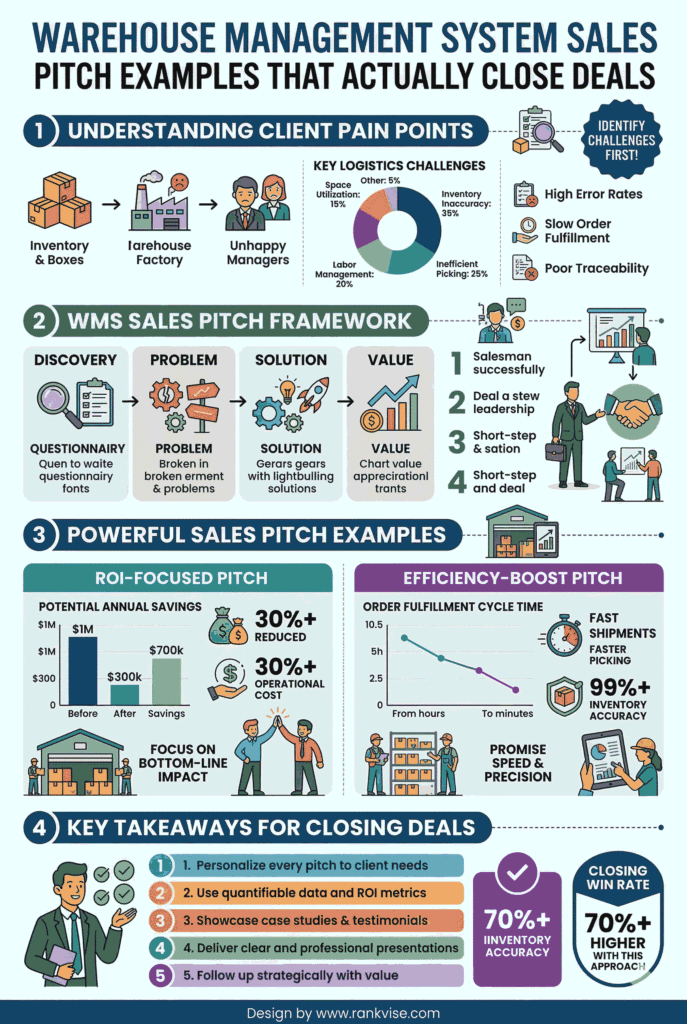
Many sales reps lead with features. They talk about barcode scanning, inventory tracking modules, and dashboard interfaces. The problem is that every WMS vendor offers those same features. Nothing stands out.
Warehouse managers and logistics directors care about results. They want to know how your system fixes their specific bottleneck. A pitch that opens with “our platform has 200 features” loses attention instantly. One that opens with “we helped a 3PL reduce picking errors by 34 percent in 90 days” earns a second meeting.
The best warehouse technology pitches focus on pain first and product second. Every example below follows that principle.
The Problem-First Pitch Framework
This framework works especially well for initial discovery calls and cold outreach. It flips the traditional pitch structure on its head.
How It Works
Start by naming a specific operational problem your prospect likely faces. Then connect it to a cost. Finally, introduce your WMS as the solution with proof.
Example Script
“Most warehouses your size lose between 15 and 25 hours per week on manual inventory counts. That is roughly 50,000 USD a year in labour costs alone. Our clients typically eliminate 80 percent of that manual counting within the first 60 days of going live. Would it be worth a 20-minute conversation to see if we could do the same for you?”
This approach works because it leads with empathy and a real number. It positions your software as a fix for a known pain point, not a shiny new tool.
The ROI-Led Sales Presentation
When you reach the demo or presentation stage, numbers become your best friend. Decision-makers in logistics and supply chain roles respond to hard data more than storytelling. A strong WMS sales presentation builds the entire narrative around return on investment.
Structure for This Pitch
- Slide 1 — State the prospect’s current challenge using data from your discovery call.
- Slide 2 — Show the financial cost of that challenge over 12 months.
- Slide 3 — Present your WMS solution with a focused feature walkthrough tied to that challenge.
- Slide 4 — Share a case study from a similar company with before-and-after metrics.
- Slide 5 — Display a projected ROI timeline specific to the prospect’s operation.
Why It Closes
This format makes the buying decision feel logical rather than emotional. When a warehouse director sees that your system paid for itself in seven months for a peer company, the risk feels manageable. Data-backed logistics software sales strategies consistently outperform feature-dump presentations.
The Day-in-the-Life Demo Script
Product demos often fail because they follow a generic walkthrough. The day-in-the-life approach customises the demo around the prospect’s actual daily workflow.
Example Script
“Let me walk you through what a typical Monday morning looks like for your receiving team after implementing our WMS. A shipment arrives at 7 AM. Instead of manually logging each pallet, your team scans inbound items using handheld devices. The system assigns put-away locations automatically based on velocity and slot availability. By 7:45, receiving is done. Your team used to finish by 10.”
This approach makes the software feel real and tangible. It answers the unspoken question every buyer has: “What will this actually look like in my warehouse?” Personalised WMS product demo scripts consistently outperform generic feature walkthroughs in conversion rates.
The Competitor Displacement Pitch
Many prospects already use a WMS. Your job is to show them why switching is worth the disruption. This pitch requires tact and specificity.
Example Script
“I know you are currently using [Competitor System]. A lot of our clients came from that platform. The most common frustration they mention is limited real-time visibility during peak season. Our system provides live dashboards that update every 15 seconds, which helped [Client Name] reduce fulfilment delays by 22 percent during their busiest quarter. Would it help to see a side-by-side comparison?”
This script works because it validates the prospect’s current choice while positioning your product as the next logical step. Avoid badmouthing competitors directly. Let results do the talking.
The Executive-Level Elevator Pitch
Sometimes you get two minutes with a VP of Operations or a CFO. You cannot waste a single sentence. This warehouse automation pitch is built for brevity and impact.
Example Script
“We help mid-size distribution centres cut fulfilment costs by 20 to 30 percent within six months. We do it by automating inventory tracking, optimising pick paths, and eliminating paper-based processes. Our last three implementations paid for themselves in under eight months. I would love 20 minutes to show you what that looks like for your operation.”
This pitch packs outcome, method, and proof into four sentences. It respects the executive’s time while opening the door for a deeper conversation.
Tailoring Your Pitch by Buyer Persona
Different stakeholders care about different things. A one-size-fits-all pitch will underperform. Here is how to adjust your messaging based on who you are speaking with.
| Buyer Persona | Primary Concern | Lead Your Pitch With |
|---|---|---|
| Warehouse Manager | Daily efficiency and team productivity | Labour savings and process automation |
| IT Director | Integration, security, and uptime | API capabilities and cloud architecture |
| CFO / Finance Lead | Total cost of ownership and ROI | Payback period and cost reduction data |
| VP of Operations | Scalability and strategic alignment | Growth support and multi-site capability |
| 3PL Account Manager | Client SLA compliance | Real-time tracking and reporting accuracy |
Adapting your supply chain solution selling approach to each persona dramatically increases your close rate. Prepare at least two versions of your pitch before any meeting.
Common Mistakes That Kill WMS Sales Pitches
Even experienced reps make errors that stall deals. Avoid these pitfalls to keep your pipeline moving.
- Leading with features instead of outcomes — Buyers do not care about your tech stack until they trust your results.
- Skipping discovery — A pitch without tailored insights feels generic and forgettable.
- Overloading the demo — Showing every module overwhelms the prospect. Focus on three to four features that solve their top pain points.
- Ignoring implementation concerns — Buyers fear downtime and disruption. Address your onboarding process early and clearly.
- Forgetting the follow-up — A great pitch without a structured next step is a wasted opportunity. Always end with a clear call to action.
How to Build a WMS Pitch Deck That Stands Out
Your pitch deck should be visual, data-rich, and tailored. Avoid walls of text. Use real client metrics wherever possible.
Start with the problem. Show two to three slides that quantify the prospect’s current inefficiencies. Move into your solution with targeted feature highlights. Close with a case study and a clear ROI projection. Keep the entire deck under 12 slides.
Include one slide dedicated to implementation. Show a realistic timeline with milestones. This reassures buyers that going live will not disrupt their operation. Strong warehouse technology pitch decks always address risk alongside reward.
What Top WMS Sales Teams Do Differently
The highest-performing WMS sales teams share a few common habits. They research the prospect’s operation before the first call. They customise every demo. They bring customer references from the same industry vertical.
They also invest in post-demo follow-up content. Sending a personalised ROI summary within 24 hours keeps momentum alive. The best how to sell warehouse software strategies treat every touchpoint as a chance to reinforce value.
FAQs
A strong WMS pitch includes a clear problem statement, measurable ROI data, a tailored demo, a relevant case study, and a specific call to action for the next step.
Keep demos between 30 and 45 minutes. Focus on three to four features that directly solve the prospect’s stated challenges rather than showing every module.
Quantify the cost of manual errors and wasted labour hours. Show a side-by-side comparison of their current process versus an automated WMS workflow with real time savings.
Acknowledge the concern, share a relevant client example that faced the same objection, and offer a pilot or phased rollout to reduce perceived risk.
Lead with total cost of ownership and payback period. Present a 12-month ROI projection using data from a comparable client to make the financial case undeniable.