Visual effects techniques are the methods used to create, enhance, or manipulate imagery that would be difficult, dangerous, expensive, or impossible to capture in-camera. In film, TV, advertising, animation, and gaming, VFX helps creators build believable worlds, add spectacle, and solve practical production problems.
- Key VFX techniques include compositing, keying, rotoscoping, motion tracking, matchmoving, CGI, matte painting, simulation, particle effects, and digital cleanup.
- Industry tools span After Effects, Nuke, Blender, Maya, Houdini, Cinema 4D, DaVinci Resolve Fusion, PFTrack, SynthEyes, and Mocha Pro.
- Professional shots combine multiple techniques and require precise lighting, perspective, motion blur, and color matching so effects feel natural and support the story.
At a basic level, visual effects techniques fall into a few major categories: compositing, CGI, simulation, motion tracking, matte painting, keying, rotoscoping, and digital cleanup. Each technique serves a different purpose, and most professional projects combine several of them in the same shot.
Types of visual effects techniques
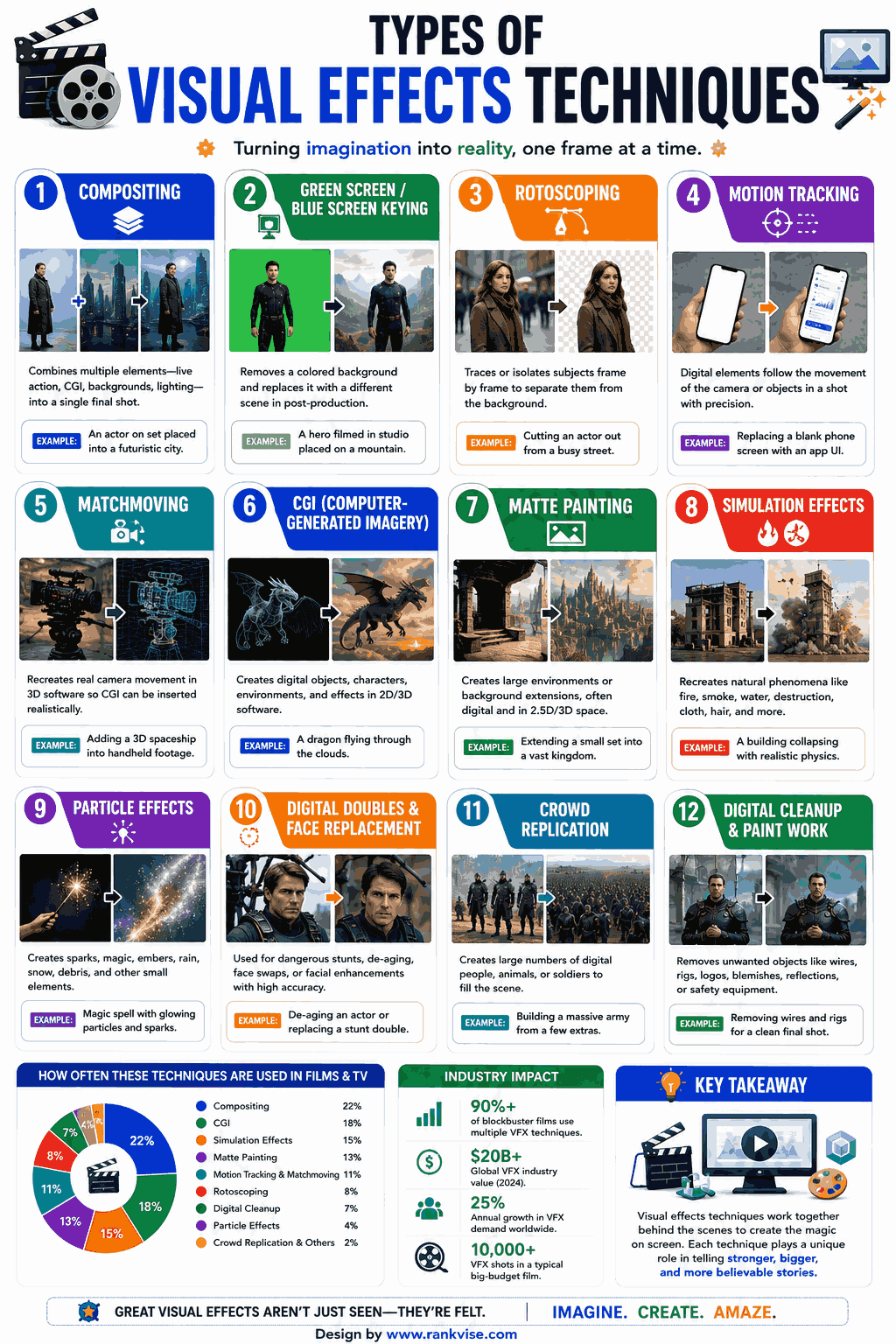
Compositing is one of the most common visual effects techniques. It involves combining multiple visual elements, such as live-action footage, CGI, backgrounds, smoke, fire, or lighting effects, into a single final shot. For example, an actor filmed on set can be composited into a futuristic city created separately.
Green screen and blue screen keying are used to remove a colored background and replace it with another scene. This technique is common in superhero films, weather broadcasts, and fantasy productions. A simple example is filming a character in a studio and placing them on a mountain, spaceship, or battlefield in post-production.
Rotoscoping is the process of tracing or isolating subjects frame by frame so they can be separated from the background or selectively adjusted. It is often used when clean green screen footage is unavailable. For example, if an actor needs to be cut out from a busy street background, roto work makes that possible.
Motion tracking allows digital elements to follow the movement of the camera or objects in a shot. If a screen replacement, 3D object, or floating graphic needs to stay locked to a moving surface, tracking is essential. A common example is replacing a blank phone screen with an animated app interface.
Matchmoving, sometimes grouped with tracking, recreates the real camera’s movement in 3D software so CGI can be inserted realistically. This is critical when adding digital creatures, vehicles, or buildings into handheld or moving footage.
CGI, or computer-generated imagery, refers to creating digital objects, characters, environments, and effects in 2D or 3D software. Entire creatures, explosions, cities, and sci-fi worlds are often built with CGI. For example, a dragon flying through clouds is usually a combination of modeling, rigging, animation, lighting, and compositing.
Matte painting is used to create large environments or background extensions. Modern matte painting is often digital and can be projected in 2.5D or 3D space for camera movement. A small set can be extended into a vast kingdom, alien planet, or ruined city.
Simulation effects recreate natural phenomena such as fire, smoke, water, dust, destruction, cloth, hair, and explosions. These are typically created using physics-based systems in 3D software. A collapsing building or crashing wave is a classic simulation-heavy shot.
Particle effects are used for sparks, magic, embers, rain, snow, debris, and similar elements. These effects add realism and energy to action scenes, fantasy sequences, and title animations.
Digital doubles and face replacement are advanced visual effects techniques used when stunts are too risky or when de-aging, face swaps, or facial enhancements are needed. These techniques require highly accurate tracking, modeling, and compositing.
Crowd replication creates large numbers of digital people, animals, or soldiers. Instead of hiring thousands of extras, studios generate crowd agents and blend them into the scene.
Digital cleanup and paint work remove unwanted objects such as wires, rigs, microphones, logos, blemishes, reflections, or safety equipment. This may be invisible to viewers, but it is one of the most used techniques in modern production.
Common tools used for visual effects techniques
Different tools are used at different stages of the VFX pipeline.
Adobe After Effects is widely used for motion graphics, compositing, keying, tracking, cleanup, and basic VFX work. It is popular for commercials, YouTube content, title design, and lighter VFX shots.
Nuke is an industry-standard node-based compositing tool used in high-end film and TV. It is especially strong for advanced compositing, deep compositing, multi-pass workflows, and large production pipelines.
Blender is a powerful all-in-one 3D package used for modeling, animation, simulation, compositing, and rendering. It is popular with freelancers, indie creators, and increasingly with professionals because it is capable and accessible.
Autodesk Maya is commonly used for 3D animation, rigging, character work, and complex production pipelines. It is a major tool in film and game VFX.
Houdini is one of the most respected tools for procedural workflows and simulations. It is often the go-to choice for explosions, destruction, smoke, water, debris, and large-scale environments.
Cinema 4D is often used for motion design, broadcast graphics, and stylized 3D effects. It integrates well into design-heavy workflows.
DaVinci Resolve Fusion combines compositing and finishing tools and is useful for artists who want editing, color, and VFX in one environment.
PFTrack, SynthEyes, and similar tools are used for camera tracking and matchmoving.
Mocha Pro is widely used for planar tracking, roto, masking, object removal, and screen replacement.
Real-world examples of visual effects techniques
In a superhero flight shot, several visual effects techniques may work together. The actor might be filmed on wires against green screen, the wires are removed with paint work, the sky and city are added with matte painting and CGI, the camera is matchmoved, the costume is enhanced digitally, and motion blur and atmospheric effects are composited into the final shot.
In a historical drama, digital cleanup may remove modern buildings, roads, signs, and antennas from the background. Matte painting can extend practical sets, while crowd replication adds a believable city population.
In a sci-fi cockpit scene, actors may be filmed in a partial physical set. Outside the windows, artists add space, planets, enemy ships, laser blasts, and reflections. Screen graphics are tracked onto monitors, and lighting effects are composited to match the action.
In product commercials, visual effects techniques are used to create polished liquids, floating particles, impossible camera moves, and glossy pack shots. Even when the result looks simple, the shot may involve CGI, reflections, compositing, and cleanup.
Why visual effects techniques matter?
Visual effects are not only for big explosions and fantasy creatures. They are also used to solve production problems, improve realism, save money, and expand creative possibilities. Many of the best VFX shots are invisible because they quietly support the story without drawing attention to themselves.
Strong visual effects work depends on both artistic taste and technical precision. Good VFX must match lighting, perspective, lens distortion, grain, motion blur, shadows, and color so the final image feels natural and believable.
Simple explanation
If you want the simplest definition, visual effects techniques are the tricks and processes used after filming to change what appears on screen. Some techniques add things, like monsters or explosions. Others remove things, like wires, green screens, or unwanted objects.
Summary
Visual effects techniques include compositing, keying, rotoscoping, motion tracking, CGI, simulation, matte painting, crowd work, and digital cleanup. The most common tools include After Effects, Nuke, Blender, Maya, Houdini, Fusion, and Mocha Pro. In real production, multiple techniques are usually combined to create a single final shot.