Skip to content
Encryption protects everything from military communications to your online banking session. But not all encryption is created equal. When the National Security Agency designs a set of cryptographic algorithms, the entire security industry pays attention.
- Suite B standardized four public algorithms (AES, ECDSA, ECDH, SHA-2) to provide encryption, signatures, key exchange, and integrity across government and industry.
- Quantum threats prompted NSA to retire Suite B and introduce CNSA 2.0 with lattice and hash-based, quantum-resistant algorithms like Kyber and Dilithium.
- Organizations must inventory Suite B usage, adopt CNSA 2.0 vendor roadmaps, consider hybrid post-quantum configurations, and update key management practices.
NSA Suite B encryption defined the gold standard for protecting classified and unclassified information for over a decade. It shaped how governments, defense contractors, and regulated industries secured their most sensitive data. Although the NSA officially retired Suite B in favor of newer standards, its influence remains deeply embedded in systems worldwide.
This guide explains what NSA Suite B encryption is, how each algorithm works, why the NSA replaced it, and what organizations running legacy systems or planning future migrations need to know right now.
What Is NSA Suite B Encryption and Why Does It Matter?
NSA Suite B encryption is a collection of four cryptographic algorithms that the National Security Agency approved in 2005 for securing national security systems. The NSA designed it to standardize how government agencies and their partners encrypted data, verified identities, exchanged keys, and confirmed data integrity.
Before Suite B, government agencies used a patchwork of classified, proprietary algorithms. This created interoperability problems. Two agencies using different encryption methods could not easily share protected information. Suite B solved that problem by publishing a clear, unified set of publicly known algorithms that worked across systems.
The “B” designation distinguishes it from Suite A, which contains classified algorithms reserved for the most sensitive intelligence operations. Suite B algorithms are publicly documented, widely implemented, and available for use by both government and commercial organizations. That openness maSuite B one of the most widely adopted government encryption frameworks in history.
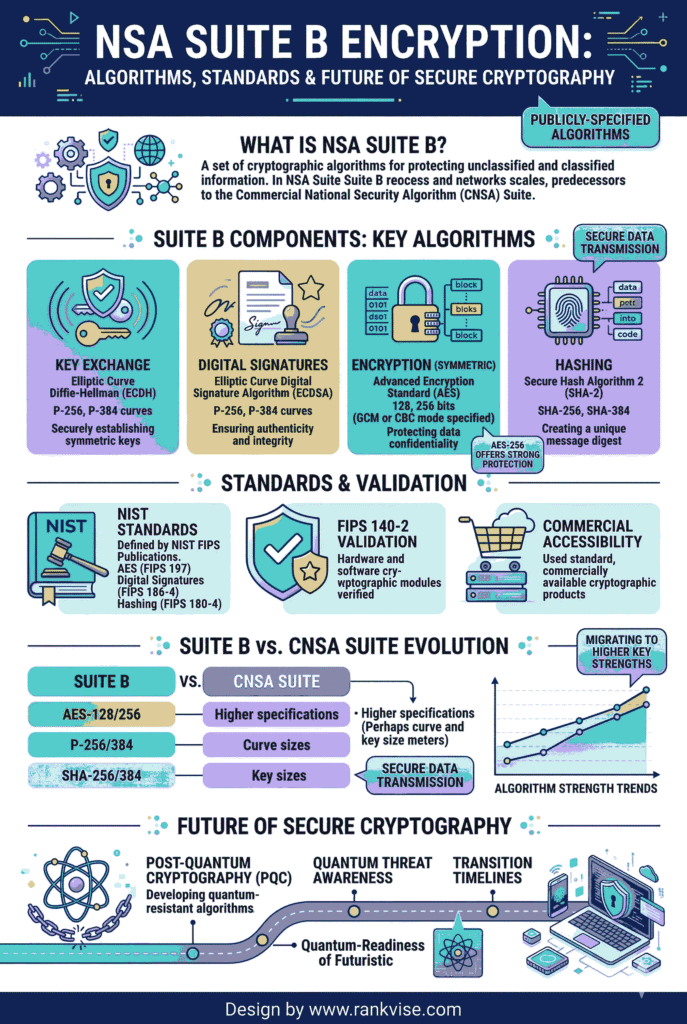
The Four Core Algorithms Inside NSA Suite B
Each algorithm in Suite B serves a distinct security function. Together, they cover the four pillars of modern cryptography: confidentiality, authentication, key exchange, and data integrity. Here is what each one does and why the NSA selected it.
AES: The Encryption Engine
The Advanced Encryption Standard handles the actual encryption and decryption of data. AES is a symmetric algorithm, meaning the same key locks and unlocks the information. Suite B specifies 128-bit keys for Secret-level data and 256-bit keys for Top Secret-level data.
AES earned its position because of speed, efficiency, and proven resistance to attack. It remains the most widely used symmetric cipher in the world. Every major operating system, browser, and VPN product implements AES. Its selection for Suite B reinforced its status as the default choice for serious encryption.
ECDSA: The Digital Signature
The Elliptic Curve Digital Signature Algorithm verifies that a message or document genuinely came from its claimed sender. It also confirms that nobody altered the content during transmission. ECDSA uses 256-bit curves for Secret-level operations and 384-bit curves for Top Secret.
Elliptic curve cryptography delivers the same security strength as older methods like RSA but with much smaller key sizes. A 256-bit elliptic curve key provides roughly the same protection as a 3,072-bit RSA key. Smaller keys mean faster processing, lower bandwidth consumption, and better performance on devices with limited computing power.
ECDH: The Key Exchange Protocol
Elliptic Curve Diffie-Hellman allows two parties to establish a shared secret key over an insecure channel. Neither party needs to send the actual key. Instead, they exchange mathematical values that only become useful when combined with each party’s private information.
This matters because encryption is only as strong as the key exchange process. If an attacker intercepts the key during transmission, the encryption itself becomes worthless. ECDH ensures that even someone monitoring every message between two parties cannot reconstruct the shared key.
SHA-2: The Integrity Verifier
The Secure Hash Algorithm 2 family produces a fixed-length digital fingerprint of any data. Suite B specifies SHA-256 for Secret-level use and SHA-384 for Top Secret. If even a single bit of the original data changes, the hash output changes completely.
Organizations use SHA-2 to verify file integrity, authenticate software updates, and confirm that transmitted data arrived without tampering. It acts as the final quality check in the encryption process, ensuring nothing was corrupted or manipulated between sender and receiver.
NSA Suite B Algorithms at a Glance
| Algorithm | Function | Secret Level | Top Secret Level |
|---|---|---|---|
| AES | Data encryption (symmetric) | 128-bit keys | 256-bit keys |
| ECDSA | Digital signatures (authentication) | 256-bit curves | 384-bit curves |
| ECDH | Key exchange (secure key agreement) | 256-bit curves | 384-bit curves |
| SHA-2 | Hashing (data integrity verification) | SHA-256 | SHA-384 |
How NSA Encryption Types Are Classified
The NSA organizes its entire cryptographic product line into categories based on security level and intended use. Understanding this hierarchy clarifies where Suite B fits within the broader landscape.
Type 1 products use classified algorithms certified by the NSA for protecting classified national security information. These devices operate under the strictest controls and undergo rigorous evaluation before deployment.
Type 2 products protect sensitive but unclassified information. They offer strong security with fewer procedural requirements than Type 1. Type 3 products also handle sensitive but unclassified data, using NIST-approved algorithms under Federal Information Processing Standards. Type 4 products are commercial offerings that have not been formally evaluated by the NSA.
Suite B algorithms fall primarily into the Type 1 and Type 3 categories, depending on key length and implementation. This dual applicability made Suite B uniquely versatile. A single set of algorithms could protect both classified military communications and routine government administrative data.
Why the NSA Retired Suite B and Introduced CNSA
In 2015, the NSA surprised the cryptographic community by announcing plans to transition away from Suite B. By 2018, the Commercial National Security Algorithm Suite had officially replaced it. The reason was quantum computing.
Traditional computers process information in bits that are either zero or one. Quantum computers use qubits that can represent both states simultaneously. This capability makes quantum machines exceptionally powerful at solving certain mathematical problems, including the exact problems that elliptic curve cryptography relies on for security.
A sufficiently powerful quantum computer could break ECDSA and ECDH in hours rather than the billions of years a classical computer would require. While such machines do not exist yet at that scale, the NSA operates on long planning horizons. Classified information encrypted today may still need protection decades from now. Waiting until quantum computers arrive would be too late.
The CNSA suite addresses this threat in two phases. CNSA 1.0 largely mirrors Suite B but increases minimum key sizes. CNSA 2.0 introduces entirely new quantum-resistant algorithms designed to withstand attacks from both classical and quantum computers.
CNSA 2.0: The Quantum-Resistant Replacement
CNSA 2.0 represents the most significant shift in government cryptographic standards in two decades. It replaces the elliptic curve algorithms in Suite B with lattice-based and hash-based alternatives that resist quantum attacks.
The key new algorithms include ML-KEM (based on CRYSTALS-Kyber) for key exchange and ML-DSA (based on CRYSTALS-Dilithium) for digital signatures. Both are lattice-based, meaning their security depends on mathematical problems that quantum computers cannot efficiently solve. For firmware and software signing, CNSA 2.0 specifies LMS and XMSS, which are hash-based signature schemes.
AES-256 and SHA-384 or SHA-512 remain in the suite because symmetric algorithms and hash functions are far more resistant to quantum attacks than public-key methods. Doubling the key length of AES from 128 to 256 bits provides sufficient quantum resistance for the foreseeable future.
CNSA 2.0 Compliance Deadlines
| Milestone | Deadline |
|---|---|
| New equipment purchases must be CNSA 2.0 compliant | January 1, 2027 |
| Non-compliant equipment must be phased out | December 31, 2030 |
| Full CNSA 2.0 implementation mandatory | December 31, 2031 |
These deadlines apply to National Security Systems. However, organizations in defense contracting, financial services, and healthcare should treat them as strong signals for their own planning timelines.
Who Still Needs to Understand Suite B in 2026?
Suite B may be officially retired, but it remains operationally relevant for several groups.
Organizations running legacy government systems still encounter Suite B configurations in deployed infrastructure. Military platforms, embassy communications systems, and long-lifecycle defense equipment often use Suite B algorithms that will remain in service for years. Teams maintaining these systems need to understand Suite B to manage them correctly while planning migrations to CNSA 2.0.
Defense contractors and government vendors must often demonstrate familiarity with both Suite B and CNSA standards during contract evaluations. Compliance documentation frequently references Suite B specifications, even when the target architecture uses newer algorithms.
Regulated industries including healthcare, finance, and critical infrastructure adopted Suite B practices because they aligned with FIPS 140-2 certification requirements. Many of these implementations remain active. Understanding Suite B helps security teams audit existing configurations and identify components that need upgrading.
Cybersecurity professionals and students benefit from studying Suite B because it represents a clean, well-documented example of how to design a comprehensive cryptographic framework. The principles behind Suite B, such as algorithm selection, key management, and security level classification, apply directly to implementing any modern encryption standard.
Practical Steps for Migrating From Suite B to CNSA 2.0
Transitioning away from Suite B requires a structured approach. Organizations that start planning now will avoid compliance gaps and security vulnerabilities as deadlines approach.
First, inventory every system and application that currently uses Suite B algorithms. Identify which components rely on ECDSA, ECDH, AES-128, or SHA-256 at the Secret level. These are the elements that need upgrading.
Second, evaluate vendor roadmaps for CNSA 2.0 support. Major platform providers including Microsoft, Cisco, and Palo Alto Networks have published timelines for integrating post-quantum cryptography into their products. Align your migration schedule with their availability dates.
Third, consider hybrid cryptographic configurations during the transition period. Hybrid approaches run a classical algorithm alongside a quantum-resistant algorithm simultaneously. If either one is broken, the other still provides protection. This strategy reduces risk during the years when post-quantum algorithms are still maturing.
Fourth, update key management practices. Quantum-resistant algorithms use significantly larger key sizes than their elliptic curve predecessors. Storage, transmission, and rotation procedures all need adjustment to accommodate this change.
Finally, use only FIPS 140-2 or FIPS 140-3 validated cryptographic modules. Validation confirms that the implementation correctly follows the algorithm specification and meets minimum security requirements. Unvalidated implementations may contain subtle flaws that undermine the entire encryption process.
FAQs
NSA Suite B encryption protects both classified and unclassified government data using four standardized algorithms for encryption, digital signatures, key exchange, and hashing.
Suite B was officially replaced by the CNSA suite in 2018. It remains in use on legacy systems, but all new deployments should follow CNSA 2.0 standards.
Suite A uses classified, unpublished algorithms for the most sensitive intelligence operations. Suite B uses publicly known algorithms available to both government and commercial organizations.
Quantum computers threaten to break the elliptic curve algorithms in Suite B. CNSA 2.0 introduces quantum-resistant replacements like ML-KEM and ML-DSA to ensure long-term security.
Official specifications are available through NIST publications, IETF RFC 6460, and NSA guidance documents hosted on government websites like nsa.gov and nist.gov.