Skip to content
Someone you have never met can type your name into a search bar right now. Within seconds, they can see your home address, phone number, family members, and past locations. That is the reality of cyber background checks.
- Data brokers aggregate public records and commercial data into searchable profiles, monetizing personal information for easy access.
- These profiles enable identity theft, targeted scams, stalking, and employment or housing discrimination.
- Brokers collect data legally from court files, voter rolls, property records, marketing databases, purchase histories, and social media.
- Manual opt-outs work but are time-consuming; each broker requires a separate removal and ongoing checks to prevent re-listing.
- Use privacy habits, credit freezes, state and federal rights, or paid removal services for continuous digital footprint protection.
These people-search platforms aggregate public records and commercial data into detailed personal profiles. The profiles are free or cheap to access. Anyone with an internet connection can pull one up. For millions of people, this creates privacy risks they never agreed to.
This guide explains exactly how cyber background checks work, what they expose, and the concrete steps you can take to remove your information and protect your digital footprint.
What Are Cyber Background Checks and How Do They Work?
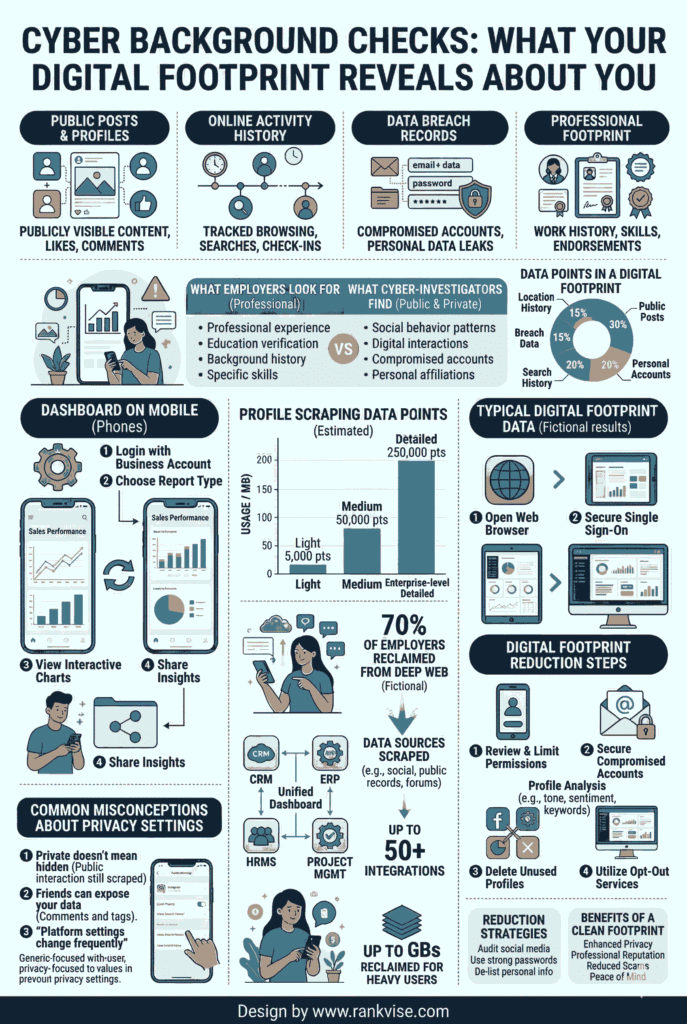
Cyber background checks refer to online services that compile personal information from public and commercial sources into searchable databases. Websites like CyberBackgroundChecks.com, Spokeo, BeenVerified, and Whitepages are the most common examples.
These platforms are not government agencies. They are data brokers, which are private companies that profit from collecting and selling personal information. Their business model depends on making your data easy to find.
The information they display typically comes from court records, voter registration files, property records, social media profiles, marketing databases, and commercial purchase histories. Individually, each data point seems harmless. Combined into a single profile, they paint a disturbingly complete picture of your life.
What Information Do People Search Websites Expose?
The depth of data available through cyber background checks surprises most people when they search for themselves. A single profile can contain far more than a name and address.
Here is what a typical people-search result may include:
- Full name, aliases, and maiden names
- Current and past home addresses going back decades
- Mobile, landline, and work phone numbers
- Email addresses tied to your name
- Names and contact details of family members and known associates
- Property ownership records and estimated home values
- Court records including civil judgments and, in some states, criminal history
- Social media profiles linked to your identity
- Age, date of birth, and educational background
Some premium services go further. They cross-reference financial data, professional licenses, and bankruptcy filings. The result is a personal dossier that costs a stranger less than 20 USD to access.
Why Cyber Background Checks Create Real Privacy Risks
The convenience of these platforms creates genuine dangers for the people listed in them. These are not theoretical risks. They affect real people every day.
Identity Theft and Financial Fraud
A 2024 report from the Federal Trade Commission recorded over 1.1 million identity theft complaints in a single year. Data brokers make the job easier for criminals by centralizing the exact personal details needed to open fraudulent accounts, file fake tax returns, or take over existing financial services.
Stalking and Harassment
Domestic violence survivors, harassment victims, and public-facing professionals face heightened danger when their addresses appear in people-search databases. A single query can undo years of careful privacy measures. Advocacy organizations have documented cases where abusers used these platforms to locate victims who had relocated for safety.
Employment and Social Discrimination
Employers, landlords, and even romantic interests routinely run informal online background checks. Outdated court records, mistaken identity matches, or misleading data can cost someone a job, a lease, or a relationship without their knowledge.
Targeted Scam Campaigns
Scammers use data broker information to craft highly personalized phishing messages. When a fraudulent email references your real address, family member names, or recent purchases, it becomes far more convincing. Personal data privacy erosion feeds directly into social engineering attacks.
How Data Brokers Collect Your Personal Information
Understanding where these platforms get your data is the first step toward controlling it. Data brokers do not hack into systems. They exploit entirely legal channels.
Public records form the foundation. Government agencies make court filings, property transactions, voter rolls, and business registrations accessible to the public. Data brokers scrape these records at scale using automated tools.
Commercial data supplements the public record layer. Loyalty programs, warranty registrations, online purchase histories, and app permissions all feed information into marketing databases. These databases are bought, sold, and traded between hundreds of companies.
Social media profiles add another dimension. Even when your accounts are set to private, data brokers can capture publicly visible information like your profile photo, employer, location, and connections.
The result is a self-reinforcing cycle. The more data sources a broker accesses, the more complete your profile becomes, and the more valuable it is to paying customers.
How to Remove Your Data From Cyber Background Check Sites
Opting out is possible, but it requires patience and a systematic approach. Each data broker has its own removal process. Here is a step-by-step method that applies broadly.
Step 1: Search for Yourself
Start by searching your full name on major people-search websites. Check CyberBackgroundChecks.com, Spokeo, Whitepages, BeenVerified, Intelius, and MyLife. Note which sites display your information.
Step 2: Locate the Opt-Out Page
Most data brokers bury their removal options in the footer or privacy policy page. On CyberBackgroundChecks.com, scroll to the bottom of the homepage and click “Do Not Sell My Information,” then navigate to the Record Removal Request form.
Step 3: Submit Your Removal Request
Fill in the required fields, which typically include your name, email address, and sometimes your date of birth or location. Complete any CAPTCHA verification. Use a secondary email address to avoid spam.
Step 4: Confirm via Email
Check your inbox for a verification email. Click the confirmation link to finalize the request. Without this step, most brokers will not process the removal.
Step 5: Verify Removal After Processing
Removal timelines range from 48 hours to several weeks. Search for your name again after two weeks to confirm your profile no longer appears.
Step 6: Repeat Across All Brokers
This is the tedious part. Each site requires a separate opt-out submission. With over 100 active data broker sites operating in the United States alone, manual removal across all of them takes significant time.
Comparing Major People Search Websites
Not all data brokers operate the same way. Some make removal straightforward. Others make it deliberately difficult. Here is how the most common platforms compare.
| Platform | Data Depth | Opt-Out Difficulty | Removal Timeframe | Re-listing Risk |
|---|---|---|---|---|
| CyberBackgroundChecks | High | Moderate | 1–3 weeks | High |
| Spokeo | High | Easy | 48–72 hours | Medium |
| Whitepages | High | Moderate | 1–2 weeks | High |
| BeenVerified | Very High | Moderate | 1–2 weeks | High |
| Intelius | High | Difficult | 2–4 weeks | Very High |
| MyLife | Very High | Difficult | 2–4 weeks | Very High |
| TruePeopleSearch | Medium | Easy | 48 hours | Medium |
The re-listing risk column matters most. Even after successful removal, your data can reappear when brokers refresh their databases from updated public records. This makes one-time removal insufficient for long-term protection.
Automated Data Removal Services: Are They Worth It?
Manual opt-out works, but the scale of the problem makes it unsustainable for most people. Automated removal services exist specifically to handle this ongoing burden.
Services like Optery, DeleteMe, and Privacy Duck scan dozens or hundreds of data broker sites for your information. They submit removal requests on your behalf and monitor for re-listings on a recurring basis.
Pricing typically ranges from 100 to 250 USD per year for individual plans. Family plans cost more but cover multiple household members. The value depends on your personal risk level.
For professionals in public-facing roles, executives handling sensitive business information, or anyone who has experienced stalking or harassment, the investment often pays for itself in peace of mind and time savings. For the average person with moderate privacy concerns, manual removal of the largest five or six brokers may be sufficient.
Your Legal Rights Under State and Federal Privacy Laws
The legal landscape for personal data privacy has shifted significantly in recent years. Several laws now give you explicit rights over your information held by data brokers.
The California Consumer Privacy Act grants residents the right to know what personal data a company holds, request deletion, and opt out of data sales. The California Delete Act, signed in 2023, goes further by creating a single portal where residents can request removal from all registered data brokers at once.
Virginia, Colorado, Connecticut, and Texas have enacted similar consumer privacy laws. Each provides some form of data access, deletion, and opt-out rights, though enforcement varies.
At the federal level, the Fair Credit Reporting Act governs background checks used for employment, housing, or credit decisions. If a data broker’s report is used for these purposes, it must comply with accuracy and dispute resolution requirements. Informal people-search lookups, however, often fall outside FCRA protections.
Knowing your state-specific rights strengthens your opt-out requests. When you cite applicable law in your removal submission, brokers tend to process requests faster.
Proactive Steps to Protect Your Digital Footprint Long Term
Removing existing listings is reactive. Building habits that limit future exposure is where lasting digital footprint protection happens.
- Use a P.O. box or virtual mailbox for public-facing registrations instead of your home address
- Set all social media accounts to private and audit connected apps quarterly
- Opt out of marketing databases and loyalty programs that share data with third parties
- Use unique email addresses for different purposes, separating personal, financial, and commercial accounts
- Freeze your credit with all three bureaus to block unauthorized financial account openings
- Search for your own name every 90 days to catch new data broker listings early
- Register with the National Do Not Call Registry and Direct Marketing Association opt-out to reduce data collection at the source
Each of these steps reduces the raw material that data brokers rely on. Over time, your digital footprint shrinks, and new profiles become harder for brokers to build.
The Bigger Picture: Public Records vs. Personal Privacy
Cyber background checks sit at the intersection of two competing values. Public records exist for transparency. Property transactions, court filings, and voter rolls serve legitimate democratic functions. But when private companies aggregate that data for profit, the balance tips away from individual privacy.
This tension will not resolve quickly. Legislative efforts are moving toward stronger consumer protections, but the data broker industry generates billions in revenue annually and lobbies aggressively to preserve its business model.
In the meantime, the responsibility falls on individuals to understand their exposure and take deliberate action. The tools and legal rights exist. Using them consistently is what separates people who control their digital identity from those who do not.
FAQs
They display addresses, phone numbers, emails, family connections, property records, and sometimes court or criminal history, all compiled from public and commercial data sources.
Yes, it operates legally by aggregating publicly available records. However, the compilation of personal data in one place raises serious privacy concerns for the individuals listed.
Removal timelines range from 48 hours to four weeks depending on the platform. Most sites require email verification before processing your opt-out request.
Yes. Data brokers refresh their databases from updated public records. Your information can reappear within months, making regular monitoring or automated removal services important.
Automated services like Optery or DeleteMe scan and remove your data across dozens of brokers simultaneously. California residents can also use the state’s Data Broker Registry portal for centralized requests.