Skip to content
Most businesses lose clients quietly. There is no dramatic exit, no angry email, no formal complaint. The client simply drifts away because nobody made them feel like a priority.
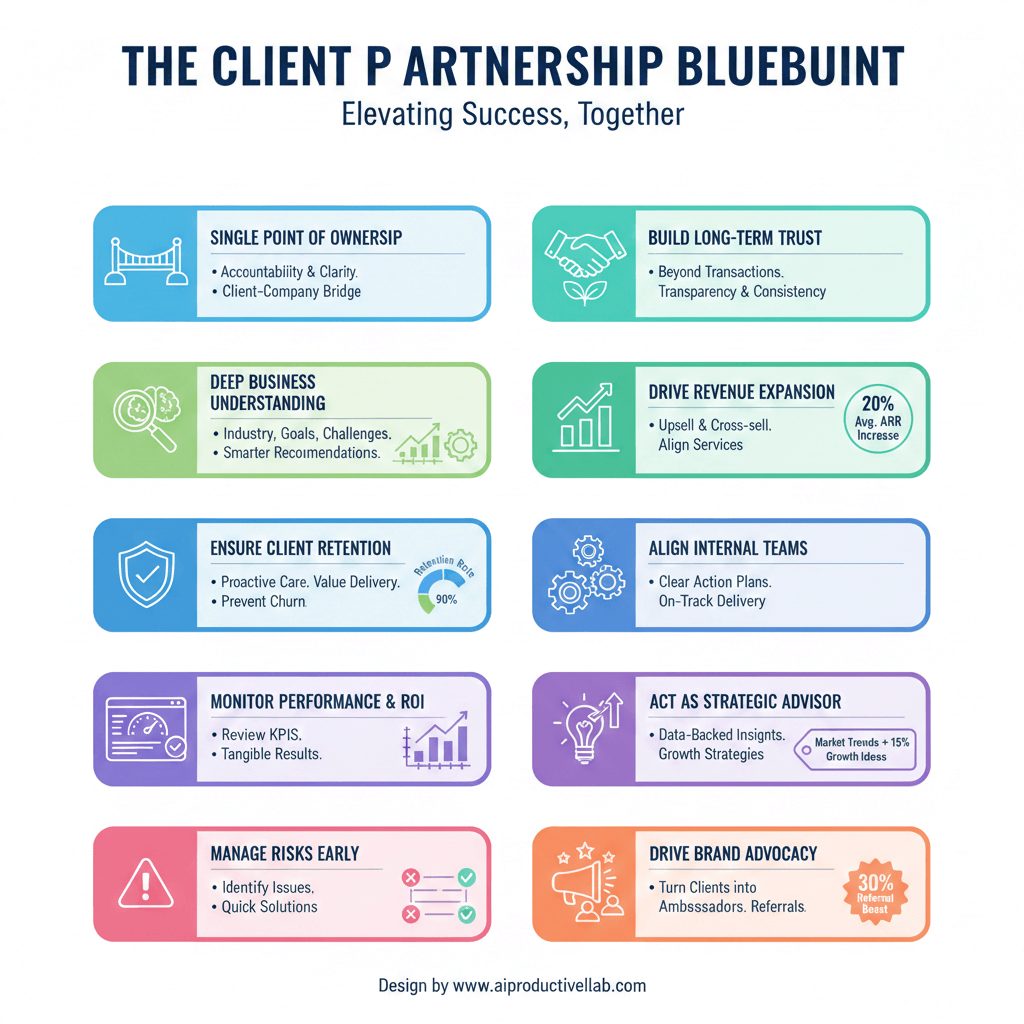
- Owns strategic client relationships, aligning company capabilities with clients' long-term goals to prevent silent churn and drive retention.
- Drives revenue through trust-based growth, prioritizing retention, deeper engagement, and mutually beneficial expansion over transactional selling.
- Requires emotional intelligence, strategic thinking, cross-functional advocacy, and proactive problem detection to manage outcomes, not tasks.
- Measures success by retention, NPS, account growth, and referrals, supported by CRM, analytics, and human judgment enhanced by AI.
That slow erosion is exactly what a client relationship partner exists to prevent. This role goes far beyond answering emails and scheduling quarterly check-ins. It is a strategic function that connects a company’s capabilities directly to its most valuable accounts.
According to Bain & Company, increasing customer retention by just 5% can boost profits by 25% to 95%. Yet many organizations still treat relationship management as an afterthought. They assign it to overstretched account managers or assume good service alone will keep clients loyal.
It will not. Not anymore. Here is everything you need to know about the client relationship partner role, why it matters, and how to get it right.
What Does a Client Relationship Partner Actually Do?
A client relationship partner serves as the primary strategic contact between a business and its most important clients. Think of them as the bridge between what a client needs and what your organization can deliver.
Unlike a traditional account manager who handles day-to-day transactions, this role operates at a higher level. They understand the client’s long-term business goals, anticipate challenges before they surface, and identify opportunities for mutual growth.
In professional services firms like consulting, law, and accounting, the role often carries formal authority. Partners at firms like Deloitte and PwC use this title to describe senior leaders responsible for major client portfolios. In SaaS, technology, and B2B services, the role increasingly appears under titles like key account partner or strategic relationship manager.
Regardless of the title, the core function remains the same. This person owns the health of the relationship, not just the status of the project.
Why This Role Is a Revenue Driver, Not a Cost Center
Many leaders view client relationship management as a soft skill. Something nice to have, but hard to measure. The data tells a different story.
Harvard Business Review reports that acquiring a new customer costs five to twenty-five times more than retaining an existing one. Existing customers also spend 67% more on average than new buyers, according to research by BIA Advisory Services. And Gartner’s 2024 analysis found that 80% of a company’s future revenue will come from just 20% of its current clients.
A dedicated client relationship partner protects and grows that 20%. They do this not through aggressive upselling, but through trust. When a client genuinely trusts their partner, they share more about their challenges, accept strategic recommendations, and stay loyal even when a competitor offers a lower price.
This is what relationship-driven growth looks like in practice. It is measurable, repeatable, and far more sustainable than constantly chasing new logos.
Client Relationship Partner vs. Account Manager
These two roles are often confused, but they operate with fundamentally different mindsets.
| Dimension | Account Manager | Client Relationship Partner |
|---|---|---|
| Focus | Daily operations and task execution | Long-term strategy and business alignment |
| Approach | Reactive, responds to issues as they arise | Proactive, anticipates needs and prevents problems |
| Scope | Single account or project deliverables | Portfolio of key accounts across departments |
| Authority | Limited to operational decisions | Empowered to negotiate, allocate resources, and shape strategy |
| Success metric | Task completion and issue resolution | Client retention, account growth, and lifetime value |
| Client perception | Service provider | Trusted advisor and strategic partner |
Here is a practical example. An account manager at a marketing agency receives a brief and executes the campaign. A client relationship partner at that same agency notices the client’s market share declining, researches the competitive landscape, and proactively presents a revised strategic approach before the client even asks.
One manages work. The other manages outcomes.
The Essential Skills Behind Effective Client Relationship Management
Technical knowledge alone does not make someone effective in this role. The most successful client relationship partners combine analytical thinking with deeply human capabilities.
Emotional intelligence sits at the top of the list. According to TalentSmart research, emotional intelligence accounts for 58% of job performance across all professional roles. For relationship-focused positions, that percentage is even higher. The ability to read a client’s frustration, sense an unspoken concern, or navigate a politically sensitive situation separates great partners from average ones.
Strategic thinking is equally important. A strong partner does not just respond to what the client says today. They connect patterns, anticipate market shifts, and position their organization as a forward-thinking ally. This means understanding the client’s industry deeply enough to offer insights they have not considered.
Other critical skills include active listening, clear and honest communication, cross-functional collaboration, and commercial acumen. The best partners understand both the relationship and the numbers behind it.
Core Responsibilities That Define the Role
The responsibilities of a client relationship partner extend across multiple dimensions. Each one directly impacts client retention strategy and long-term revenue.
Strategic relationship development means building connections with multiple stakeholders on the client side, not just one contact. If your entire relationship depends on a single person, you are one resignation away from losing the account.
Proactive problem resolution requires monitoring for early warning signs. A sudden drop in engagement, delayed responses to proposals, or reduced attendance at meetings often signals dissatisfaction long before a formal complaint arrives. The best partners address these signals immediately.
Growth identification involves spotting opportunities where additional services or solutions genuinely help the client achieve their goals. This is not about pushing products. It is about understanding their business well enough to recommend what they actually need.
Internal advocacy rounds out the role. A client relationship partner represents the client’s voice inside the organization. They push internal teams to prioritize quality, meet deadlines, and deliver experiences that reinforce trust.
How to Measure Client Relationship Performance
You cannot improve what you do not measure. The best organizations track relationship health through a combination of quantitative and qualitative indicators.
Client retention rate remains the most important metric. According to the Customer Success Association, best-in-class B2B companies maintain retention rates above 90%. Anything consistently below 85% suggests systemic relationship issues.
Net Promoter Score captures how likely clients are to recommend your business. A score above 50 is considered excellent in most B2B contexts. When tracked over time, NPS trends reveal whether relationships are strengthening or eroding.
Account growth rate measures revenue expansion within existing accounts. A healthy client relationship partner portfolio should see 15% to 25% annual growth through cross-selling, upselling, and expanded scopes driven by genuine client need.
Referral generation is perhaps the most powerful signal. When clients actively refer new business to you, it confirms the relationship has moved beyond satisfaction into genuine advocacy.
Common Mistakes That Destroy Client Relationships
Even experienced professionals fall into patterns that damage trust over time. Recognizing these pitfalls early is critical.
Over-promising to win approval is the most frequent mistake. Telling a client what they want to hear feels good in the moment, but it creates expectations you cannot meet. According to a 2024 Edelman Trust Barometer report, 63% of B2B buyers say that broken promises are the top reason they switch providers.
Treating every client the same ignores the reality that different accounts have different needs, communication styles, and priorities. A technology startup and a government agency require fundamentally different relationship approaches.
Disappearing between projects is another silent killer. If your client only hears from you when there is something to sell or a contract to renew, the relationship is transactional, not strategic. Consistent engagement between active projects signals genuine investment.
Failing to involve the right internal teams creates bottlenecks. A client relationship partner who hoards information instead of connecting clients with specialists appears protective rather than collaborative.
Technology That Supports Modern Client Relationship Partners
The right tools amplify a partner’s effectiveness without replacing the human connection that defines the role.
CRM platforms like Salesforce, HubSpot, and Microsoft Dynamics centralize client data, track interaction history, and surface patterns that inform strategy. According to Nucleus Research, companies using CRM effectively see an average return of 8.71 USD for every dollar spent.
Analytics platforms such as Tableau, Power BI, and Gainsight enable partners to monitor relationship health through data dashboards. Predictive analytics can flag at-risk accounts before problems become visible, giving partners time to intervene.
Communication and collaboration tools like Slack, Microsoft Teams, and Zoom maintain the cadence of engagement that clients expect. The key is using these tools to enhance personal connection, not replace it. A well-timed video call after a difficult quarter carries more weight than an automated email ever could.
How to Become a Client Relationship Partner
This is not an entry-level role. Most professionals reach it after years of experience in client success management, account management, consulting, or business development.
The career path typically starts with direct client-facing roles where you develop communication skills and learn to manage expectations. From there, professionals move into senior account positions where they manage larger portfolios and take on strategic responsibilities.
The transition from account manager to client relationship partner requires a mindset shift. You stop thinking about completing tasks and start thinking about creating outcomes. You stop waiting for problems and start preventing them.
During interviews, hiring managers look for evidence of this shift. They ask questions like, “Describe a time you saved a client relationship that was at risk,” or “How do you identify growth opportunities within an existing account?” Strong candidates answer with specific examples, measurable results, and honest reflections on what they learned.
The Future of Client Relationship Partnerships
The role is evolving rapidly. Artificial intelligence and automation are handling more routine relationship management tasks, which means human partners must focus on what technology cannot replicate: empathy, judgment, and strategic creativity.
According to McKinsey’s 2024 report on B2B customer experience, companies that combine AI-driven insights with human relationship management outperform competitors by 20% in customer satisfaction and 15% in revenue growth.
The most forward-thinking organizations are also expanding this role beyond traditional professional services. Technology companies, healthcare providers, and financial institutions are all investing in dedicated strategic account management functions to protect their most valuable client relationships.
The businesses that thrive in the next decade will not be those with the best products alone. They will be those that build the deepest, most trusted partnerships with the people they serve.
FAQs
In the United States, salaries typically range from 95,000 to 180,000 USD annually depending on industry and seniority. Senior partners at large consulting firms often earn significantly more with performance bonuses.
Most firms assign between 5 and 15 key accounts per partner. Complex industries like consulting or enterprise technology often keep portfolios smaller at 3 to 8 accounts for deeper engagement.
Professional services, financial services, enterprise technology, healthcare, and management consulting are the most active sectors. Any B2B business with high-value, long-term accounts benefits from this role.
Initial trust improvements appear within 3 to 6 months. Deep, strategic partnerships that drive measurable business results typically require 12 to 18 months of consistent investment and engagement.
A client success manager focuses primarily on product adoption and reducing churn. A client relationship partner operates at a broader strategic level, managing the entire business relationship including growth opportunities and executive alignment.