Nearly all published AI consulting advice is priced for companies with 25 to 500 employees. Readiness assessments at $8,000. Roadmaps at $25,000. Pilot implementations at $50,000.
- Productize repeatable packages instead of selling hours so deployments scale and margins work.
- Solve pains owners already complain about and show measurable ROI within weeks, such as missed calls or slow quotes.
- Price and package for local budgets with a fixed setup plus monthly management, and bill tooling costs transparently.
- Specialize by vertical and build one service to deploy quickly, then reuse and iterate for efficiency.
- Manage liabilities: follow data privacy rules and automated communication regulations, and carry appropriate terms and insurance.
A six-person dental practice will not pay that. Neither will a plumbing company, a hair salon, or a two-partner law firm. Those businesses have the same problems — missed calls, admin overload, quotes taking too long — and none of the budget the consulting market assumes.
That gap is the opportunity. Local businesses are underserved precisely because the standard consulting model does not fit them, and the consultants who make it work do so by productising rather than by scoping bespoke engagements.
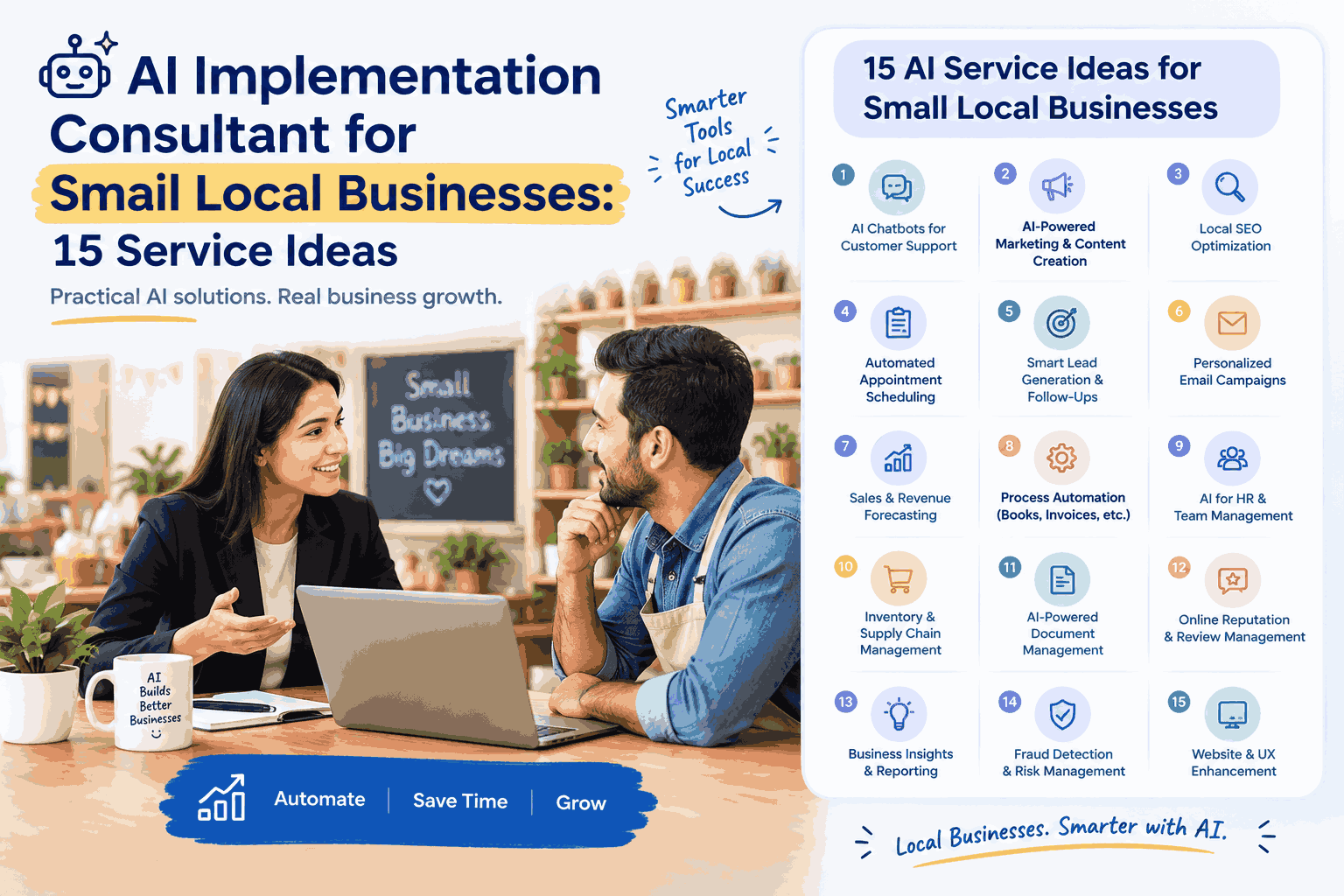
Here are fifteen services that sell, with realistic numbers.
Local Is Not the Same Market as SMB
Get the economics right before choosing services.
The published SMB benchmarks — hourly advisory around $100 to $300, fixed-scope quick wins from $2,500 to $10,000, retainers from $1,500 to $8,000 monthly, initial engagements commonly $10,000 to $50,000 — describe companies with a finance function and an IT budget.
Genuinely local businesses operate differently. Realistic bands look closer to:
- Single-workflow build: $500 to $3,000
- Multi-workflow package: $3,000 to $8,000
- Monthly management retainer: $300 to $1,500
- Hourly, where you must: $100 to $200
The consultants who profit here do not sell fewer hours at lower rates. They sell the same solution repeatedly with minimal customisation, which is the only way the arithmetic works at these price points.
What Local Businesses Actually Buy
Four criteria. A service failing any of them will be hard to sell.
It solves a pain the owner already complains about. Not “AI transformation.” Missed calls. No-shows. Quotes taking three days.
It pays back visibly within weeks. An owner who can count recovered bookings will renew. One waiting on a productivity claim will not.
It requires no integration with systems they do not have. Most local businesses run a booking tool, a phone, and possibly QuickBooks. Assume nothing else.
It does not require them to change behaviour much. Anything demanding staff learn a new daily habit will be abandoned within a month.
Front Desk and Lead Capture
The highest-value category, because the pain converts directly to revenue.
1. Missed-call text-back. When a call goes unanswered, an automatic text goes out within seconds offering to help or book. For a service business, a missed call is usually a customer who has already dialled the next result. This is the easiest sale on the list because the loss is obvious and the fix is measurable. $500–$1,500 setup, $100–$300/month.
2. AI phone answering. An assistant that handles calls outside business hours, answers routine questions, and takes bookings. Particularly valuable for trades, clinics, and restaurants. $1,000–$3,000 setup, $200–$600/month.
3. Website chat to booking. Chat that answers common questions and moves visitors into the calendar rather than into an enquiry form nobody reads. $500–$2,000 setup, $100–$300/month.
4. Lead intake and routing. Enquiries from web forms, email, and social arriving in one place, classified by service type and urgency, with a drafted first reply for human approval. $1,500–$4,000.
Customer Communication
5. Review generation and response. Automated review requests timed to the end of a job, plus drafted responses for the owner to approve. Local search visibility depends heavily on review volume and recency, which makes this an easy business case. $500–$1,500 setup, $150–$400/month.
6. Appointment reminders and no-show reduction. Sequenced reminders with easy rescheduling. For any appointment-based business, cutting no-shows has a directly calculable value the owner can verify. $500–$1,500 setup, $100–$250/month.
7. FAQ assistant. A knowledge assistant trained on the business’s own policies, pricing, and procedures — used by staff internally or by customers on the site. Most useful where staff turnover is high. $800–$2,500.
Back Office
8. Quote and estimate drafting. Generating first-draft quotes from a job description and the business’s own pricing, for review before sending. Contractors and trades routinely lose work to slow quoting, so speed here is a revenue argument. $1,500–$4,000.
9. Invoice and receipt processing. Extracting data from supplier invoices and receipts into a spreadsheet or accounting tool. Unglamorous, universally needed. $800–$2,500 setup, $150–$400/month.
10. Bookkeeping preparation. Categorising transactions and flagging anomalies before they reach the accountant. Sell it against what their accountant charges to do the same tidying. $1,000–$3,000 setup, $200–$500/month.
11. Scheduling and dispatch. Route and job scheduling for businesses running multiple vehicles or technicians. Higher complexity, correspondingly higher fee. $2,000–$6,000.
Marketing
12. Local search content. Ongoing Google Business Profile posts, service page content, and location-specific pages. Local visibility is where most of these businesses actually get customers. $300–$1,000/month.
13. Social content system. A repeatable process producing on-brand posts from the business’s own photos and jobs. Sell the system plus management rather than one-off content. $400–$1,200/month.
14. Email and SMS campaigns. Reactivating past customers from an existing list — usually the highest-return marketing available to a business with a customer database it has never used. $800–$2,000 setup, $200–$600/month.
Advisory
15. Fractional AI advisor. A monthly retainer covering prioritisation, tool selection, staff training, and oversight. This works only after you have delivered something concrete — local owners buy advice from people who have already fixed something for them. $500–$1,500/month.
Pricing at a Glance
| Service type | Setup | Monthly |
|---|---|---|
| Call capture and answering | $500–$3,000 | $100–$600 |
| Reviews and reminders | $500–$1,500 | $100–$400 |
| Quoting and documents | $800–$4,000 | $150–$400 |
| Marketing systems | $0–$800 | $300–$1,200 |
| Advisory retainer | — | $500–$1,500 |
Note that tooling costs sit on top and are typically $20 to $50 per user monthly. Bill these through transparently rather than absorbing them.
Productise, Do Not Consult
The single decision that determines whether this business works.
Sell packages, not hours. “Missed-call recovery, installed and managed” is a purchase. “AI consulting at $150 an hour” is a negotiation.
Build once, deploy repeatedly. Your second missed-call implementation should take a third of the time of your first. If every client is bespoke, you have bought yourself a job.
Specialise by vertical. Ten dental practices is a far better business than ten unrelated businesses, because the workflows repeat, the language repeats, and referrals happen inside the industry.
Lead with a paid diagnostic. A modest fixed-fee audit — a few hundred dollars — that produces a prioritised list qualifies buyers and converts far better than free consultations.
Charge monthly for something real. Setup fees are one-off. Monitoring, iteration, and support are what make this a business rather than a series of projects.
Landing the First Clients
- Start with businesses you already use. Your dentist, your accountant, your gym. Warm, local, and they can see you are real.
- Fix one visible thing free for one business, then use it as a case study with numbers.
- Go where owners are, not where marketers are — chambers of commerce, trade associations, local business groups.
- Partner with adjacent providers. Bookkeepers, web designers, and IT support firms already have the relationships and no interest in doing this work themselves.
- Show the calculation. Missed calls per week, average job value, recovery rate. Owners buy arithmetic, not capability.
The Part You Must Get Right
Two liabilities to handle before you take money.
Data handling. You will touch customer records, and in some verticals health or financial information. Understand what applies — health privacy rules, payment data standards, and whichever data protection regime covers your clients’ customers. Get this reviewed rather than assumed.
Automated communication rules. Automated calls and texts to consumers are regulated in most markets, with real penalties. Consent requirements apply to your clients but you built the system, so know the rules before deploying anything that dials or messages automatically.
Neither is a reason to avoid the work. Both are reasons to have proper terms and appropriate insurance.
What Not to Sell
- Strategy decks. Local owners want something working, not a roadmap.
- Anything requiring six months to show value.
- Custom model training. Off-the-shelf tools solve essentially every local business problem.
- Services depending on data they do not have. Most have no usable historical dataset.
- Fully autonomous customer-facing systems with no human review. One confidently wrong answer to a customer costs more than the automation saved.
Final Thoughts
The opportunity in local AI implementation is not technical sophistication. It is that nobody is serving these businesses at a price they can pay, in language they understand, with something that works next week.
Pick one vertical, build one service until you can deliver it in a day, price it as a package with a monthly component, and sell it on arithmetic the owner can check. That is a business. Bespoke consulting at these price points is not.
FAQs
How much can an AI consultant charge small local businesses?
Realistically $500 to $3,000 per workflow build and $300 to $1,500 monthly, well below the SMB benchmarks aimed at larger companies.
What AI service is easiest to sell to local businesses?
Missed-call text-back. The loss is obvious to the owner, the fix is fast, and recovered bookings are directly countable.
Do I need technical skills to be an AI implementation consultant?
Not deep ones. Most local business problems are solved with configured off-the-shelf tools rather than custom development.
Should I specialise in one industry?
Yes. Vertical focus lets you reuse the same build repeatedly, which is the only way these price points produce a viable margin.
How do I find my first clients?
Start with local businesses you already patronize, deliver one measurable result, and partner with bookkeepers and IT providers who already hold the relationships.