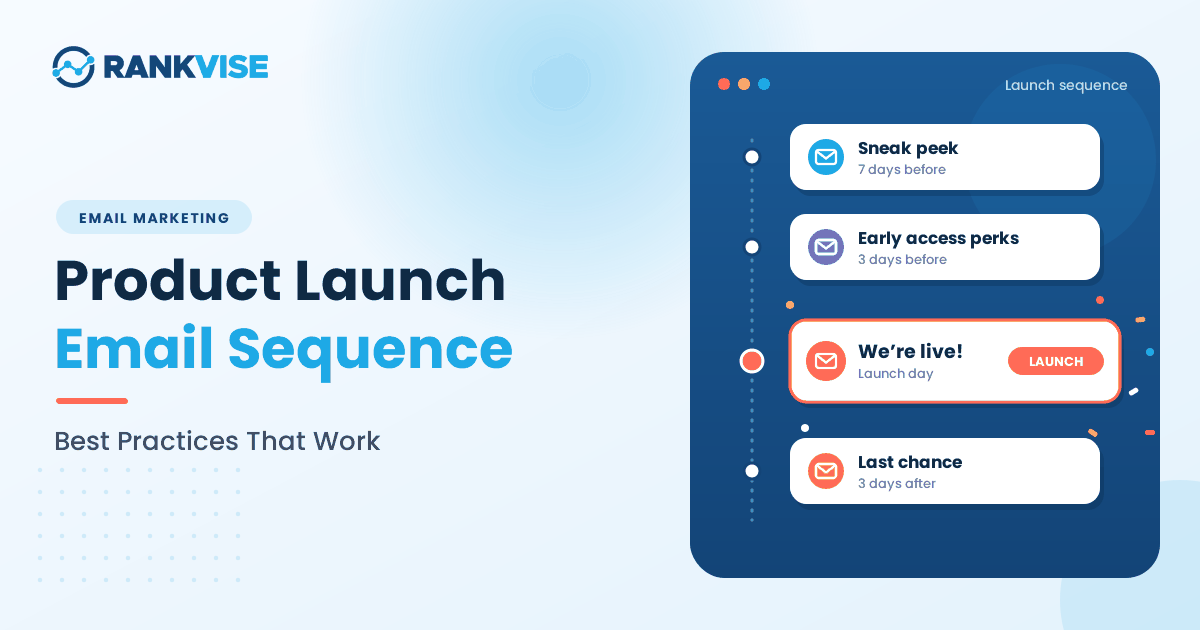
Most launch sequence advice presents one template as universal: tease, announce, educate, urgency, last call.
- Align sequence length and email focus to launch type and audience intent to avoid over- or under-educating recipients.
- Prepare deliverability four to six weeks out: authenticate, clean lists, re-engage inactives, warm up sending to protect domain reputation.
- Segment and simplify: one email one job, lead with the purchase link, suppress purchasers, and tailor final emails by recipient behavior.
That template is fine, and it is wrong for at least three of the five situations people actually mean when they say “product launch.” A feature release to existing customers and a limited-stock product drop have almost nothing in common beyond the word launch.
This guide covers what changes by launch type, the practices that hold regardless, and the technical preparation that determines whether any of it reaches an inbox.
Five Launch Types, Five Sequences
| Launch type | Audience state | Sequence length | Primary job |
|---|---|---|---|
| Waitlist launch | Already interested | 5–7 emails | Convert existing intent |
| Cold-list launch | Aware of you, not the product | 8–12 emails | Educate, then convert |
| Cohort or founding member | Mixed | 10 emails over ~2 weeks | Convert before a hard close |
| Feature launch | Existing customers | 2–4 emails | Drive adoption, not purchase |
| Product drop | Existing buyers | 3–4 emails | Create urgency around scarcity |
The single most common error is running a cold-list sequence on a waitlist. People who signed up for the thing do not need eight emails of education. They need the link, the price, and a reason to act now.
The opposite error is equally costly: running a five-email waitlist sequence to a general list that has no idea the product exists.
The Structure Underneath All of Them
Every launch sequence does the same five jobs in the same order. What varies is how many emails each job takes.
- Signal — something is coming, without full detail
- Announce — what it is, who it is for, what it costs
- Educate — how it works, what is included, who it is not for
- Prove — evidence it works
- Close — the deadline or scarcity, and the final call
A waitlist launch might compress signal and announce into one email and spend three on close. A cold-list launch might spend four on educate. The jobs do not change.
Sequence by Type
Waitlist launch (5–7 emails). One heads-up, one announce with the link in the first hundred words, one on what it includes and who it is not for, one proof email, then two or three in the close window. Do not over-explain to people already sold.
Cold-list launch (8–12 emails). Front-load education. Three or four emails establishing the problem before you mention a product. The temptation is to shorten this; resist it, because you are building the case for the category before the case for your version of it.
Cohort or founding member launch (10 emails). Built backwards from a hard close date, with most conversions landing in the final 48 hours. This one has enough specific mechanics — offer structure, close discipline, cohort scarcity — to warrant its own treatment.
Feature launch (2–4 emails). Different job entirely. You are not converting, you are driving adoption. One announce, one showing the feature solving a real problem, one to non-adopters after two weeks. Urgency language is inappropriate and erodes trust with customers who already paid.
Product drop (3–4 emails). Existing buyers need no education. Heads-up with the date, live announcement, low-stock notice, sold-out or closing. Scarcity does the work, provided it is genuine.
The Part That Decides Whether Any of It Arrives
Here is what launch sequence articles almost universally skip, and it matters more than your subject lines.
A launch is the exact pattern that triggers spam filtering. You mail a list you have neglected for weeks or months, and you spike volume sharply. Machine learning systems at major providers are specifically tuned to detect anomalous sending patterns — going from a few thousand messages one week to a large multiple of that the next is precisely what they flag.
The stakes rose in 2025 when Google, Yahoo, and Microsoft brought in enforced bulk sender requirements: spam complaints below 0.3%, bounces below 2%, authenticated sending, and one-click unsubscribe.
And the damage outlasts the launch. A harmed sending domain typically needs four to twelve weeks of clean sending before meaningful recovery, with severe cases taking months. Get this wrong and it is not one launch you lose — it is the next one too.
Prepare four to six weeks out:
- Verify authentication. SPF, DKIM, and DMARC present and correctly aligned. Authentication fixes take effect within hours, so there is no reason to leave this late.
- Clean the list. Remove invalid addresses before you send, not after they bounce.
- Re-engage inactives properly. Run a re-engagement campaign to non-openers rather than either mailing them cold at launch or deleting them outright.
- Warm up gradually. If you send infrequently, begin with your most engaged recent subscribers and scale volume up over several weeks. Never let the launch broadcast be your first send in months.
- Confirm one-click unsubscribe is enabled and prominent. An unsubscribe costs you far less than a spam complaint.
- Watch the numbers daily during the launch. If complaints climb toward the threshold, reduce volume and tighten segmentation immediately rather than pushing through.
Note that volume itself does not help you. Consistent sending to an engaged audience drives placement; large sends to an indifferent list do the opposite.
Practices That Hold Regardless of Type
One email, one job. An email doing three things does none of them. If you are tempted to add a second call to action, that is a second email.
Lead with the link for buyers. A meaningful share of your list is already convinced. Making them read six paragraphs before finding the link costs sales for no benefit.
Say who it is not for. Explicit disqualification raises conversion among the right buyers and reduces refunds. It also reads as confidence.
Segment the final emails by behaviour. Someone who clicked the sales page and did not buy needs a different final email from someone who never opened anything. This matters more than adding emails.
Suppress purchasers immediately. Nothing sours a new customer faster than three urgency emails about something they already bought.
Write the plain-text version deliberately. Heavy image-based emails perform worse in filtering and worse with readers.
Send from a person, not a brand. Consistently outperforms across launch types.
Publish the deadline in a specific timezone. Ambiguity at the close creates support tickets and lost sales in equal measure.
What to Measure
- Conversion by sequence stage, which tells you which job is failing rather than just that something is
- Click-to-purchase rate, isolating whether the problem is the email or the sales page
- Percentage of sales in the final 48 hours, which calibrates your next launch
- Unsubscribes per email, watching for the point where cadence tips into irritation
- Complaint rate and bounce rate, against the 0.3% and 2% thresholds
- Inbox placement, not just open rate — open rate cannot distinguish a bad subject line from an email nobody received
Common Mistakes
- Using one template for every launch type. A feature launch is not a cohort launch.
- Mailing a cold list at full volume with no warm-up. The most expensive mistake here, because the cost carries into future launches.
- Burying the purchase link.
- Over-educating a waitlist that signed up because it already wanted the thing.
- Applying urgency to a feature launch, which reads as manipulative to people who already pay you.
- Failing to suppress buyers.
- Extending a deadline, which teaches your list that future deadlines are optional.
- Judging performance on open rate alone, now a less reliable metric than it used to be.
Final Thoughts
The sequence is the easy part. Five jobs in a fixed order, with the number of emails per job set by how much your audience already knows.
The parts that actually determine outcomes are less visible: matching sequence length to launch type, segmenting the close, and doing the deliverability work weeks before anyone writes a subject line. Get those right and an ordinary sequence performs well. Get them wrong and an excellent one never arrives.
FAQs
How many emails should a product launch sequence have?
Between two and twelve depending on launch type. Waitlists need five to seven, cold lists eight to twelve, and feature launches only two to four.
How far in advance should the sequence start?
Content-wise, one to two weeks before launch. Deliverability preparation should start four to six weeks out.
What is the biggest mistake in launch emails?
Sending a large broadcast to a neglected list without warming up, which risks domain reputation damage that takes weeks or months to repair.
Should feature launches use urgency?
No. Existing customers are being asked to adopt something they already pay for, and artificial deadlines read as manipulative.
When do most launch sales happen?
Predominantly in the final 48 hours before a deadline, which is why the close window deserves your strongest emails rather than your leftovers.