Most guides to podcast sponsorship do the same piece of arithmetic. Take your downloads, divide by a thousand, multiply by a CPM. Ten thousand downloads at $30 CPM equals $300 an episode.
- Price sponsors on 30-day downloads and placement matters; host-read mid-rolls command top rates because they convert better.
- Calculate earnings using mid-roll reach and fill rate, not raw downloads; expect negotiated rates below published rate cards.
- If under 1,000 downloads focus on affiliates, flat-fee deals, and audience building rather than chasing CPM opportunities.
That number is almost always too high, for two reasons nobody mentions. You are not paid on raw downloads, and the rate you publish is not the rate you close.
This guide covers how sponsorship pricing actually works, what you can realistically expect to earn at each audience size, and what to do if you are nowhere near the download thresholds sponsors ask for.
How Podcast Sponsorship Pricing Works
Podcast advertising is priced on CPM — cost per mille, meaning cost per thousand downloads. A $30 CPM means the advertiser pays $30 for every thousand times your episode is downloaded.
Two details decide whether your quote is credible.
The 30-day window. CPM is conventionally measured against downloads in the first 30 days after an episode publishes, not lifetime downloads. Sponsors know this. Quoting a lifetime figure marks you as inexperienced and invites a renegotiation you will lose.
Placement changes the rate. Where the ad sits in the episode matters more than most new podcasters expect, because listener attention is not evenly distributed.
| Placement | Typical CPM range | Why |
|---|---|---|
| Pre-roll | $15–$25 | Plays before the content, lower engagement |
| Mid-roll (host-read) | $25–$40 | Premium slot — listeners are already invested |
| Post-roll | $10–$20 | Highest drop-off has already happened |
| Niche B2B / finance | $50–$100+ | Audience purchasing power commands a premium |
Host-read ads sit at the top of that ladder for a reason. They reportedly convert two to three times better than pre-produced spots, because they read as a recommendation rather than an interruption. That is what most direct sponsors are actually buying.
The Gap Between Asking and Closing
Here is the thing rate-card articles do not tell you.
Independent guides cluster mid-roll host-read rates around $25 to $40 CPM. Large datasets of actually-placed ads report negotiated rates closer to $15 to $30. That gap is the whole game.
Your published rate is an opening position. What you close depends on your niche, your production quality, whether you can prove retention, and how much competition the sponsor has for their budget. A polished show in a valuable niche justifies the top of the range. A rough show with weak positioning will not, however confident the rate card looks.
Ask from strength. Close from evidence.
What You Will Actually Earn
Downloads are not impressions. Two factors sit between them.
Mid-roll reach — the share of listeners still present when the ad plays. Commonly somewhere around 60% for a mid-roll placement, depending on episode length and audience loyalty.
Fill rate — the share of your available ad slots that actually sell. Rarely 100%, and often nearer 70% for independent shows.
Run the real calculation:
3,000 downloads × 60% mid-roll reach × 70% fill rate = 1,260 effective impressions 1,260 ÷ 1,000 × $35 CPM = roughly $44 per slot
Not the $105 the naive formula suggests. With two mid-roll slots you are looking at somewhere near $88 an episode, not $210.
This is not a reason to give up. It is a reason to plan on real numbers, and to understand why experienced podcasters push hard on fill rate and flat-fee deals rather than obsessing over CPM alone.
How Many Downloads Do You Need?
There is no universal threshold, but the tiers below reflect where the market actually sits.
| Downloads per episode (30-day) | Realistic route |
|---|---|
| Under 500 | Affiliate deals, own products, audience building |
| 500–2,000 | Affiliate marketplaces, flat-fee local or niche sponsors |
| 2,000–5,000 | Most direct advertisers’ minimum begins here |
| 5,000–10,000 | Direct sales become viable; rate card worth building |
| 10,000+ | Ad networks and agencies start approaching you |
If you are under 1,000 downloads, read this part carefully. Chasing CPM deals at that size wastes months. The better moves are affiliate marketing on products you genuinely use, flat-fee arrangements with small businesses in your niche, and building the audience. Micro shows do attract sponsors that larger ones ignore — local businesses, startups, indie software companies — but almost always on flat fees rather than CPM.
Four Routes to Sponsors
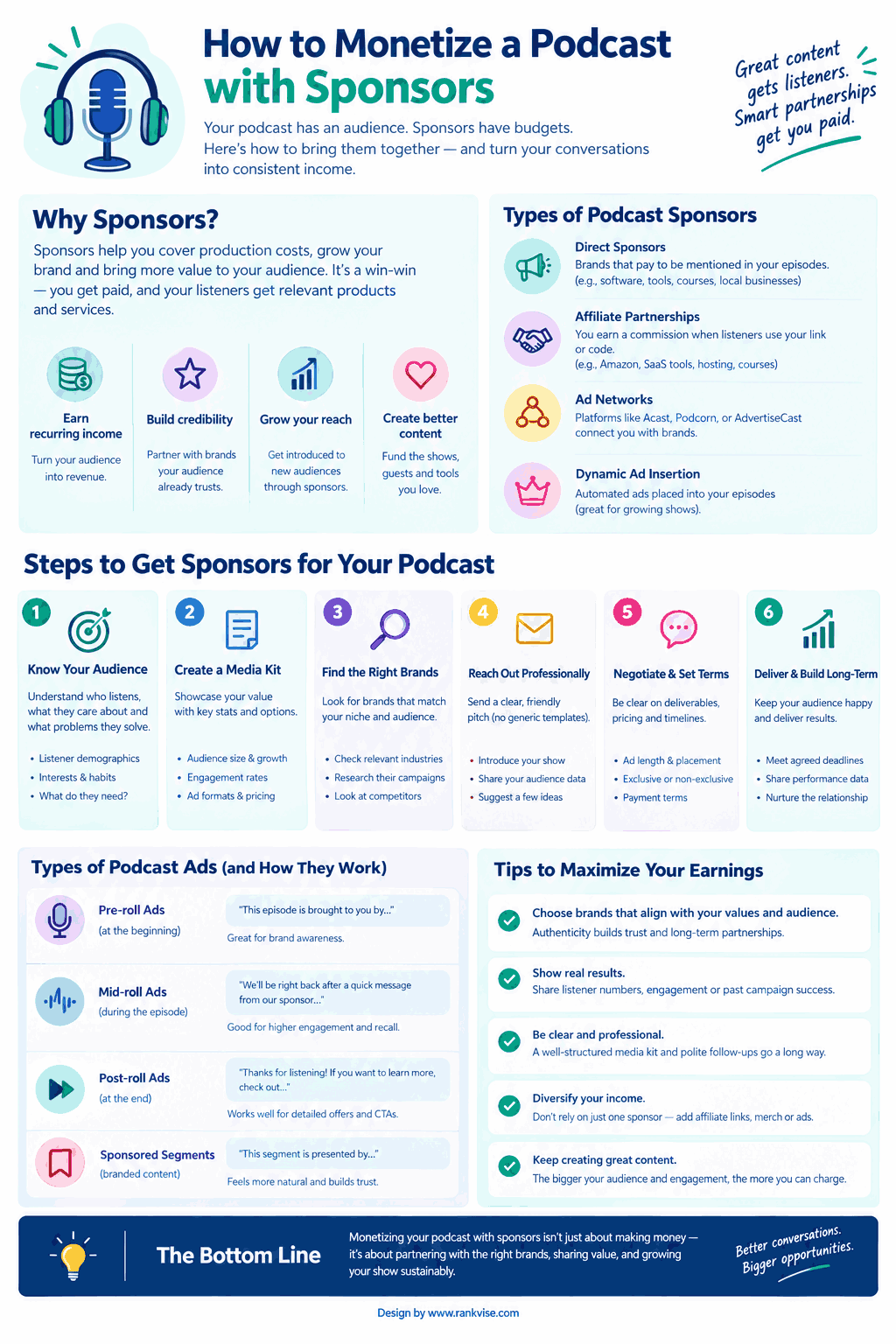
Direct sales. You find and negotiate with sponsors yourself. You keep 100% of the revenue and choose who appears on your show. The cost is your time, and time is the reason most podcasters never do this consistently.
Ad marketplaces. Platforms that match shows and sponsors. Download minimums are far lower — some work with shows around 500 downloads — and you choose which campaigns to take. Earnings are inconsistent and admin-heavy, and some deals are performance-based rather than guaranteed.
Ad networks. They sell on your behalf and handle billing and relationships, typically taking 20% to 40% as their fee. Genuinely hands-off, but most want consistent volume above roughly 10,000 downloads per episode before they are interested.
Affiliate arrangements. Commission on sales rather than payment for impressions. No download minimum, which makes it the only realistic option for small shows, and the returns scale with how much your audience trusts you rather than how many of them there are.
Most sustainable shows run more than one of these at once — a couple of direct sponsors, with programmatic filling unsold inventory.
What Sponsors Actually Want to See
Build a one-page media kit containing:
- 30-day downloads per episode, stated plainly and honestly
- Audience demographics — location, age, role or industry
- Listener retention or consumption rate, which is your strongest differentiator if it is good
- Available placements and your rates for each
- Two or three past sponsor results, with promo code redemptions if you have them
- A short description of who your listeners are and why they are worth reaching
Retention data matters disproportionately. Any show can quote a download number. A show that can prove listeners stay through the mid-roll is selling something measurably better, and modern hosting analytics make that evidence easy to produce.
Beyond CPM
CPM is the baseline, not the ceiling. Higher-value structures include:
- Bundled campaigns. Four episodes sold together, at a modest discount, in exchange for guaranteed revenue.
- Branded segments. A recurring named feature rather than a 60-second read.
- Flat-fee deals. Often better for smaller shows, because they are not penalised for modest download counts.
- Dynamic insertion. Ads inserted into your back catalogue without re-recording, turning old episodes into inventory.
- Multi-channel packages. Newsletter, social, and show notes bundled with the audio spot.
Before agreeing to anything, pin down what the sponsor is actually buying: which placement, how long the ad stays live, whether they can cut the audio for use elsewhere, and which download window counts. A rate conversation without those answers is not ready to happen.
Disclosure Is Not Optional
Paid sponsorships require clear disclosure to your audience. In the US that falls under FTC endorsement guidelines, and comparable rules apply in most other markets.
Practically: say it is an ad, say it near the top of the read rather than buried at the end, and make it audible rather than confining it to show notes. Listeners overwhelmingly do not mind sponsorship. They mind being deceived, and the trust you would lose is the exact asset sponsors are paying for.
Requirements vary by jurisdiction, so check the rules that apply where your audience is.
Final Thoughts
Podcast sponsorship is a real business model, but the version in most guides is inflated by arithmetic that ignores reach and fill rate.
Work out your genuine 30-day number. Apply realistic reach and fill assumptions. Price from that, publish a rate you can defend with evidence, and expect to close somewhat below your ask. If you are under a thousand downloads, spend this year on affiliates and audience instead — the CPM conversation will be far easier when you get there.
FAQs
How many downloads do I need for sponsors?
Most direct advertisers start around 2,000 to 5,000 per episode. Marketplaces and affiliate deals work with shows as small as a few hundred.
What is a good podcast CPM in 2026?
Mid-roll host-read spots commonly range from $25 to $40 CPM, with niche B2B and finance shows able to command considerably more.
How much does a podcast with 10,000 downloads earn?
At a $30 CPM the headline figure is $300 per slot, but realistic reach and fill rates typically bring that closer to $120 to $180.
Should I use an ad network or sell directly?
Direct sales keep all the revenue but cost time. Networks handle everything for roughly 20% to 40%, and usually want 10,000-plus downloads.
Do I have to disclose podcast sponsorships?
Yes. Disclosure is legally required in most markets and should be spoken clearly within the episode, not hidden in the show notes.