Skip to content

A business broker acts as an intermediary between sellers and buyers of privately held companies. Think of them as real estate agents, but for businesses. They guide owners through every stage of the sale process.
- Evaluate and value businesses using market comparables and financial analysis to set realistic asking prices.
- Market companies confidentially with blind listings and NDAs to protect employees, customers, and competitive position.
- Screen and qualify buyers, expanding reach through buyer databases, networks, and private equity contacts.
- Negotiate deal terms, structure transactions, and coordinate due diligence toward a successful closing.
- Save owners time and stress, producing higher sale prices and fewer deal failures compared to DIY sales.
Their core responsibilities include valuing the company, marketing it confidentially, and screening potential buyers. They also negotiate deal terms and coordinate due diligence. Most importantly, they keep the transaction moving toward a successful close.
Business brokers typically handle sales of companies valued between 100,000 USD and 5 million USD. Larger transactions often involve M&A advisors or investment banks instead. However, the fundamental goal remains the same: maximizing value while minimizing stress for the seller.
Why Do Business Owners Use Brokers to Sell?
Selling a business involves far more complexity than most owners anticipate. The average sale takes six to twelve months to complete. During that time, owners must continue running daily operations while managing a demanding transaction.
Most business owners sell a company only once in their lifetime. They lack the experience to navigate negotiations, legal requirements, and buyer psychology. Brokers bring this expertise to the table immediately.
Confidentiality presents another major concern. Owners fear what happens if employees, customers, or competitors learn about the sale prematurely. Brokers use blind listings and non-disclosure agreements to protect sensitive information throughout the process.
Key Benefits of Hiring Business Brokers
1. Access to Qualified Buyers
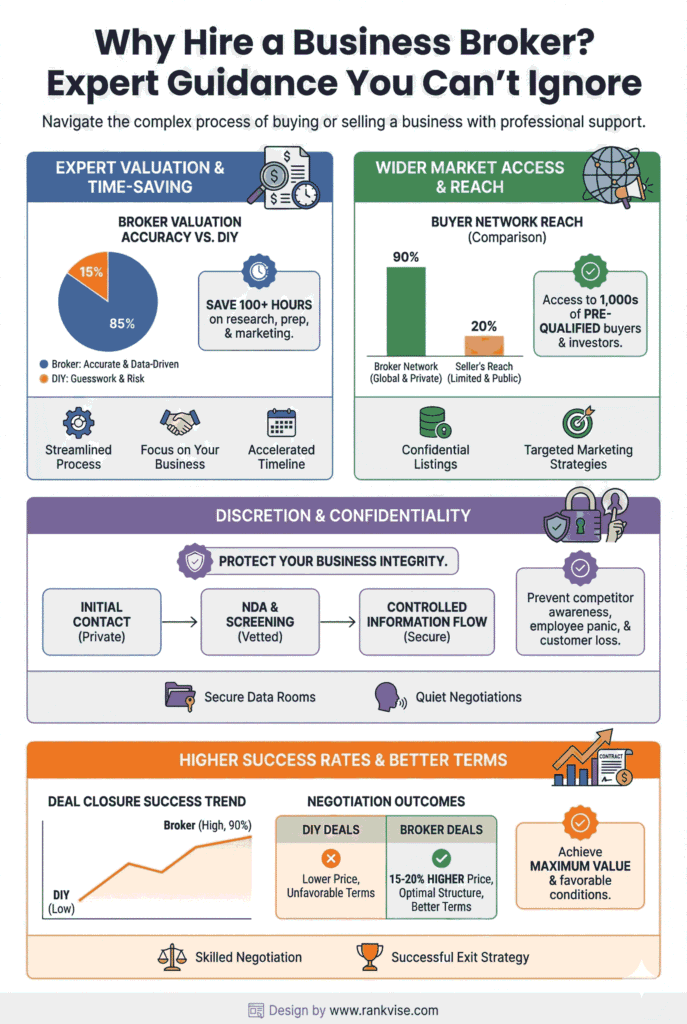
Many Business brokers in USA maintain databases of pre-screened buyers actively seeking acquisition opportunities. They also network with private equity groups, strategic acquirers, and high-net-worth individuals.
This reach dramatically expands the buyer pool beyond what owners could access independently. More qualified buyers mean more competitive offers and better final terms.
2. Professional Business Valuation
Pricing a business correctly requires analyzing financial statements, industry trends, and market comparables. Overpricing drives buyers away. Underpricing leaves money on the table.
Brokers use proven valuation methods to establish realistic asking prices. They understand what buyers pay for similar companies in current market conditions. This expertise prevents costly pricing mistakes.
3. Skilled Negotiation and Deal Structuring
Negotiations determine whether sellers achieve their financial goals. Emotions often cloud judgment when owners negotiate directly. Personal attachment to the business creates blind spots.
Brokers serve as objective advocates focused solely on the seller’s interests. They handle difficult conversations, counter lowball offers, and structure deals that benefit their clients. Their experience with dozens or hundreds of transactions provides significant leverage.
4. Time Savings for Business Owners
The sale process demands substantial time and attention. Responding to buyer inquiries, preparing documents, and attending meetings pulls focus from operations.
Revenue declines during poorly managed sales, reducing the company’s value. Brokers handle the heavy lifting so owners can maintain business performance throughout the transition.
How Much Business Brokers Charge?
Broker commission structures vary, but most follow a success-fee model. This means sellers pay only when the transaction closes successfully. Commissions typically range from 8% to 12% for smaller businesses.
| Business Value | Typical Commission Rate |
|---|---|
| Under 500,000 USD | 10%–12% |
| 500,000–1 million USD | 8%–10% |
| 1–5 million USD | 6%–8% |
| Over 5 million USD | 4%–6% (often with minimums) |
Some brokers charge upfront retainers or monthly marketing fees. These amounts usually range from 2,000 USD to 10,000 USD. Clarify all fee structures before signing any engagement agreement.
The Lehman Formula represents another common pricing method for larger transactions. This sliding scale charges 5% on the first million, 4% on the second million, and decreasing percentages thereafter.
Calculating the ROI of Using a Broker
The real question isn’t what brokers cost. It’s what value they deliver compared to selling independently. Data consistently shows broker-assisted sales yield higher prices.
Studies indicate businesses sold through brokers command 10% to 20% higher sale prices on average. They also close faster and with fewer deal failures. Consider this simple example:
A business worth 1 million USD might sell for 900,000 USD without professional representation. With a broker who achieves full asking price, the gross is 1 million USD. After a 10% commission, the net is 900,000 USD.
Same result? Not quite. The broker-assisted sale likely closed faster with less owner stress. It probably included better contract terms and reduced post-sale liability. These factors represent significant hidden value.
When Does Hiring a Broker Make Sense?
Certain situations strongly favor working with professional sell-side representation. Consider hiring a broker if:
- Your business generates over 200,000 USD in annual revenue
- You lack time to manage a lengthy sale process
- Confidentiality concerns make open marketing impossible
- You’ve never sold a business before
- The company has complex financials or operations
- You want maximum competitive tension among buyers
Conversely, very small businesses or simple asset sales might not justify broker fees. Owners with M&A experience and industry connections occasionally succeed independently. However, these represent exceptions rather than rules.
How to Choose the Right Business Broker?
Not all brokers deliver equal results. The wrong choice wastes time and potentially costs significant money. Evaluate candidates carefully before signing engagement letters.
Questions to Ask Potential Brokers
- How many similar businesses have you sold in the past three years?
- What is your average time to close?
- What percentage of your listings actually sell?
- How do you market businesses confidentially?
- Can you provide references from recent clients?
- What happens if the business doesn’t sell?
Red Flags to Avoid
Watch for brokers who guarantee specific sale prices or timelines. Be cautious about those who pressure you into quick decisions. Avoid anyone unwilling to explain their process or fee structure transparently.
Industry expertise matters tremendously. A broker specializing in restaurants understands that market far better than a generalist. Seek professionals who know your specific business type.
The Business Sale Process with a Broker: What to Expect
Working with a broker follows a predictable timeline. Understanding each phase helps set realistic expectations.
Phase 1: Preparation (Weeks 1–4) The broker analyzes financials, determines valuation, and prepares marketing materials. You’ll gather documentation and answer detailed questions about operations.
Phase 2: Marketing (Months 2–4) Confidential listings go live on business-for-sale platforms. The broker contacts potential buyers directly and responds to inquiries.
Phase 3: Buyer Screening (Ongoing) Interested parties sign NDAs and submit proof of financial capability. Unqualified prospects get filtered out before wasting your time.
Phase 4: Negotiation (Months 4–6) Serious buyers submit letters of intent. The broker negotiates price, terms, and contingencies on your behalf.
Phase 5: Due Diligence and Closing (Months 6–9) Buyers verify financial and operational claims. Attorneys draft purchase agreements. The transaction closes with fund transfer and ownership transition.
Common Mistakes When Selling Without a Broker
Owners who attempt selling independently often encounter predictable problems. Learning from these mistakes highlights why professional help matters.
- Emotional Pricing Owners overvalue businesses based on personal attachment rather than market data. Buyers quickly recognize unrealistic expectations and walk away.
- Poor Confidentiality Management Word spreads when owners market their own businesses. Employees start job hunting. Customers question stability. Competitors exploit the uncertainty.
- Negotiation Blunders Without experience, owners accept unfavorable terms or drive away qualified buyers. They reveal desperation or fail to create competitive tension.
- Deal Fatigue The process takes longer than expected. Motivation fades. Owners accept worse offers just to end the ordeal.
Final Thoughts: Is a Business Broker Worth the Investment?
Selling a business represents one of the most significant financial events in any owner’s life. The stakes are simply too high for amateur mistakes. Business brokers bring expertise, networks, and negotiation skills that typically more than justify their fees.
The right broker becomes a strategic partner in achieving your business exit strategy. They protect your interests, maintain confidentiality, and maximize your return. For most owners, that peace of mind alone makes the investment worthwhile.
Before signing with any broker, conduct thorough due diligence. Interview multiple candidates. Check references and verify credentials. The effort you invest in choosing the right professional pays dividends at closing.
FAQs About Business Brokers
Most charge success-based commissions ranging from 6% to 12% of the final sale price, depending on transaction size.
Yes, but studies show broker-assisted sales typically achieve 10% to 20% higher prices and close faster.
The average business sale takes six to twelve months from listing to closing, depending on complexity.
Brokers typically handle smaller transactions under 5 million USD, while M&A advisors focus on larger, more complex deals.
Most brokers work on success fees, meaning you pay nothing unless the sale closes, though some charge upfront retainers.