Skip to content
The Talent Gap Is Winning – and Most Businesses Know It
Something broke quietly in enterprise data strategy – somewhere between the third failed AI pilot and the sixth month of trying to hire a senior data engineer who never showed up. Businesses aren’t struggling because they lack data. They’re drowning in it. And the gap between what their internal teams can process and what the business actually needs has become, well, embarrassing.
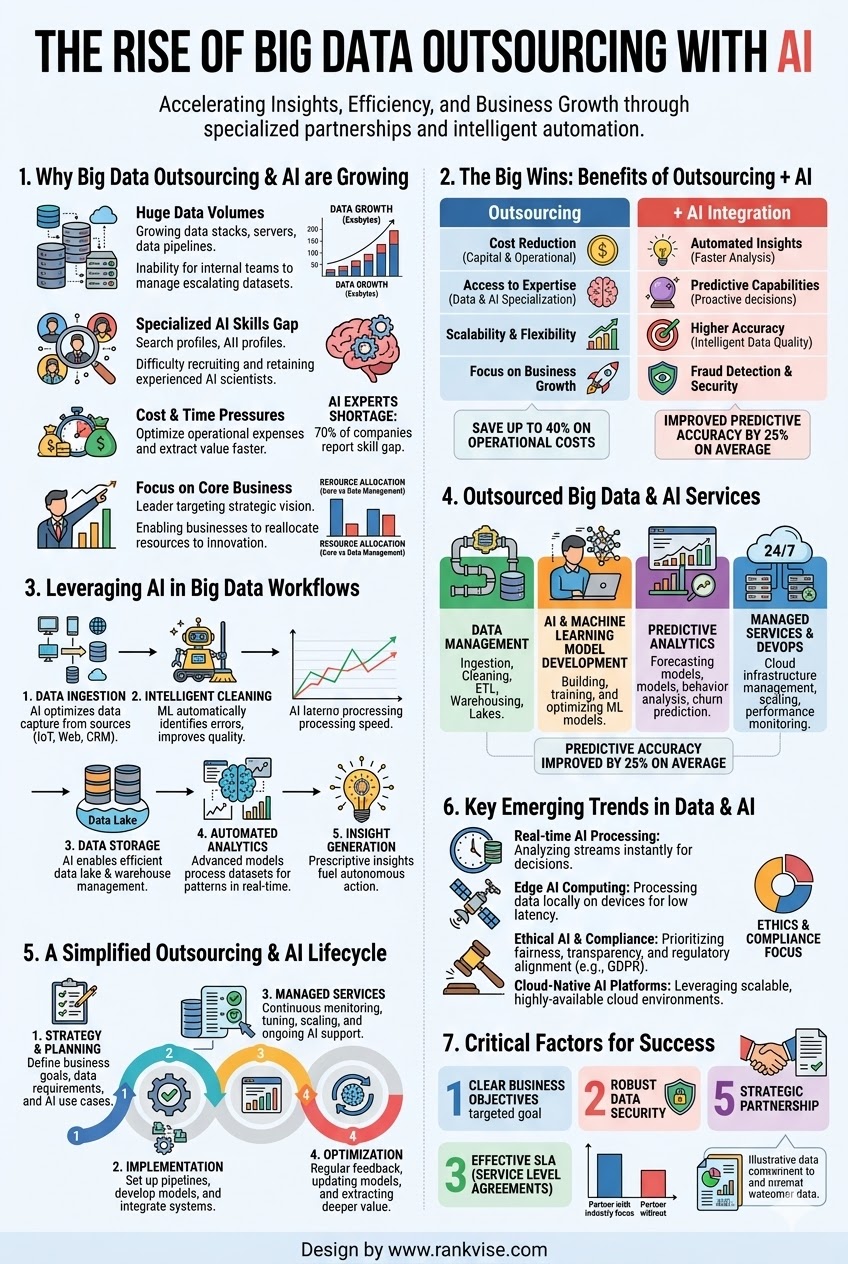
- AI integration is mandatory; outsourcing partners must deliver embedded automation, predictive models, NLP, and adaptive systems that accelerate development and productivity.
- Outsourcing replaces capitalized in-house builds with scalable, variable operational expense, reducing time to senior expertise and providing battle-tested data frameworks.
- Pick partners that own outcomes: industry domain expertise, embedded governance and compliance, upstream data quality, and real post-deployment monitoring and optimization.
Here’s the uncomfortable truth: 74% of employers report serious difficulty hiring qualified data and AI professionals. Demand for specialists in machine learning, data pipeline engineering, and real-time analytics has outpaced local talent supply in North America and Western Europe by a wide margin. Teams get stretched, roadmaps slip, and executives stare at dashboards that are three quarters built and three months overdue.
This is precisely why, in 2026, the conversation has shifted. Companies aren’t asking whether to outsource big data operations anymore – they’re asking how fast they can do it well.
What’s Actually Driving the Shift in 2026
The data analytics outsourcing market was valued at roughly $10.89 billion in 2025 and is projected to grow from $14.54 billion in 2026 to $61.58 billion by 2031 – a 33.47% compound annual growth rate. That isn’t speculative. That’s a structural shift in how enterprises think about building data capability.
Three forces are converging at once, and each one accelerates the others.
First: AI integration has become non-negotiable. Organizations now expect outsourcing partners to arrive with AI already embedded – automation, predictive modeling, generative AI interfaces. Research from McKinsey indicates that AI-driven teams significantly improve both productivity and development speed. Companies that treat AI as optional are quietly being lapped by competitors who don’t. By 2026, roughly 78% of enterprises report using AI in at least one core business function – a clear majority.
Second: The cost of building in-house has become unjustifiable. Data infrastructure is expensive. GPUs, cloud compute, specialized tooling, compliance frameworks – these costs compound fast. Add in the fully loaded cost of a senior data engineering team in San Francisco or London, and the ROI math rarely works out in favor of the internal build. Outsourcing flips that equation: variable operational expense instead of capital-intensive headcount, with the added benefit of accessing battle-tested frameworks from day one.
Third: Data complexity has quietly exploded. The average enterprise is now managing structured databases, streaming event data, unstructured documents, third-party data feeds, IoT sensor streams, and real-time customer behavior – simultaneously. No single internal team, especially in a mid-size organization, is equipped to handle that breadth without trade-offs. Specialization wins, and outsourced data partners have spent years solving exactly these problems.
Why AI-Integrated Outsourcing Changes the Game Entirely
Not all outsourcing is created equal – and that distinction matters more in 2026 than it ever has. The old model was simple: hand off a data pipeline, get a report, repeat. What companies are choosing now is something categorically different. Engaging in big data outsourcing with AI solutions means the partner brings predictive modeling, automated anomaly detection, NLP-driven analytics, and adaptive recommendation systems – not just storage and ingestion.
The difference shows up in outcomes. Consider a few scenarios that illustrate this shift:
- A mid-size logistics company outsourced its route optimization and supply chain analytics to an external data partner. Within eight months, they reduced fuel costs by 14% and cut delivery exception rates nearly in half – using AI models that their internal team had been attempting to build for over two years.
- A healthcare technology firm handed off its patient data pipeline to a managed services partner with embedded ML capabilities. The result was an opioid over-prescription detection model, built and deployed on AWS, that processed data across dozens of major US hospitals – something that would have required a multi-year internal hiring initiative to attempt.
- A hospitality analytics provider brought in an external data engineering team to implement demand forecasting and precision search tools. Operational efficiency improved measurably, and the time-to-insight for revenue teams dropped from days to hours.
None of these outcomes required the companies to build full-stack data science teams from scratch. They required the right partner.
The Hidden Costs of Getting This Wrong
There’s a version of this story that doesn’t end well – and it’s worth naming directly.
70–85% of AI projects fail. Not because the technology doesn’t work, but because the strategy doesn’t. Common failure modes: teams solve the wrong problem, data quality is poor, governance is absent, and no one owns the outcome once a pilot ends. Rushing to deploy the “coolest” new tool without a clear business problem attached is, frankly, a very expensive hobby.
This is where the choice of outsourcing partner becomes critical – not just a procurement decision.
When evaluating vendors for data engineering or AI-integrated analytics work, the questions that matter most are:
- Does their team have domain expertise in your industry – or are they generalists who’ll learn on your budget?
- What does their governance and compliance framework look like – especially for regulated industries like healthcare, fintech, or logistics?
- How do they handle data quality upstream, before models are trained, not after they fail?
- Can their infrastructure scale without a renegotiated contract every six months?
- What does post-deployment support actually look like – real monitoring and optimization, or just a ticketing queue?
The best external data partners treat themselves as extensions of the business, not vendors on a statement of work. That framing changes everything about how projects are scoped, staffed, and maintained.
What Good Partnership Looks Like in Practice
The geography of outsourcing has also changed meaningfully. Nearshore collaboration is one of the dominant trends of 2026 – with 58% of IT firms now preferring nearshore partners for time zone alignment, faster iteration cycles, and reduced friction in agile development. Eastern Europe and Latin America have both built deep technical benches in data engineering, ML, and cloud-native infrastructure.
A global data solutions company with distributed teams across the US, Europe, and beyond – like those operating in the managed services and IT outsourcing space – can compress timelines that used to take months. One business model that works consistently: a company gets the right senior data engineer within one to two weeks rather than the five-to-six months a domestic search would require. That’s not a marginal improvement. That’s a fundamental shift in how quickly a business can execute on its data strategy.
The most effective engagements share a few consistent traits:
- Clear ownership of outcomes, not just deliverables. Contracts that link compensation to measurable business results, not just output volume.
- Embedded security and compliance from the start. Boards in 2026 evaluate outsourcing vendors explicitly on compliance, risk posture, and infrastructure transparency – not just technical specs.
- Flexibility in engagement model. Team augmentation, dedicated development centers, and project-based delivery each serve different contexts. The best partners offer all three and help businesses choose honestly.
Sectors Seeing the Fastest Adoption
The industries moving fastest aren’t necessarily the most tech-native. Healthcare and life sciences have accelerated sharply – driven by a combination of complex data environments, regulatory mandates, and the genuine life-or-death stakes of better predictive modeling. Financial services is close behind, where AI-driven credit decisions and fraud detection deliver measurable ROI that justifies investment cycles quickly.
Manufacturing and logistics have emerged as sleeper sectors – quietly deploying big data infrastructure to optimize supply chains, predictive maintenance schedules, and energy consumption at a scale that wasn’t viable three years ago. Smart-city initiatives and digital-government programs in Asia-Pacific are fueling the fastest regional growth, with a projected 34.62% CAGR in the region through 2031.
The pattern across all of these: organizations that moved early on outsourced data capability are compounding advantages. Those still waiting for the internal team to be “ready” are facing a widening gap.
Reading Between the Trends
Here’s what the aggregate data suggests, and what the individual business decisions behind it confirm: outsourcing big data and AI work in 2026 isn’t a cost-cutting tactic anymore. It’s a growth strategy. The companies choosing it aren’t doing so because they’re behind – they’re doing so because they want to get further ahead, faster, without betting the next 18 months on a hiring market that doesn’t cooperate.
The shift toward outcome-based contracts, AI-embedded partnerships, and domain-specific expertise over generalist delivery is not a prediction for the future. It’s the expectation on most enterprise RFPs right now.
What that means practically: businesses evaluating data outsourcing in 2026 should spend less time asking whether the vendor has a big data practice, and more time asking whether their specific industry problems have been solved before – and what the proof looks like. Portfolios matter. Case studies matter. Repeat client rates matter. A provider with 90%+ client retention across 5,000+ completed projects over two decades is telling you something meaningful about consistency that no pitch deck can replicate.
The talent gap isn’t closing anytime soon. The data complexity isn’t shrinking. And the window for companies to build competitive advantage through better data infrastructure – rather than scrambling to catch up – is narrowing. The decision most organizations are arriving at, quarter by quarter, is the same: find a partner who’s already solved the problems you’re about to face.