Skip to content
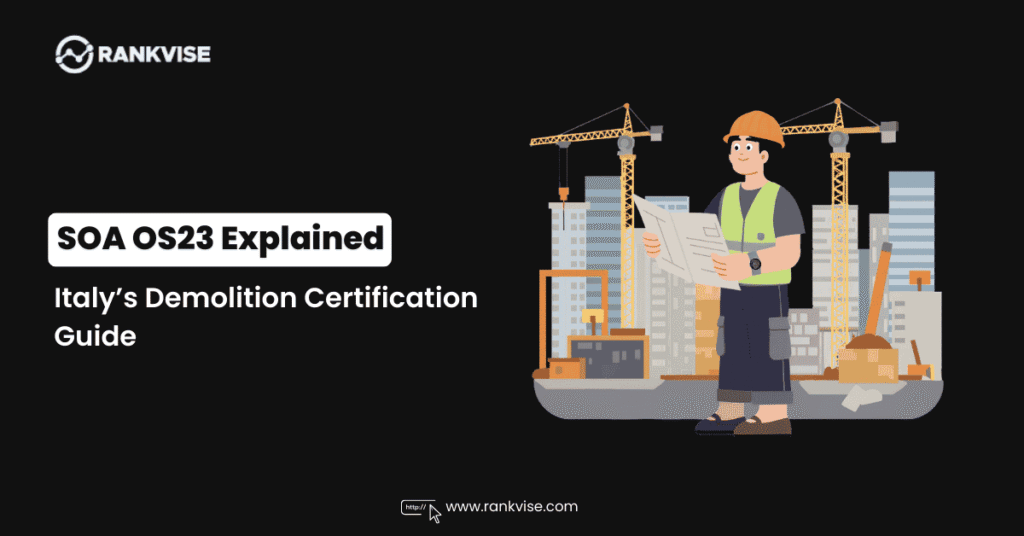
Every year, thousands of Italian construction firms compete for lucrative public demolition contracts. Yet many lose bids before they even begin. The reason? They lack the right certification. SOA OS23 is the qualification that separates credible demolition companies from the rest.
- SOA OS23 certifies technical, safety, and financial capacity for demolition projects under Italy's SOA framework.
- Certification is required for public demolition contracts over €150,000 and valid five years with a three-year interim verification.
- Trends include sustainability mandates, BIM and digital credentialing, and AI tools shaping future compliance and competitiveness.
This guide breaks down everything you need to know about SOA OS23. You will learn what it covers, who needs it, how to get certified, and where the industry is heading. Whether you run a demolition firm or manage public procurement, this is your roadmap to compliance.
What Does SOA OS23 Actually Mean?
SOA OS23 stands for the demolition of works category, known in Italian as “demolizione di opere.” It falls under the OS (Opere Specializzate) classification within Italy’s SOA certification system.
The certification is governed by Annex A of Presidential Decree 207/2010. It validates that a company possesses the technical skill, equipment, and financial stability to execute demolition projects safely and legally.
Think of it as a professional license. Without it, your firm cannot credibly compete for public sector demolition contracts in Italy.
What Type of Work Does SOA OS23 Cover?
SOA OS23 is not limited to swinging a wrecking ball. The category encompasses a wide range of specialized demolition activities that demand precision, safety protocols, and environmental compliance.
Work covered under OS23 includes:
- Controlled explosive demolition of civil and industrial structures
- Mechanical dismantling using hydraulic breakers and crushers
- Precision cutting techniques such as diamond sawing and abrasive wire cutting
- Push-pull and top-down demolition methods for confined urban sites
- Removal, loading, and transport of demolished materials from the worksite
- Selective demolition with material separation for recycling and waste management
This broad scope means OS23-certified firms handle everything from a small residential teardown to the dismantling of large industrial plants.
Who Needs SOA OS23 Certification?
Not every construction company requires this specific qualification. However, the following businesses gain a significant competitive edge by holding it.
Demolition contractors bidding on Italian public works contracts above 150,000 EUR need SOA certification in the relevant category. If your projects involve structural teardowns, OS23 is the category that applies.
Industrial plant decommissioning firms that dismantle factories, power stations, or heavy infrastructure rely on OS23 to prove their capability in high-risk environments.
Environmental remediation companies involved in selective demolition and hazardous material removal also benefit. The certification signals adherence to strict safety and waste management protocols.
Joint venture partners and subcontractors working alongside larger general contractors on public tenders often need OS23 to satisfy consortium qualification requirements.
How the SOA Certification Framework Works in Italy
Italy’s public procurement system uses SOA certifications to pre-qualify firms for government contracts. SOA stands for Società Organismo di Attestazione, which translates to Attestation Body Organization.
These independent bodies evaluate companies across several dimensions before granting certification. The framework splits qualifications into two main groups.
| Category Type | Code Examples | Focus Area |
|---|---|---|
| OG (General Works) | OG1, OG3, OG11 | Broad construction disciplines like buildings, roads, and hydraulic works |
| OS (Specialized Works) | OS23, OS21, OS8 | Niche capabilities like demolition, special structures, and furnishings |
OS23 sits within the specialized works group. While OG categories cover general construction competencies, OS categories prove deep expertise in specific technical disciplines.
Under the Italian Public Procurement Code (D.Lgs. 36/2023), SOA certification becomes mandatory for any public contract exceeding 150,000 EUR. For demolition-specific tenders, OS23 is the relevant classification.
How SOA OS23 Connects to Other Certification Categories
Demolition rarely happens in isolation. Most projects involve reconstruction, structural reinforcement, or site remediation after teardown. This is why OS23 frequently overlaps with other SOA categories.
| Related Category | Description | Why It Connects to OS23 |
|---|---|---|
| OG1 | Civil and industrial buildings | Reconstruction often follows demolition on the same contract |
| OG12 | Restoration and maintenance of heritage buildings | Heritage demolition requires specialized cultural preservation skills |
| OS8 | Provisional and special structures | Temporary shoring and support during phased demolition |
| OS21 | Special structural works | Complex structural interventions before or after demolition |
Firms that hold OS23 alongside complementary categories position themselves for larger, multi-phase contracts. This cross-qualification strategy increases bid eligibility and perceived reliability.
Step-by-Step Process to Obtain SOA OS23
Getting certified is not an overnight task. It requires preparation, documentation, and patience. Here is a clear breakdown of the process.
- Choose an authorized SOA body. Italy has several accredited attestation organizations. Research their fees, processing times, and client reviews before selecting one.
- Prepare your documentation package. This includes company registration records, financial statements for the last five years, proof of completed demolition projects, equipment inventories, and staff qualification records.
- Demonstrate technical capacity. You must prove your firm has completed demolition works of sufficient scale and complexity. The value of past contracts matters. Higher classification tiers (called “classifiche”) require demonstrating larger project portfolios.
- Pass financial stability checks. The SOA body reviews your revenue history, banking references, and overall financial health to confirm you can sustain operations on public contracts.
- Undergo the attestation audit. The SOA body verifies all submitted documentation, conducts checks, and may request clarifications or additional evidence.
- Receive your certification. Once approved, the SOA OS23 attestation is valid for five years, with a mandatory interim verification at the three-year mark.
Typical processing time ranges from 60 to 90 days. Costs vary by classification tier but generally fall between 3,000 EUR and 8,000 EUR for small to mid-sized firms.
Classification Tiers Within SOA OS23
SOA certifications are not one-size-fits-all. Each category has multiple classification levels based on the maximum contract value a firm can bid on.
| Classification | Maximum Contract Value (EUR) |
|---|---|
| I | Up to 258,000 |
| II | Up to 516,000 |
| III | Up to 1,033,000 |
| III-bis | Up to 1,500,000 |
| IV | Up to 2,582,000 |
| IV-bis | Up to 3,500,000 |
| V | Up to 5,165,000 |
| VI | Up to 10,329,000 |
| VII | Up to 15,494,000 |
| VIII | Unlimited |
Firms should target the classification tier that matches their project ambitions and demonstrated track record. Jumping to a higher tier later requires proving additional completed works and financial capacity.
Key Trends Shaping SOA OS23 in 2025 and Beyond
The demolition industry is evolving fast. Several trends are directly impacting how OS23 certification is earned, maintained, and applied.
Stricter sustainability mandates now require certified firms to demonstrate green demolition capabilities. Material separation, recycling targets, and low-emission equipment are becoming baseline expectations rather than optional extras. The European Green Deal and Italy’s National Recovery and Resilience Plan both push demolition firms toward circular economy practices.
BIM integration in demolition planning is gaining traction. Building Information Modelling allows firms to create detailed 3D models of structures before teardown. This supports safer planning, accurate waste estimation, and smoother regulatory approvals. Some public tenders now require BIM deliverables as part of the submission.
Digital credentialing platforms are streamlining the certification process. Online portals allow firms to submit documentation, track application status, and receive automated alerts for renewal deadlines. This reduces paperwork bottlenecks and human error.
AI-powered safety and planning tools are entering demolition workflows. Predictive analytics help assess structural risks before a single wall is touched. Drone-based inspections feed data into AI models that recommend optimal demolition sequences.
Common Challenges and How to Overcome Them
Obtaining and maintaining SOA OS23 is not without hurdles. Understanding these challenges early saves time and money.
Incomplete documentation is the most frequent cause of application delays. Many firms underestimate the volume of records required. Working with an experienced SOA consultant can streamline this process significantly.
Insufficient project history blocks newer firms from higher classification tiers. Consider partnering in joint ventures or temporary business groupings (ATI/RTI) on public contracts to build your portfolio.
Keeping up with regulatory changes is an ongoing effort. Italy’s procurement laws evolve frequently. Subscribe to updates from ANAC (the National Anti-Corruption Authority) and your SOA body to stay informed.
Three-year interim verification catches some firms off guard. Treat it as a mid-term audit. Maintain organized records throughout the certification period rather than scrambling before the review date.
Why SOA OS23 Is a Strategic Business Investment
Certification is more than a compliance checkbox. It opens doors to a steady pipeline of public sector revenue. Italian public works spending on infrastructure renewal and urban redevelopment continues to grow, fueled by EU recovery funds and national investment programs.
Firms with OS23 certification at higher classification tiers gain access to contracts worth millions of euros. They also build credibility that attracts private sector clients who value proven regulatory compliance.
The certification signals operational maturity. It tells clients, partners, and regulators that your company meets rigorous standards for safety, technical skill, and financial reliability. In a competitive market, that distinction wins contracts.
FAQs
It is mandatory for public demolition contracts exceeding 150,000 EUR. Private sector projects do not legally require it, but many clients prefer certified firms.
The certification lasts five years. A mandatory interim verification occurs at the three-year mark to confirm continued compliance.
New firms face challenges since past project experience is a core requirement. Partnering in joint ventures on public contracts helps build the track record needed.
It applies specifically to the Italian public procurement system. However, holding it demonstrates compliance with rigorous national standards, which can support credibility in international bids.
The SOA body may suspend or revoke the certification. The firm would then be ineligible for public contract bids under OS23 until the issues are resolved and a new attestation is issued.