How the white label model works – the agency owns the client relationship while an external provider handles execution
Every agency hits the same wall eventually. A client wants a full SEO campaign – technical audit, content production, and link building all running in parallel. You want the revenue. But the idea of hiring three or four specialists, onboarding them, managing them, and covering their salaries before you’ve billed a dollar makes the whole thing feel like a gamble.
The tension is real. SEO demand is growing fast, the talent market is tight, and the cost of building an internal SEO department from scratch is steep enough to kill the margin before the campaign even delivers results. So how do agencies actually scale their SEO offerings without betting the business on a hiring sprint?
This article looks at the white-label model from an operational perspective: what it actually includes, what it costs compared to in-house, when it makes sense to use it, and how to maintain consistent quality when someone else handles execution.
What does a white-label SEO service actually include?
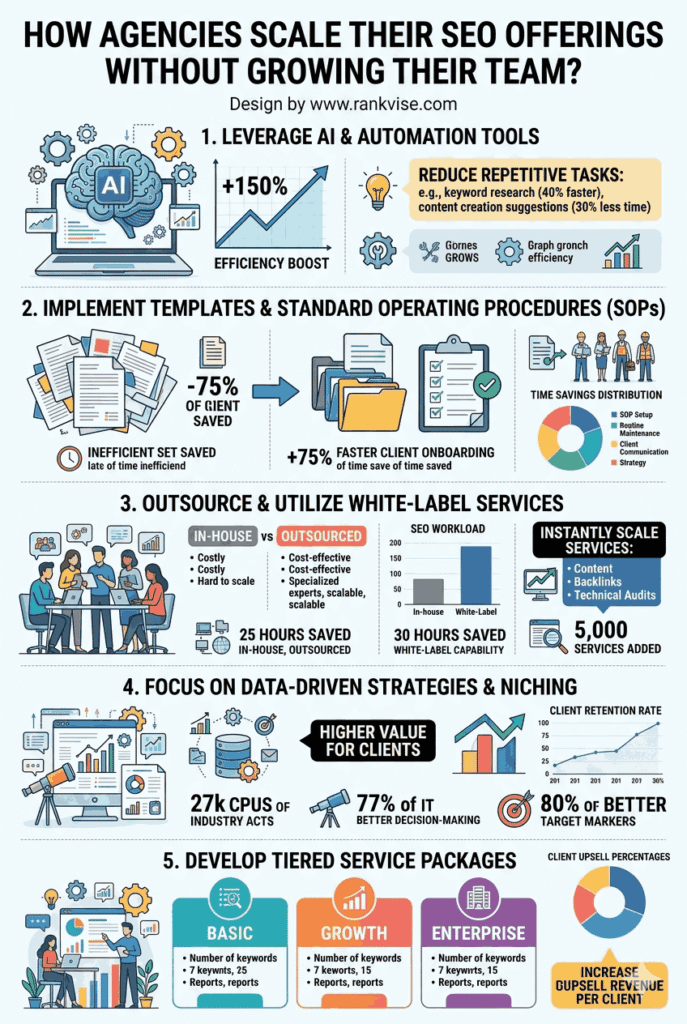
The term gets used loosely, so it’s worth being precise. A white label SEO service is an arrangement where an outside provider delivers SEO work that the agency presents to its clients under its own branding. The client sees the agency’s logo on reports, communicates only with the agency, and has no direct contact with the provider. The agency owns the relationship. The provider handles execution.
This is different from a referral model, in which an agency passes a client to another company. With white labeling, the agency stays in the middle – it manages strategy, sets expectations, reviews deliverables, and takes responsibility for results.
What’s typically included varies by provider, but a full-service arrangement usually covers on-page optimization (keyword research, meta tags, content optimization, internal linking), technical SEO (crawl issues, site speed, mobile performance, schema), link building, local SEO where relevant, and branded reporting dashboards. Some providers specialize in specific verticals or service types. Others offer a broader menu.
The important thing to understand is that the scope isn’t fixed. Agencies can often pick the components they need – say, technical SEO and link building – while continuing to handle content production internally. It’s a modular arrangement, not an all-or-nothing outsource.
Why more agencies are moving in this direction?
SEO demand is growing faster than most agencies can hire. The global SEO services market reached $74.9 billion in 2026 and is projected to grow to $83.98 billion in 2026, according to Resourcera’s 2026 SEO services market analysis. That’s a 12.3% compound annual growth rate – and the agencies competing at that level aren’t all doing it with large internal teams.
According to the 2026 HubSpot Agency Benchmark Report, 61% of agencies already outsource at least one core SEO service, and 29% plan to outsource more. A SEMrush survey from the same year found that 62% of agencies cite access to specialized expertise as their primary reason for outsourcing, while 53% point to scalability as a higher priority than cost savings.
The talent problem is a big driver. Hiring a senior SEO strategist takes an average of four to six months in a competitive market. During that window, you’re either turning down work or delivering below your standard. And if that person leaves a year in, the cycle starts again. It’s not just about salary – it’s the operational drag of constantly backfilling a specialized role.
The agencies that have cracked the capacity problem aren’t necessarily the biggest shops in the market. Many run lean internal teams and rely on established specialist partners for execution-heavy work. The model isn’t new – it’s just becoming standard practice at smaller agency sizes than it used to be.
The real cost of building an in-house SEO team
Annual cost comparison between a full in-house SEO team and a white-label provider retainer
The numbers are sobering when you lay them out. A senior SEO strategist in the U.S. runs $80,000 to $100,000 a year. Add two content writers at $50,000 to $65,000 each, a technical SEO specialist at $75,000 to $90,000, and a link building outreach manager at $55,000 to $70,000. You’re past $300,000 before you’ve counted benefits, payroll taxes, or management overhead.
Then there’s tooling. A credible SEO stack – Ahrefs, Semrush, Screaming Frog, Surfer – costs roughly $15,000 to $30,000 per year. That’s not optional if you’re doing the work properly.
Compare that to outsourcing. According to Near’s 2026 SEO outsourcing research, a white-label partner typically costs $3,000 to $5,000 per month – around $36,000 to $60,000 a year for access to a full specialist team. Agencies generally apply a 40% to 60% gross margin by billing clients $2,000 to $4,000 per month per campaign.
The risk structure is also different. In-house hires are fixed costs. You pay them whether your client pipeline is full or slow. A white label arrangement scales with your volume – add a client, add the service. Lose a client, no redundancy issue.
This isn’t a case where in-house is always worse. Agencies that have a strong, stable client base and the time to invest in building a proprietary methodology may find it worthwhile in-house long term. But for most agencies, especially those in growth phases, the math on white labeling is hard to ignore.
When does white-label SEO make the most sense?
Not every situation calls for it. There are three scenarios where it fits clearly.
The first is when you’re already at capacity. You have more SEO inquiries than your team can handle, you’re turning work down, or you’re stretching existing staff across too many accounts. This is the clearest signal – you have demand but no room to serve it.
The second is when you want to add SEO as a service but don’t have the capability yet. A web development agency or a PPC-focused shop that wants to offer SEO doesn’t have to build the discipline from zero. Partnering with a white label provider lets you offer a credible service while you develop internal understanding of what good SEO execution looks like.
The third is when a specific client’s needs have grown past what your team can handle. A client who started with basic on-page work now needs a technical overhaul and a link-building program. That’s a capability gap, not a strategy gap – and it’s solvable without a hiring cycle.
One honest caution: white labeling isn’t right for agencies that want to compete on the basis of proprietary methodology. If your pitch is “we do SEO differently than anyone else because of our unique process,” you’ll eventually need to own that process internally. White labeling gives you execution, not differentiation. Understand the distinction before you commit to the model.
What to look for in a white-label SEO partner
Choosing a partner is where most agencies underinvest. They compare pricing, pick the cheapest option, and then spend months managing quality problems that cost more in client churn than they saved on fees.
Start with reporting. Branded dashboards and clean, consistent reporting aren’t just cosmetic – they directly affect client retention. The 2026 AgencyAnalytics Marketing Agency Benchmarks Report found that quality of communication and reporting was cited by 70% of respondents as the top factor influencing client retention, ranking above actual results delivery. If your partner can’t produce clean, customizable reports, that gap will show up in your client relationships.
Look at process documentation. Ask the partner to walk you through their standard workflow for onboarding a new campaign. If the answer is vague or varies by account manager, that’s a problem. Deliverable inconsistency at scale is hard to manage from the outside.
Consider vertical experience. When you’re evaluating partners, it’s worth checking whether they have experience in the specific industries your clients work in. Specialized SEO by industry can matter more than agencies realize – what works for a national e-commerce brand doesn’t necessarily transfer to a local service business or a B2B SaaS company.
Ask for anonymized case studies and client retention rates. A strong partner should be able to show 85% to 90% retention benchmarks. Anything below that warrants a hard look at why clients are leaving.
Red flags to watch for: guaranteed rankings, vague descriptions of deliverables, no NDA or confidentiality provisions, and reluctance to explain their reporting methodology. These aren’t negotiating issues – they’re walk-away signals.
How agencies keep quality consistent without doing the work themselves
Regular reporting and KPI tracking are how agencies stay in control of white-label SEO delivery
The agencies that run into trouble with white label SEO aren’t usually the ones who chose the wrong partner. They’re the ones who chose a decent partner and then went hands-off. Quality control is the agency’s job, not the provider’s.
The foundation is a written SLA. Define deliverable timelines, communication protocols, and escalation paths before the first campaign launches. Ambiguity about what’s expected is where quality starts to erode.
Assign someone internally to review deliverables before they go to the client. This person doesn’t need to be a technical SEO expert – they need to be familiar enough with the work to catch obvious gaps and ask the right questions. Relaying deliverables straight from partner to client without review is a pattern that eventually produces a client complaint you weren’t prepared for.
Part of that review process means understanding what’s being built on the link side. Auditing the link profile regularly – including understanding the difference between dofollow and nofollow links and how each type contributes to domain authority – is basic quality control that agencies can’t delegate entirely to a partner.
Set performance benchmarks upfront. Organic traffic targets, ranking movement by keyword cluster, and conversion metrics were trackable. “We’ll do SEO” is not a benchmark. If you can’t measure progress against something specific, you can’t manage the partner – and you can’t defend the engagement when a client asks why they’re not seeing results.
How this model affects client relationships
Clients care about results and communication. They don’t generally care who’s executing the work. A 2022 Gartner report found that 79% of clients renew contracts based on consistent results – not on how the work gets done behind the scenes.
The agency still owns everything the client actually experiences: strategy calls, reporting conversations, issue escalation, and relationship continuity. White labeling doesn’t outsource those things. It handles execution, which frees the agency to focus on the higher-value parts of the relationship.
The retention data is clear. Agencies using established white-label providers report 85% to 90% client retention rates, compared to 60% to 75% for agencies that rely on inconsistent in-house performance. The variable isn’t in-house versus outsourced – it’s whether the execution is consistent and the communication is strong.
Agencies should still be actively directing their SEO content strategy even when production is handled externally. Handing over execution isn’t the same as handing over thinking. The agencies that fare worst with white labeling are the ones that stop being strategically involved and start functioning as a pass-through. That’s when client questions go unanswered, and trust erodes.
On disclosure: some agencies tell clients they partner with external specialists; others don’t. Either approach can work. What doesn’t work is promising a capability you can’t actually deliver, or being unprepared to explain your process when a client asks.
Is white label SEO the right move?
The case for white label SEO comes down to two things: economics and execution speed. Economically, the math favors it for most agencies – lower fixed costs, predictable margins, and access to a full specialist team at a fraction of the cost of building one. At execution, it lets agencies serve SEO clients immediately rather than running a months-long hiring process while revenue sits on the table.
It works best when the agency stays engaged. Strategy, communication, quality control, and client relationship management don’t get outsourced in this model – only the technical execution does. Agencies that treat it as a fully hands-off arrangement tend to run into problems at the client retention stage. The decision isn’t complicated if you’re honest about your current state. Look at your client pipeline, your internal capacity, and the cost of the delay caused by not being able to offer SEO right now. If the gap is real, white-labeling is a practical way to close it without incurring the fixed overhead of a full internal build.