Skip to content
Why Digital Transformation Matters More Than Ever in 2025?
The pace of technological change is accelerating exponentially. For businesses across every industry, this creates an urgent reality: modernize your operations or risk becoming irrelevant. What was optional innovation just three years ago is now a survival requirement for maintaining market share, customer loyalty, and operational efficiency.The Digital Transformation Statistics That Demand Attention
- 99% of businesses plan to adopt emerging tech within the next 12-24 months
- Companies that complete digital transformation are 26% more profitable than competitors
- 70% of digital transformation initiatives fail due to poor planning and execution
- Organizations using AI and automation see 40% reduction in operational costs
- Digital-first companies grow revenue 5x faster than traditional businesses
This isn’t a trend limited to tech startups or Silicon Valley giants. Small businesses, mid-market companies, and Fortune 500 enterprises are all racing to digitize their operations, customer experiences, and business models.
The window of opportunity is closing. Businesses that delay digital transformation face:
- Higher operating costs compared to automated competitors
- Poor customer experiences that drive loyalty to digital-savvy rivals
- Inability to attract top talent who prefer modern, tech-forward employers
- Reduced agility when market conditions change rapidly
4 Key Technologies Driving Business Modernization in 2025
Understanding which emerging technologies deliver the most value is critical for prioritizing your digital transformation investments.
1. Artificial Intelligence (AI) and Machine Learning (ML)
Artificial intelligence and machine learning are revolutionizing how businesses operate, make decisions, and serve customers.
Business Applications of AI:
- Predictive analytics that forecast customer demand, inventory needs, and market trends
- Personalization engines delivering customized recommendations and dynamic pricing
- Intelligent chatbots providing 24/7 customer support with 85% resolution rates
- Fraud detection systems identifying suspicious transactions in milliseconds
- Supply chain optimization reducing waste by 20-30% through demand forecasting
ROI Impact: Companies implementing AI report average productivity gains of 37% and cost reductions of 30-40% in targeted processes.
2. Business Process Automation and RPA
Robotic Process Automation (RPA) and intelligent automation eliminate repetitive tasks, reduce errors, and free employees for strategic work.
High-Impact Automation Use Cases:
- Finance and accounting: Invoice processing, expense reporting, reconciliation
- HR operations: Onboarding, benefits administration, payroll processing
- Customer service: Ticket routing, data entry, status updates
- Compliance: Audit trails, regulatory reporting, document management
- Sales operations: Lead scoring, data enrichment, quote generation
ROI Impact: RPA implementations typically deliver 200-300% ROI within the first year, with payback periods of 6-9 months.
3. Cloud Computing Infrastructure
Cloud computing provides the scalable, flexible foundation that makes digital transformation possible without massive capital investments.
Cloud Computing Benefits:
- Scalability: Instantly adjust computing resources based on demand
- Cost efficiency: Reduce infrastructure costs by 30-50% compared to on-premises
- Business continuity: Built-in disaster recovery and 99.9%+ uptime guarantees
- Faster innovation: Deploy new applications in hours instead of months
- Global accessibility: Enable remote work and international expansion
Market Reality: By 2025, 85% of enterprises have adopted a cloud-first strategy, with multi-cloud architectures becoming the standard.
4. Edge Computing for Real-Time Processing
Edge computing brings processing power closer to data sources, enabling instant decision-making critical for IoT, manufacturing, and customer experience.
Edge Computing Applications:
- Manufacturing: Real-time quality control and predictive maintenance
- Retail: In-store personalization and inventory optimization
- Healthcare: Remote patient monitoring and diagnostic imaging
- Logistics: Fleet tracking and route optimization
- Smart buildings: Energy management and security systems
Performance Impact: Edge computing reduces latency by 90% and bandwidth costs by 40% compared to centralized cloud processing.
Why Fast Adopters Win: Competitive Advantages of Digital Transformation
Businesses that successfully execute digital transformation strategies gain multiple, compounding advantages that become nearly impossible for competitors to overcome.
1. Superior Operational Efficiency and Cost Reduction
Digital transformation directly impacts your bottom line through:
- 30-50% reduction in manual processing costs through automation
- 25-35% improvement in resource utilization through AI optimization
- 40-60% faster cycle times for key business processes
- 70% reduction in errors and rework through automated validation
Real-World Example: A mid-sized manufacturing company implementing cloud ERP and automation reduced order processing time from 48 hours to 4 hours, cutting costs by $2.3M annually.
2. Exceptional Customer Experience and Loyalty
Modern consumers expect personalized, instant, seamless experiences across all channels. Digital leaders deliver:
- Omnichannel consistency: Unified experiences across web, mobile, social, and physical locations
- Personalization at scale: AI-driven recommendations increasing conversion rates by 20-30%
- 24/7 availability: Intelligent chatbots and self-service portals reducing support costs by 40%
- Faster resolution: Integrated systems cutting average response time from days to minutes
Customer Impact: Companies with mature digital transformation report customer satisfaction scores 25% higher than industry averages.
3. Talent Acquisition and Retention Advantage
The war for tech talent is fierce. Digital-forward companies win by:
- Offering modern technology stacks that developers and engineers want to work with
- Enabling remote and flexible work through cloud collaboration tools
- Providing career development opportunities in emerging technologies
- Building innovation cultures that attract ambitious professionals
Recruitment Impact: Tech-forward companies receive 3x more qualified applications and have 50% lower turnover in technical roles.
4. Market Agility and Innovation Speed
Organizational agility—the ability to pivot quickly and capitalize on opportunities—becomes a decisive competitive weapon:
- 50% faster time-to-market for new products and features
- Ability to scale operations 10x without proportional cost increases
- Real-time market intelligence enabling proactive strategy adjustments
- Experimentation capability to test and validate new business models rapidly
5 Common Barriers Slowing Digital Transformation (and How to Overcome Them)
Despite widespread recognition of digital transformation’s importance, 70% of initiatives fail or underdeliver. Understanding common obstacles is the first step to avoiding them.
Barrier #1: Legacy Systems and Technical Debt
The Problem: Outdated systems are expensive to maintain, difficult to integrate, and limit innovation potential.
The Solution:
- Conduct a technology audit to identify critical modernization priorities
- Adopt a phased migration approach rather than risky “rip and replace” strategies
- Implement API layers to integrate legacy systems with modern cloud applications
- Budget 15-20% of IT spend specifically for technical debt reduction
Barrier #2: Skills Gaps and Talent Shortages
The Problem: Organizations lack in-house expertise in AI, cloud architecture, data science, and cybersecurity.
The Solution:
- Launch upskilling programs for existing employees through platforms like Coursera, Udacity, or LinkedIn Learning
- Partner with managed service providers or consultancies to fill immediate gaps
- Implement knowledge transfer requirements in consultant contracts
- Create competitive compensation packages for specialized technical roles
- Build partnerships with universities for internship and recruitment pipelines
Barrier #3: Cultural Resistance to Change
The Problem: Employees fear job loss, struggle with new tools, or prefer familiar processes.
The Solution:
- Secure visible executive sponsorship with regular communication about vision and progress
- Emphasize augmentation over replacement—technology as a tool to enhance human work
- Provide comprehensive training and ongoing support during transitions
- Celebrate early wins and recognize teams driving successful adoption
- Include change management experts in transformation project teams
Barrier #4: Unclear Strategy and Priorities
The Problem: Companies adopt technology without clear business objectives or success metrics.
The Solution:
- Define specific, measurable outcomes tied to business goals (revenue, cost, satisfaction)
- Start with pilot projects in high-impact areas to prove value
- Establish governance structures with cross-functional steering committees
- Use agile methodologies enabling iterative improvement and course correction
- Implement regular review cadences to assess progress and adjust priorities
Barrier #5: Security and Compliance Concerns
The Problem: Fear of data breaches, regulatory violations, or loss of control slows cloud and AI adoption.
The Solution:
- Choose enterprise-grade cloud providers with robust security certifications (SOC 2, ISO 27001, GDPR)
- Implement zero-trust architecture with identity management and encryption
- Conduct regular security audits and penetration testing
- Work with compliance experts familiar with your industry regulations
- Maintain data governance frameworks defining ownership, access, and retention policies
How to Build a Winning Digital Transformation Roadmap (7-Step Framework)
A successful digital transformation strategy requires a structured, phased approach that balances speed with risk management.
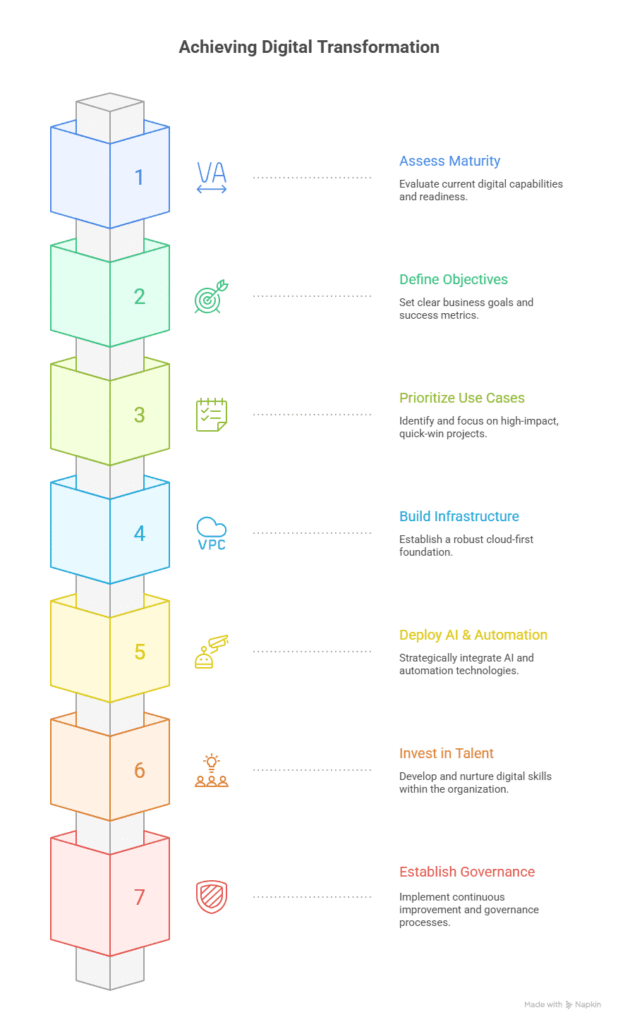
Step 1: Assess Your Current Digital Maturity
Begin with an honest evaluation of where you stand today:
- Infrastructure audit: Catalog all systems, applications, and integrations
- Process mapping: Identify manual workflows, bottlenecks, and inefficiencies
- Skills inventory: Assess current team capabilities and gaps
- Customer experience analysis: Map touchpoints and pain points across the journey
- Competitive benchmarking: Understand where competitors lead or lag
Deliverable: A comprehensive digital maturity scorecard rating capabilities across infrastructure, processes, people, and customer experience.
Step 2: Define Clear Business Objectives and Success Metrics
Digital transformation must tie directly to business outcomes, not just technology adoption:
Example Objectives:
- Reduce customer acquisition costs by 25% through marketing automation
- Improve customer satisfaction (CSAT) scores from 7.2 to 8.5
- Decrease operational costs by 30% through process automation
- Launch new products 50% faster through agile development
- Expand into 3 new markets enabled by cloud infrastructure
Key Metrics to Track:
- Revenue growth and customer lifetime value
- Operating margin and cost per transaction
- Customer satisfaction and Net Promoter Score (NPS)
- Employee productivity and engagement
- Time-to-market for new initiatives
Step 3: Prioritize High-Impact, Quick-Win Use Cases
Rather than attempting organization-wide transformation simultaneously, focus initial efforts on:
Ideal Starting Points:
- High-volume, repetitive processes with clear automation ROI (AP, expense reports)
- Customer pain points impacting satisfaction scores (long wait times, manual processes)
- Revenue-generating activities where improvements directly increase sales
- Risk mitigation addressing security vulnerabilities or compliance gaps
Quick-Win Criteria:
- Achievable within 3-6 months
- Measurable business impact
- Limited dependencies on other systems
- High visibility to build organizational momentum
Step 4: Build a Cloud-First Infrastructure Foundation
Before layering on AI, automation, and advanced analytics, establish a modern infrastructure:
Cloud Migration Priorities:
- Email and collaboration tools (Microsoft 365, Google Workspace)
- CRM and sales systems (Salesforce, HubSpot)
- Financial and ERP systems (NetSuite, SAP S/4HANA Cloud)
- HR and workforce management (Workday, BambooHR)
- Data warehousing and analytics (Snowflake, Google BigQuery)
Migration Approach:
- Use SaaS solutions for standard business functions
- Adopt PaaS for custom applications requiring flexibility
- Reserve IaaS for specialized workloads requiring infrastructure control
- Implement multi-cloud strategy to avoid vendor lock-in
Step 5: Deploy AI and Automation Strategically
With cloud foundations in place, layer intelligent capabilities:
Year 1 Focus:
- Customer service chatbots handling 60-80% of routine inquiries
- RPA for back-office processes (invoice processing, data entry)
- Predictive analytics for demand forecasting and inventory optimization
- Marketing automation for lead nurturing and campaign management
Year 2 Expansion:
- AI-powered personalization across website, app, and email
- Computer vision for quality control or visual search
- Natural language processing for sentiment analysis and insights
- Prescriptive analytics providing recommended actions, not just predictions
Step 6: Invest Heavily in Talent and Culture
Technology alone never delivers transformation—people and culture determine success:
Talent Development Initiatives:
- Certification programs: Sponsor AWS, Azure, Google Cloud certifications
- Innovation time: Allocate 10-20% of time for learning and experimentation
- Cross-functional teams: Break down silos with integrated project squads
- External partnerships: Bring in consultants for specialized expertise and knowledge transfer
Cultural Transformation:
- Leadership modeling: Executives must visibly use and champion new tools
- Communication cadence: Weekly updates on progress, wins, and learnings
- Incentive alignment: Tie bonuses to digital adoption and innovation metrics
- Psychological safety: Encourage experimentation and learn from failures
Step 7: Establish Continuous Improvement and Governance
Digital transformation is not a one-time project—it’s an ongoing operating model:
Governance Structure:
- Digital transformation steering committee meeting monthly
- Center of Excellence (CoE) teams for AI, cloud, automation
- Regular portfolio reviews assessing project health and ROI
- Technology radar tracking emerging capabilities and competitive threats
Conclusion: The Time to Transform Is Now
Digital transformation is no longer optional—it’s an existential requirement for business survival and growth in 2025 and beyond. The statistics are clear: 99% of businesses are moving forward with modernization, those that execute well are 26% more profitable, and the gap between digital leaders and laggards widens daily.
We’ve explored the four key technologies driving transformation (AI, automation, cloud, and edge computing), examined the decisive competitive advantages fast adopters gain, identified the common barriers that derail initiatives, and provided a comprehensive seven-step framework for building your roadmap.
The companies that will thrive in the coming decade are those that:
✅ Act decisively rather than waiting for perfect clarity
✅ Start with strategy tying technology to business outcomes
✅ Focus on quick wins building momentum and proving value
✅ Invest in people alongside technology
✅ Embrace continuous transformation as an operating model
The cost of inaction grows every day. Organizations that delay digital transformation face rising operational costs, declining customer satisfaction, talent exodus, and ultimately, market irrelevance.
The question isn’t whether to pursue digital transformation—it’s whether you’ll be a leader or a follower, a disruptor or the disrupted.