Skip to content
Running social media for a business in 2026 is nothing like it was five years ago. There are more platforms, more content formats, and far more competition for attention. With over 5.6 billion internet users worldwide and people active on an average of seven platforms per month, staying visible everywhere manually is nearly impossible.
Social media management tools solve this problem. They let you schedule posts, track performance, engage with your audience, and manage multiple accounts from a single dashboard. The right tool does not just save hours each week. It gives you the data and consistency needed to actually grow.
This guide covers ten of the best social media management tools available today. Whether you run a solo brand or manage clients at an agency, you will find a platform here that fits your workflow and budget.
Why Social Media Management Matters More Than Ever?
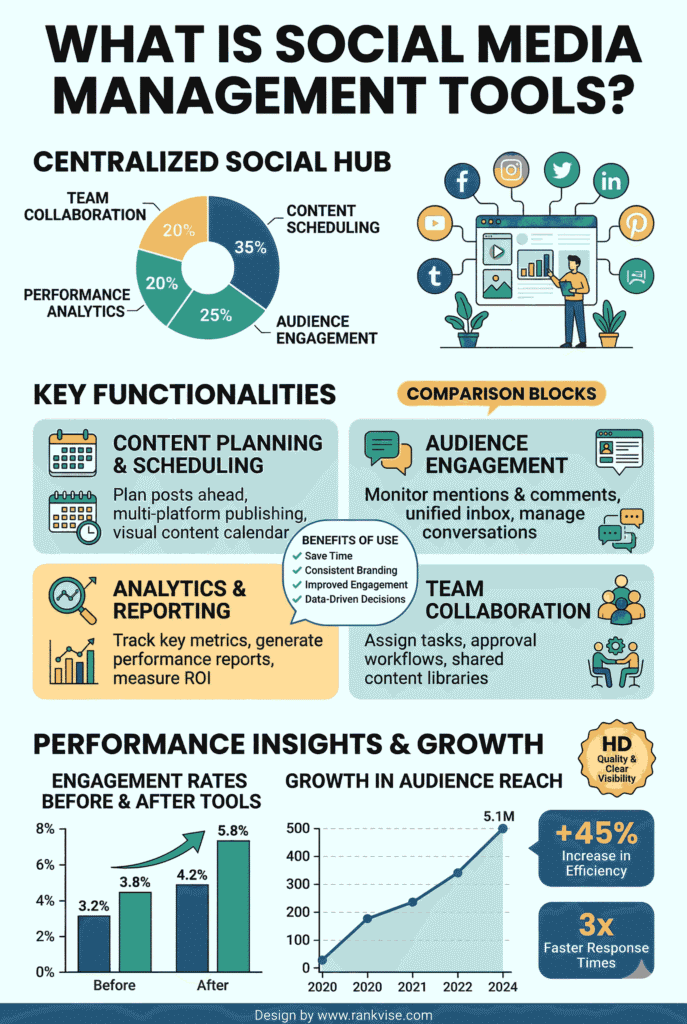
Posting randomly and hoping for results does not work anymore. Audiences expect consistent, high-quality content on every platform they use. That means brands must show up on Instagram, TikTok, LinkedIn, X, Facebook, and YouTube with tailored content for each channel.
Managing all of that without a system leads to burnout and missed opportunities. Users now spend roughly 2.5 hours daily on social platforms. The opportunity is massive, but only if you can publish consistently and optimize based on real performance data.
Social media management is about timing, frequency, engagement, and informed decisions. Tools built for this purpose replace guesswork with clarity. They help you understand what works, when to post, and where your audience actually engages.
Key Features to Look for in Social Media Management Tools
Not all platforms offer the same capabilities. Before choosing a tool, know which features matter most for your goals. Here is what to prioritize.
Scheduling and Automation
The ability to plan and schedule content weeks or months in advance is essential. Good scheduling tools let you queue posts across multiple platforms from one calendar view.
Automation goes further by handling repetitive tasks like reposting evergreen content, publishing at optimal times, or sending follow-up messages. This frees you to focus on strategy instead of manual posting.
Analytics and Performance Tracking
Every post generates data. The best social media analytics tools turn that data into clear reports showing engagement rates, audience growth, reach, and conversions.
You need to know which content performs best, what time your audience is most active, and which platform delivers the highest return. Without analytics, you are operating blind.
Content Creation and Team Collaboration
Creating content consistently is one of the biggest challenges for social media teams. Tools that include built-in design features or integrate with creative platforms simplify production significantly.
Collaboration features matter for teams. Look for approval workflows, content calendars with role-based access, and comment threads that keep feedback organized.
10 Best Social Media Management Tools for 2026
1. Metricool
When it comes to social media management, Metricool stands out as a total arrangement. It’s not fair to a scheduler—it’s a full biological system for overseeing your online presence.
Metricool combines everything you require in one dashboard. From planning posts to analyzing execution, it covers all viewpoints of social media management.
- Social media scheduling
- Advanced analytics
- Inbox management
- Competitor tracking
- Ad execution insights
It too coordinates consistently with instruments like Canva, making substance creation indeed easier.
Benefits of Utilizing Metricool What makes itl uncommon is its straightforwardness. You don’t require bouncing between numerous tools—it’s all in one place.
It spares time, progresses productivity, and makes a difference when you make data-driven choices. For apprentices and experts alike, it’s one of the most capable apparatuses accessible today.
Key strengths:
- Unified analytics covering organic posts and paid ad campaigns
- Competitor tracking and benchmarking across platforms
- Integration with Canva for seamless content creation and scheduling
It appeals to marketers and small agencies that want comprehensive features at a reasonable price. Its ability to monitor ad performance alongside organic metrics sets it apart from many competitors.
2. Buffer
Buffer keeps things simple and effective. It focuses on scheduling, publishing, and analytics without overwhelming users with features they do not need.
Key strengths:
- Clean, intuitive interface that requires almost no learning curve
- AI-powered posting time suggestions based on audience activity
- Engagement tools for responding to comments directly from the dashboard
Buffer is ideal for freelancers, solopreneurs, and small businesses that want a straightforward social media scheduler without enterprise-level complexity or pricing.
3. Sprout Social
Sprout Social combines publishing, analytics, social listening, and customer care into one premium platform. It is built for teams that treat social media as a core business function.
Key strengths:
- Advanced social listening and sentiment analysis
- CRM-style engagement tools for managing audience relationships
- Detailed competitive benchmarking and reporting
Sprout Social fits mid-size to large organizations that need deep analytics and cross-team collaboration. Its reporting capabilities are among the best for demonstrating social media ROI to leadership.
4. Later
Later started as an Instagram-first scheduling tool and has expanded to cover TikTok, Pinterest, LinkedIn, Facebook, and X. Its visual content calendar makes planning highly intuitive.
Key strengths:
- Visual drag-and-drop content calendar
- Linkin.bio feature turning Instagram feeds into shoppable landing pages
- AI-driven caption and hashtag suggestions
Later works well for visual-first brands, creators, and e-commerce businesses. Its strength lies in making Instagram and TikTok planning effortless with media library management built in.
5. Hootsuite
Hootsuite remains one of the most recognized social media scheduling platforms on the market. It supports publishing, monitoring, and reporting across all major networks.
Key strengths:
- Schedule and publish to multiple platforms from one dashboard
- Social listening to track brand mentions and industry conversations
- Customizable analytics reports for clients and stakeholders
Hootsuite suits agencies and enterprise teams managing multiple brand accounts. Its broad integration library connects with over 150 apps, making it a flexible hub for complex workflows.
6. Sendible
Sendible is built specifically for agencies managing multiple clients. It offers white-label reporting, client dashboards, and a content library for streamlined multi-brand management.
Key strengths:
- White-label reports and client-facing dashboards
- Content recommendation engine for discovering shareable material
- Priority inbox for managing messages across all platforms in one view
Agencies that juggle ten or more client accounts find Sendible particularly valuable. Its workflow is designed around agency operations from onboarding to reporting.
7. SocialBee
SocialBee focuses on content categorization and recycling. You organize posts into categories, and the tool automatically balances your publishing schedule to keep your feed diverse.
Key strengths:
- Category-based scheduling that mixes content types automatically
- Evergreen content recycling to maximize the lifespan of high-performing posts
- AI content generation tools for captions and post variations
SocialBee suits content-heavy brands and solo marketers who want to publish frequently without creating new content from scratch every day.
8. Agorapulse
Agorapulse delivers a clean interface with strong engagement and reporting features. Its social inbox centralizes all comments, messages, and mentions into one manageable feed.
Key strengths:
- Unified social inbox with assignment and labeling for team workflows
- One-click ROI tracking connecting social activity to website conversions
- Built-in social listening for brand monitoring
Agorapulse is popular with mid-size businesses and agencies that prioritize community management. Its ROI tracking feature helps justify social media spend with concrete revenue data.
9. Canva (Content Creation Companion)
While not a traditional social media management tool, Canva has become essential to the content creation workflow. It offers thousands of templates designed specifically for social media platforms.
Key strengths:
- Platform-specific templates for Instagram, TikTok, LinkedIn, Facebook, and more
- Brand kit functionality ensuring visual consistency across all content
- Direct publishing and integration with schedulers like Metricool and Buffer
Canva fills the content creation gap that most scheduling tools leave open. Pairing it with a dedicated scheduler creates a powerful end-to-end social media workflow.
10. Brand24
Brand24 is a social listening and online monitoring tool. It tracks mentions of your brand, competitors, and industry keywords across social media, blogs, forums, and news sites.
Key strengths:
- Real-time mention tracking with sentiment analysis
- Influencer identification based on reach and engagement
- Automated PDF reports for stakeholder updates
Brand24 complements your publishing tools by showing you what people say about your brand when you are not posting. It is essential for reputation management and proactive engagement.
How to Choose the Right Social Media Management Tool
Picking the right platform starts with understanding your specific needs. Consider these factors before committing:
- Team size: Solo users thrive with Buffer or Later. Agencies need Sendible or Agorapulse.
- Platform focus: If Instagram and TikTok drive your business, Later and Metricool excel in visual planning.
- Budget: Free tiers from Buffer and Later cover basics. Premium tools like Sprout Social deliver advanced analytics at a higher cost.
- Feature priority: Need strong analytics? Choose Sprout Social. Want content recycling? Go with SocialBee.
- Integration needs: Ensure the tool connects with your existing CRM, design apps, and advertising platforms.
Start by identifying your top three pain points. Then match those against the strengths listed above. Most platforms offer free trials, so test before you commit.
Common Mistakes to Avoid With Social Media Tools
Even the best tools cannot fix a flawed strategy. Avoid these common pitfalls that waste time and budget.
First, do not rely on a single platform for all your reach. Audiences behave differently on LinkedIn versus TikTok. Diversify your presence and tailor content accordingly.
Second, never ignore your analytics. Posting without reviewing performance data means repeating mistakes. Check your reports weekly and adjust your content mix based on what the numbers reveal.
Third, stay consistent. Sporadic posting confuses algorithms and audiences alike. Use your scheduling tool to maintain a steady rhythm, even during busy periods.
FAQs
Buffer, Later, and Metricool offer affordable plans with scheduling, analytics, and multi-platform support, making them ideal for small businesses with limited budgets.
Yes. Most tools like Hootsuite, Sprout Social, and Agorapulse let you schedule, publish, and monitor content across Instagram, Facebook, TikTok, LinkedIn, and X from one dashboard.