Skip to content
In an increasingly digital business environment, organisations are expected to operate faster, deliver better customer experiences, and scale efficiently. However, many companies still struggle with operational bottlenecks caused by manual processes, disconnected systems, and outdated software tools. These inefficiencies slow down productivity, increase operational costs, and limit business growth.
- Automating repetitive tasks removes manual workload, boosts productivity, and lets employees focus on strategic, high-value work.
- Centralizing operations into automated SaaS platforms streamlines workflows, increases real-time visibility, and accelerates cross-team coordination.
- Automation reduces human error, enforces consistent processes, and allows cloud-based SaaS to scale operations without heavy infrastructure investment.
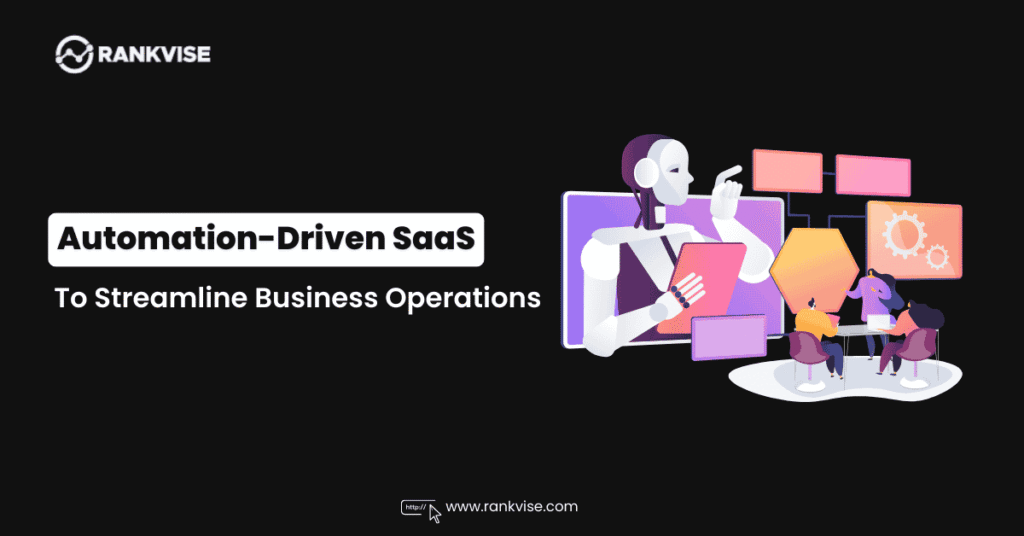
Automation-driven Software as a Service (SaaS) platforms are emerging as a powerful solution to these challenges. By integrating automation, cloud infrastructure, and intelligent workflows, modern SaaS applications help organisations streamline operations and eliminate unnecessary complexity. Businesses across industries are now investing in advanced SaaS Application Development Services to build scalable platforms that reduce manual workloads and improve operational efficiency.
Understanding Operational Bottlenecks in Modern Businesses
Operational bottlenecks refer to a process or system causing a restriction in the passage of work within the confines of the organization. The bottlenecks are mainly caused by inefficient workflows, slow processing of data, and excessive reliance on manual work.
The main causes of operational bottlenecks are:
- Manual data entry and repetitive clerical activities
- Fragmentation in communication between teams
- Limited availability of real-time business information
- Legacy software with no capacity for expansion
- An assortment of disparate tools used in all departments
When the very slow, inefficient processes are depended upon, productivity grinds to a halt, and employees end up spending valuable time performing tasks that could easily be done automatically.
The Rise of Automation in SaaS Platforms
Automation is one of the most poignant characteristics of modern SaaS products. Instead of making employees do routine work, automation-driven platforms do that part itself.
These systems consist of predefined rules, integrations which can act on data triggers without needing human intervention. Examples of such processes include automatic generation of reports, notifications, record updates, and approval processes.
While automating workflows reduces the speed of performance, it also checks human errors and sustains consistency in business processes.
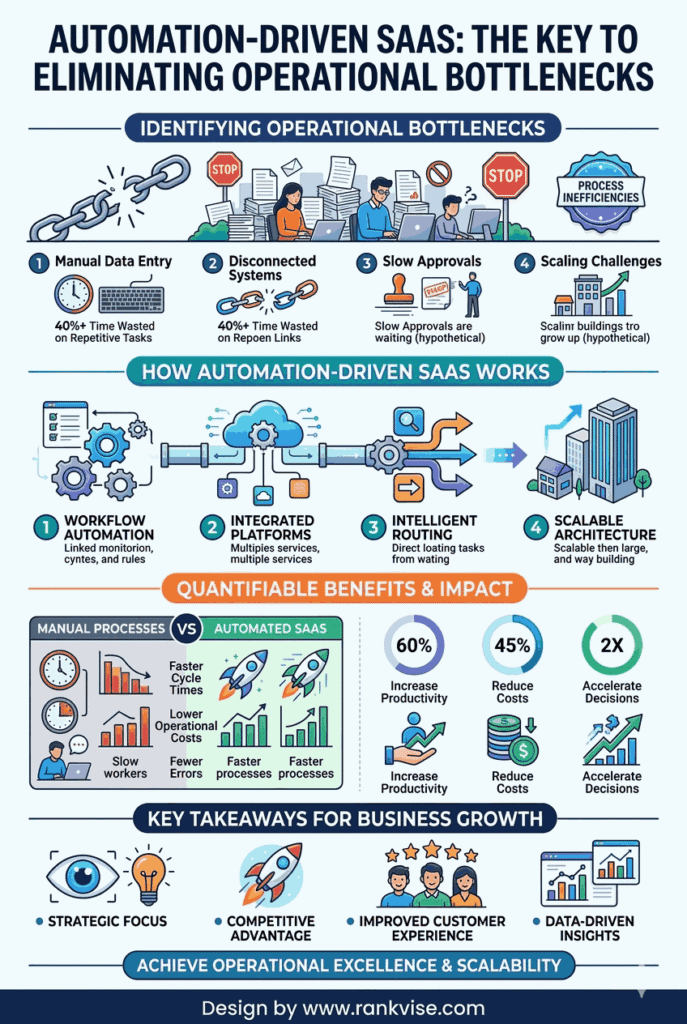
How Automation-Driven SaaS Eliminates Operational Bottlenecks
1. Automating Repetitive Tasks
Operative delays often arise out of recurring activities like data entry, approvals of documents, or information processing. Whenever staff squander their prime time on doing redundant work, it affects productivity on an organization-wide scale.
SaaS model platforms driven automatically with automation have the capacity to eliminate any human intervention-required to carry out these tasks. For example, customer onboarding workflows, task assignment forms, and invoice generation can be completely automated within the realm of SaaS.
This empowers the workers to work on strategic missions and creative ideas instead of remaining confined to irrelevant operational management functions.
2. Improving Workflow Efficiency
Business growth sees – among other things – operation bottlenecks primarily attributed to inefficient workflows. Processes that necessitate multiple approvals, email exchanges, or manual updates introduce severe bottlenecks in operations.
With SaaS platforms organised to produce automated workflows, tasks are automatically pushed to the next stage without human intervention. This automated movement allows for the quick flow of work across departments without undue delays.
Organizations trying to put in place such scalable systems rely on Digital Product Development Services to configure platforms in line with their internal processes and operational needs.
3. Centralising Business Operations
Many companies exist which are a network of independent tools for project management, communication, financials, and data analysis. Helper tools may indeed have their use in isolation. Nonetheless, these tools end up creating unsolvable problems as set close to inline infinity, between them.
SaaS platforms, based on a killer process automation functionality, put together in one neck-breaking digital environment: teams looking at data from any imaginable angle can also, efficiently, work together according to the same dataset. These platforms enable teams to coordinate and organize while removing needs to switch between multiple applications.
Centralization also ensures data consistency and evades the danger of duplicate data across multiple systems.
4. Enhancing visibility into data
Most bottlenecks crop up due to non-availability of real-time information to decision-makers that impede the quick decision-making process. Accurate information spells out not only deficiencies within an organization, but also determines what actions should be taken in respect of equals that arise.
State-of-the-art SaaS platforms come with sophisticated dashboards, tools for creating analytics, and automated generation of reports. All these capabilities come in handy for businesses to map or link the performance metrics, hence track the operational trends, as well as base decisions on real-time insights.
A business risk is any condition in the business process that adversely affects the identification of a problem of which it can escalate into a major operational issue.
5. Extinction Of Human Error
The likelihood of errors is increased by manual processes, in particular when they are characterized by repetitive actions or complex data management. Documental errors, mistakes in calculations, and delays coupled to reports make for an escalation of operational costs in any given industry.
The key method of mitigating such risks is forming an automated SaaS system in which processes themselves are tightly regulated; the task is automatically executed upon configuration. This thereby leads to more accurate workflow within the business and, hence, reliability.
6. May a Business Scale
As organizations grow, their operational needs become more and more complex. Manual processes that once suited small management teams frequently become inefficient as the business grows.
SaaS-based platforms, powered by automation and cloud infrastructure, have the inherent ability to amplify the operational demand that may arise per business expansion. Businesses would not have to invest in significant infrastructure to add new users, integrate more features, and thus increase their functionality completely.
Many organizations partner with another specialized product engineering agency in asutralia to design a SaaS platform that morphs based on their growth strategy to support long-term scalability and performance.
Industries Embracing Automation-Driven SaaS
SaaS has automated its services in many aspects of different sectors, changing how operational procedures are otherwise carried out. Financial encryption, compliance checks, transaction monitoring, and reporting system are all automated in the financial services sector.
In healthcare, automated SaaS platforms maintain patient data, appointment scheduling, and regulatory documentation accordingly.
The retail industry employs SaaS applications for the automation of inventory management, order fulfilment, and customer interaction tasks.
For logistics, users employ SaaS applications to help in route planning, shipment tracking, and supply chain visibility as well.
Across all industries aforementioned, what automation does mostly is reduce operational glides while enhancing service delivery.
Automation-Driven SaaS Gets Stronger with Future Technologies
Automation technologies are undergoing rapid changes whereas software-as-a-service platforms are witnessing the infusion of intelligence. Emerging technological advancements such as artificial intelligence and predictive analytics are thus augmenting the capacities of systems driven by automation.
The SaaS platforms of the future are likely to be equipped with intelligent functionalities for decision support, workflow optimization enabled by prediction, and customer interaction smartly.
operational inefficiencies will be further reduced and enable businesses to operate with more agility
Conclusion
Operational bottlenecks remain one of the biggest barriers to business efficiency and growth. Manual processes, disconnected tools, and limited data visibility create unnecessary complexity within organisations.
Automation-driven SaaS platforms offer a powerful solution by streamlining workflows, improving data access, and eliminating repetitive tasks. As businesses continue to embrace digital transformation, the demand for scalable and intelligent SaaS solutions will only increase.
Organisations that invest in automation-driven SaaS platforms today will be better equipped to build efficient, future-ready operations capable of adapting to evolving market demands.