Skip to content

A single blog post can rank. A single video can go viral. But a single story rarely builds lasting authority. Audiences today expect depth, context, and fresh perspectives every time they engage with a brand.
- Explore one core topic through several distinct narratives to build depth and lasting authority.
- Map three to five unique angles using PECA: Personal, Expert, Case Study, Analytical perspectives.
- Match each angle to the best format and mix media to meet audience preferences and platforms.
- Create deliberate internal linking with a pillar article and spoke-style substories for crawlability and navigation.
- Publish and promote as a staggered series, measure cluster-level metrics, and iterate based on performance.
That is exactly why a your topics multiple stories approach works so well. Instead of covering a subject once and moving on, you explore it through several connected narratives, each offering a different angle, format, or voice.
According to HubSpot’s 2024 State of Marketing report, companies that publish content clusters around core topics generate 3.5 times more organic traffic than those relying on standalone posts. The multi-story model is how modern brands earn trust, rank higher, and keep readers coming back.
This guide breaks down exactly how to implement this strategy, whether you run a business blog, teach online, or create content for a living.
What Does Your Topics Multiple Stories Actually Mean?
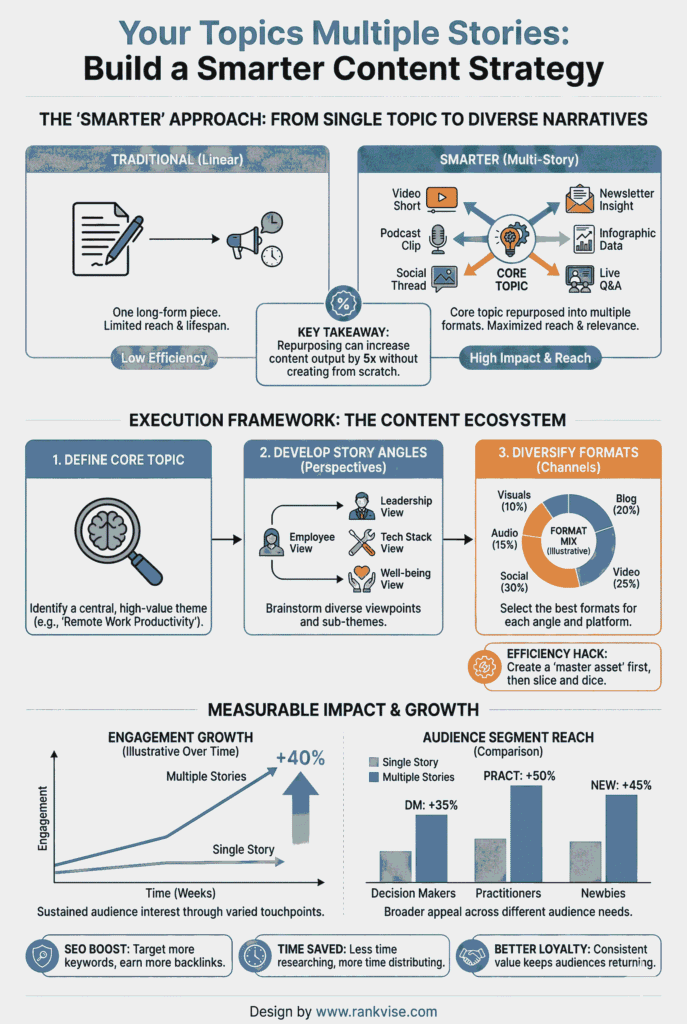
Your topics multiple stories is a content approach where one central theme branches into several distinct but connected narratives. Each story explores a unique angle, targets a different audience segment, or uses a different format.
Think of it like a documentary series versus a single news clip. The series covers the same subject but through interviews, data visualizations, personal accounts, and expert analysis. Every piece adds value on its own, yet together they create a comprehensive picture.
A 2023 Orbit Media study found that bloggers who cover a topic from three or more angles are 2.3 times more likely to report strong results. The reason is simple. People process information differently. Some want data. Others want personal stories. A multi-narrative content strategy serves all of them.
This is not about publishing repetitive content. It is about deliberate diversification around a shared theme, using layered storytelling to serve both search engines and human readers.
Why This Strategy Wins Over Single-Story Content
Most content teams still operate in a “one topic, one post” mode. That approach leaves significant value on the table. Here is why a multiple story angles framework consistently outperforms it.
It Builds Topical Authority Faster
Google’s helpful content system rewards websites that demonstrate deep expertise on a subject. Publishing five connected pieces around one theme signals to search algorithms that your site genuinely understands that space. According to Semrush’s 2024 ranking factors study, topical depth is among the top five on-page signals influencing first-page rankings.
It Captures More Search Intent
A single article can only target one primary intent at a time. With a topic-based storytelling approach, you cover informational, navigational, and even transactional queries. One piece might explain the concept, another reviews tools, and a third shares a step-by-step tutorial. Together, they capture traffic across the entire buyer journey.
It Increases Time on Site and Reduces Bounce Rate
When readers land on one story and find links to related narratives, they stay longer. Data from Contentsquare’s 2024 Digital Experience Benchmark shows that internal linking between related content pieces increases average session duration by 27%. That engagement metric directly supports better rankings.
It Resonates Emotionally With Diverse Audiences
Not everyone connects with the same storytelling format. A case study might convert a skeptical executive, while a personal narrative wins over a first-time visitor. Content diversification ensures you reach people where they are emotionally, not just informationally.
Real-World Examples of Multi-Narrative Content Done Right
Theory only goes so far. Here is how leading brands and creators apply a your topics multiple stories model in practice.
Patagonia and Environmental Storytelling. Patagonia covers sustainability through customer adventure stories, supply chain transparency reports, documentary films, and grassroots activism profiles. Each piece stands alone, yet collectively they reinforce the brand’s environmental mission. Their content drives over 4.5 million monthly organic visits, according to SimilarWeb estimates.
Harvard Business Review and Leadership Content. HBR does not publish one article on leadership and move on. They explore it through academic research summaries, CEO interviews, opinion columns, and reader case studies. This multi-perspective content model makes HBR the default resource for anyone searching leadership-related queries.
A Small Business Example. A local fitness studio could cover “post-injury recovery” through a client success story, an interview with a physiotherapist, a video demonstration of safe exercises, and an infographic showing recovery timelines. Four pieces, one topic, four distinct audiences served.
How to Build Your Topics Multiple Stories Framework
Implementing this strategy does not require a large team. It requires a clear process. Follow these five steps to turn any core topic into a multi-story content cluster.
Step 1: Select a Core Topic With Depth
Choose a subject your audience genuinely cares about and that has enough substance to explore from multiple directions. Ask three questions. Does this topic have emotional, practical, and analytical dimensions? Can I find at least three distinct angles? Does it align with my brand expertise?
Good examples include “remote work productivity,” “sustainable investing,” or “AI in small business.” Narrow topics like “how to reset a password” typically lack the depth this approach demands.
Step 2: Map Out Three to Five Unique Angles
For each core topic, brainstorm angles that serve different reader needs. A useful framework is the PECA model, which stands for Personal, Expert, Case Study, and Analytical perspectives.
| Angle Type | What It Covers | Best Format |
|---|---|---|
| Personal | First-hand experience or customer story | Blog post, video |
| Expert | Professional insight or interview | Podcast, Q&A article |
| Case Study | Real results with measurable outcomes | Long-form article, PDF |
| Analytical | Data trends, research findings, comparisons | Infographic, report |
This model ensures each piece offers something distinct. It prevents the repetition trap that weakens many content cluster strategies.
Step 3: Match Each Angle to the Right Format
Not every story works best as a blog post. A data-heavy piece might shine as an infographic. A personal account might land better as a short video or podcast episode.
According to Wyzowl’s 2024 Video Marketing Statistics report, 89% of consumers say watching a video convinced them to buy a product or service. Mixing formats is not optional anymore. It is how you meet audiences on their preferred platforms.
Step 4: Create an Internal Linking Structure
Connect your stories through deliberate internal links. Your main pillar article links to each sub-story, and each sub-story links back. This creates a content hub that search engines can crawl efficiently and readers can navigate intuitively.
Think of the structure as a wheel. The core topic sits at the center. Each story is a spoke. The rim connecting them is your internal linking architecture.
Step 5: Publish Strategically and Promote as a Series
Do not publish all pieces on the same day. Space them out over two to four weeks. Promote each one individually on social media, email, and relevant communities. Then, once all pieces are live, promote the complete series as a comprehensive resource.
This approach maximizes reach for each individual piece while building cumulative authority for the entire cluster.
Common Pitfalls and How to Avoid Them
Even strong strategies fail without proper execution. These are the most frequent mistakes content teams make with a layered storytelling approach, along with practical solutions.
Overlapping narratives that feel repetitive. Before writing, outline the unique value proposition of each piece. If two stories cover the same ground, merge them or reframe one from a completely different perspective.
Losing the connecting thread. Every sub-story should reference the core theme explicitly. Use a consistent tagline, recurring visual branding, or a brief introduction that ties each piece back to the central idea.
Publishing without a linking plan. Stories that exist in isolation lose their cluster power. Map your internal links before you publish the first piece, not after the last one goes live.
Ignoring performance data. Track which stories drive the most traffic, engagement, and conversions. Use those insights to decide which angles deserve follow-up content and which need reworking.
Measuring the Impact of Your Multi-Story Strategy
You cannot improve what you do not measure. Track these key metrics to evaluate whether your your topics multiple stories approach delivers results.
Monitor organic traffic growth for the entire topic cluster, not just individual posts. Watch for improvements in average session duration and pages per session, both signals that readers are moving between related stories. Track keyword rankings across all targeted queries to confirm that your topical authority is expanding.
According to Content Marketing Institute’s 2024 B2B report, 72% of the most successful content marketers use content clusters as a core strategy. They measure success at the cluster level, not the individual post level. That mindset shift is critical.
Who Benefits Most From This Approach?
A multi-narrative content strategy works across industries, but certain use cases see outsized returns.
B2B marketers benefit because complex products require multiple touchpoints before a prospect converts. Educators and course creators benefit because layered storytelling improves comprehension and knowledge retention. Media publishers benefit because covering news from multiple angles increases share-of-voice and credibility. Freelancers and consultants benefit because demonstrating depth of knowledge attracts higher-quality clients.
If your audience makes decisions based on trust and expertise, this strategy accelerates both.
Start Building Deeper Content Today
Your topics multiple stories is not a trend. It is how effective content strategy works in a world where attention is fragmented and trust is earned through depth.
Start with one core topic this week. Map out three angles. Choose diverse formats. Link them together. Measure the results. Then repeat for your next topic.
The brands and creators winning organic traffic today are not publishing more content. They are publishing smarter, more connected content. This framework gives you the blueprint to do exactly that.
FAQs
It is an approach where one central theme is explored through several connected narratives, each offering a different angle, format, or perspective to build topical depth and audience engagement.
Three to five stories per core topic works best. Fewer than three limits depth, while more than five risks overwhelming your audience and diluting focus.
Yes. Search engines reward topical authority. Publishing interconnected content around one theme signals expertise and increases your chances of ranking for related long-tail keywords.
Absolutely. A small business can start with one pillar blog post, a short video, and a customer testimonial. Even three well-linked pieces build more authority than a dozen unrelated posts.
Content mapping tools like Trello, Notion, or Airtable help track angles and publishing schedules. SEO platforms like Semrush or Ahrefs help identify keyword clusters to target across your stories.