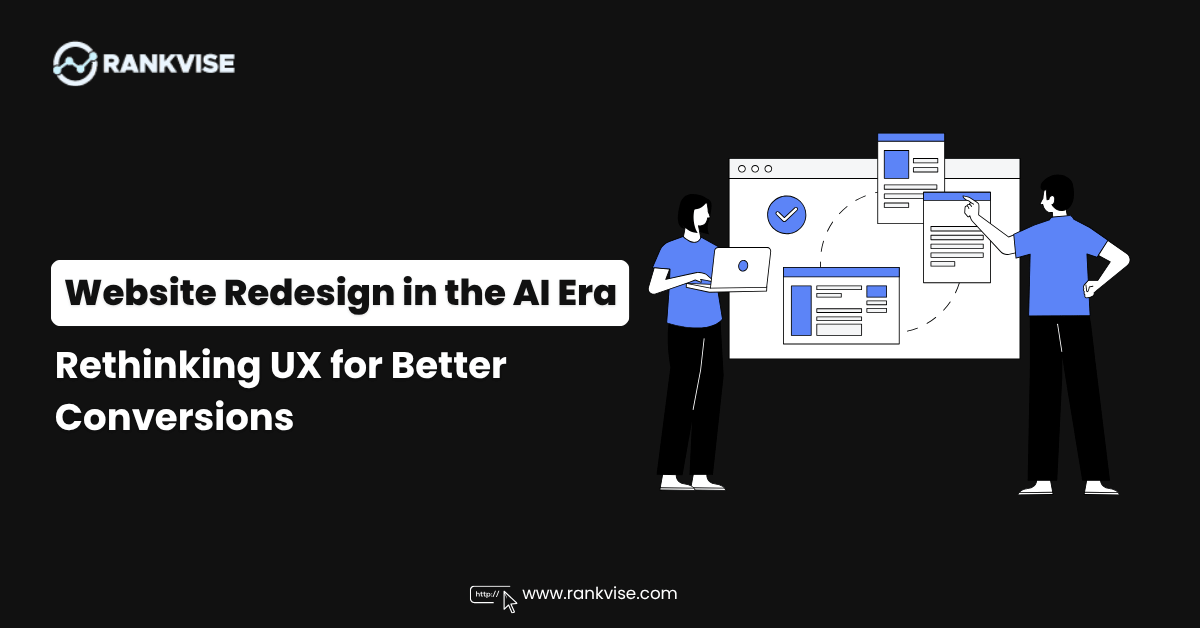
A website redesign used to mean a new visual identity, cleaner navigation, better mobile responsiveness, and perhaps a faster CMS.
That definition is no longer enough.
Today, users arrive with higher expectations, shorter attention spans, and more context than before. They may discover a brand through search, social, paid media, an AI-generated answer, or a recommendation platform. By the time they reach the website, they often expect immediate relevance.
That changes what a website redesign needs to accomplish.
The goal is not simply to make the website look newer. It is to make it easier for users to understand the brand, locate the right information, evaluate the offer, and move toward a decision with as little friction as possible.
AI can help with that process. But only when it is used to improve the user journey rather than decorate it with unnecessary features.
The real redesign opportunity in the AI era is not automation for its own sake.
It is better decision-making.
Website Redesign Has Moved Beyond the Visual Layer
A modern website is not just a collection of pages. It is part brand experience, part sales environment, part information architecture, and part conversion system.
That means redesign decisions need to go deeper than typography, imagery, animations, and layout.
Before changing the interface, businesses should understand:
- why users are arriving,
- what information they need first,
- where they hesitate,
- which pages influence decisions,
- what causes them to leave,
- and what separates high-intent visitors from casual traffic.
This is where custom website design and development becomes more valuable than simply applying a new template. The website can be structured around the actual customer journey rather than forcing the business into a predefined layout.
For brands reconsidering their digital experience, website development should therefore connect design decisions with business goals, content architecture, performance, responsiveness, and conversion pathways.
A redesign should solve problems.
A new color palette is not a problem solved.
AI Changes How We Understand User Intent
Traditional UX analysis relies on data such as page views, conversion paths, session recordings, heatmaps, bounce patterns, search terms, surveys, and usability testing.
Those inputs remain important.
AI adds another analytical layer by helping teams process larger volumes of behavioral and qualitative data more efficiently.
For example, AI-assisted analysis can help teams:
- identify recurring themes across user feedback,
- group visitors by behavioral patterns,
- detect unusual drop-off points,
- analyze on-site search behavior,
- compare the performance of content variations,
- surface common questions from customer conversations,
- and identify patterns that may be difficult to see manually.
This does not mean AI should redesign the website independently.
It means teams can enter the redesign process with a more informed view of what users are actually doing.
Good website redesign strategies increasingly start with behavioral evidence rather than subjective conversations about what the homepage should look like.
The question changes from:
“What should we redesign?”
to:
“What is preventing users from progressing?”
That is a much better starting point.
AI-Powered Website Design Still Needs Human UX Thinking
There is a temptation to interpret AI-powered website design as automatically generated layouts, copy, images, and user flows.
That is the least interesting application of AI.
The more valuable opportunity is using AI to inform the decisions behind the interface.
- Should returning visitors see the same homepage as first-time visitors?
- Should enterprise prospects be directed toward case studies while smaller businesses see product packages?
- Which proof points should appear near a pricing decision?
- Which page should a visitor see after reading a specific article?
- Where does personalization improve relevance, and where does it become distracting?
These are UX questions before they are AI questions.
Effective UI and UX design services should therefore combine behavioral insight with information architecture, usability, accessibility, interface design, and conversion logic.
AI can help identify patterns and accelerate testing. It cannot compensate for a poorly understood user.
Redesign Around Decisions, Not Pages
One of the biggest weaknesses in conventional redesign projects is that teams redesign page by page.
- Homepage.
- About.
- Services.
- Contact.
- Case studies.
That structure is convenient internally, but users do not experience websites as departmental page inventories.
They experience a sequence of decisions.
A visitor might move through:
Problem → Possible solution → Brand credibility → Service detail → Evidence → Enquiry
Another might take:
Search result → Blog → Case study → Pricing → Sales call
A strong website user experience (UX) is designed around these journeys. That requires asking what the visitor needs at each point.
If someone is evaluating a service, they may need proof before another brand statement.
If they are comparing vendors, a case study may be more useful than another promotional CTA.
If they are unfamiliar with the category, educational content may need to come before pricing.
This is why wireframing and prototyping remain important even in an AI-supported design environment. They allow teams to test hierarchy, flow, navigation, and decision paths before committing development resources.
The purpose is not to create prettier pages. It is to create clearer journeys.
UX Design for Conversions Is Mostly About Reducing Uncertainty
Conversion problems are often treated as interface problems.
Make the CTA larger. Shorten the form. Change the headline. Move the button higher.
Those changes can help, but meaningful UX design for conversions goes deeper.
Users usually fail to convert because something remains unresolved.
- They may not understand the offer.
- They may not trust the company.
- They may not see enough evidence.
- They may not know what happens after submitting the form.
- They may be comparing alternatives.
- They may simply be in the wrong stage of the buying journey.
A good redesign removes these uncertainties systematically.
That could mean:
- placing case studies closer to service pages,
- making pricing logic easier to understand,
- replacing vague claims with measurable outcomes,
- simplifying navigation,
- clarifying CTAs,
- introducing lower-commitment conversion options,
- or surfacing FAQs at moments where hesitation typically occurs.
Conversion-oriented UX is not about forcing action. It is about making the next logical action easier to justify.
Content Architecture Matters as Much as Interface Design
A website can look exceptional and still be difficult to understand. This happens when design improves but content architecture does not.
The homepage contains broad positioning statements. Service pages repeat the same language. Blogs attract traffic but do not connect to commercial pages. Case studies exist somewhere in the navigation but rarely appear within buying journeys. Important information is available, but users have to work to find it.
That is not a content volume problem. It is a structure problem.
A redesign should therefore examine what information belongs on each page, how it supports user intent, and where users should go next.
A strong website content strategy should connect informational content with consideration and conversion pages rather than treating the blog as a separate traffic channel. This matters even more as search behavior evolves.
Visitors arriving through AI-assisted discovery, long-tail search, or highly specific queries may enter the site much deeper than the homepage. Every important landing page therefore needs enough context to establish relevance, credibility, and a clear next step.
The website cannot depend on users following one perfect funnel.
Personalization Should Improve Relevance, Not Create Noise
AI has made website personalization considerably more accessible.
Brands can potentially adapt content based on referral source, geography, previous behavior, account type, product interest, or engagement history. Used well, personalization reduces unnecessary searching. Used badly, it creates a fragmented and unpredictable experience.
Showing an enterprise prospect a relevant case study is useful. Changing half the homepage because an anonymous visitor clicked one blog article probably is not.
The principle should be simple:
Personalize when there is enough reliable context to make the experience more useful.
The goal is relevance, not novelty.
Any AI-led personalization strategy also needs clear governance around data quality, privacy, consent, and how automated decisions affect the experience.
More personalization is not automatically better UX. More appropriate personalization is.
AI Website Optimization Should Be Continuous
Traditional redesign projects often follow a familiar cycle:
- Launch the new website.
- Celebrate.
- Leave it largely unchanged for several years.
- Then redesign it again.
That model makes less sense when businesses have access to continuous behavioral data, experimentation platforms, and AI-assisted analysis.
AI website optimization can help teams treat the website as an evolving system rather than a finished asset.
After launch, teams should continue monitoring:
- conversion by landing page,
- user flow between key pages,
- navigation behavior,
- form abandonment,
- device-specific performance,
- engagement by traffic source,
- on-site search,
- and interaction with important content.
A data-driven design approach means using those signals to prioritize improvements rather than waiting for the next large redesign. The strongest website may not be the one that launches with the most features. It may be the one that learns fastest.
Do Not Let AI Make the Website Feel Less Human
There is one final risk.
As AI makes it easier to generate copy, layouts, visuals, chat experiences, recommendations, and personalization, websites can become more technically sophisticated while becoming less distinctive.
Generic AI-generated copy creates generic brands. Overpersonalization feels intrusive. Unnecessary chatbots create friction rather than reducing it. Predictive interfaces can confuse users when the system guesses incorrectly.
Automation should therefore be judged against a simple standard:
Does this make the experience clearer, faster, or more relevant for the user?
If the answer is no, the AI feature probably does not belong there.
A strong redesign does not need to advertise how much AI it uses. Users care about whether the website understands what they need.
Rethinking Website Redesign for the AI Era
The biggest shift in website redesign is not that AI can produce websites faster.
It is that businesses now have better tools for understanding behavior, testing assumptions, adapting experiences, and improving journeys after launch.
That creates an opportunity to move away from redesigns driven mainly by aesthetics.
The better model is:
Understand intent → Map journeys → Reduce friction → Build credibility → Test → Learn → Improve
AI can support almost every stage of that cycle. But strategy still decides what matters. UX still determines whether the experience makes sense. Brand still determines whether it feels distinctive. And customers still decide whether any of it is convincing enough to act.
The best websites in the AI era will not necessarily be the ones with the most automation. They will be the ones that use technology to make buying decisions simpler.
FAQs
What is the role of AI in website redesign?
AI can support website redesign by analyzing behavioral data, identifying user patterns, helping teams test content variations, and informing personalization. It should support UX decisions rather than replace human strategy and design judgment.
How can a website redesign improve conversions?
A redesign can improve conversions by clarifying positioning, simplifying navigation, strengthening trust signals, reducing friction, and creating more relevant pathways for users at different stages of the buying journey.
What is AI-powered website design?
AI-powered website design uses artificial intelligence to support areas such as behavioral analysis, personalization, content optimization, experimentation, and experience improvement. It goes beyond simply generating layouts or website copy.
Why is UX important during a website redesign?
Website user experience determines how easily visitors can understand information, navigate the site, evaluate an offer, and complete important actions. Poor UX can reduce conversions even when the website attracts strong traffic.
Is AI website optimization a one-time process?
No. AI website optimization works best as an ongoing process in which behavioral data, experimentation, and user feedback are used to identify and prioritize continuous improvements after launch.