Skip to content
For Consumer Packaged Goods (CPG) brands, trade promotion effectiveness is no longer a side topic for a monthly report. It sits right in the middle of margin, retailer strategy, forecasting, and growth. Companies allocate a large share of revenue to promotions, yet too many events still fail to deliver real incremental value. McKinsey reports that CPG companies spend about 20% of revenue on trade promotions, while 59% of promotions globally lose money, and the U.S. figure reaches 72%. Those numbers explain why the conversation has shifted from “Did sales go up?” to “Did the business actually benefit?”
- Judge promotions by incremental profit, net revenue impact, and post-event effects rather than shipment lift alone.
- Use stronger analytics and event-level metrics to plan, measure, and learn before and after promotions, tightening spend and targeting.
- Align sales, finance, supply, and category teams, and enforce execution quality to make promotions repeatable and protect margin.
That is the point of this article. It looks at how consumer goods companies can turn broad promotional spending into clearer commercial discipline, stronger measurement, and better business results. The goal is not to make promotions disappear. It is to make them smarter. A promotion should be judged by what it adds after accounting for costs, execution realities, and post-event effects. Once that becomes the standard, teams stop chasing volume for its own sake and start treating promotion strategy as a serious growth lever.
Why Trade Promotion Effectiveness Has Become A Board-Level Issue In CPG
Trade promotions used to be treated as a sales lever that sat mostly with account teams. That view is too narrow now. Promotions affect profitability, retailer negotiations, supply planning, pricing discipline, and net revenue management. When the business spends this much money on discounts, displays, features, and temporary price cuts, poor decisions extend far beyond a single account plan. They affect the whole operating model.
The urgency has also increased. Inflation pressure, more aggressive private-label competition, shifting shopper behavior, and tougher ROI expectations have made weak promotions more expensive than before. A bad event does not just miss a target. It can train shoppers to wait for discounts, create waste in the supply chain, and damage margin quality. That is why the boardroom now cares. Promotional performance is not just a sales output. It is a business performance issue that touches finance, operations, commercial planning, and category strategy simultaneously.
What The Article Should Focus On
A useful discussion of promotional performance needs to stay close to business reality. The article should define success through the areas that matter most for CPG teams:
- Incremental sales and profit, not just shipment lift
- Margin protection and net revenue impact
- Promotion design, depth, timing, and execution quality
- Analytics, measurement, and post-event learning
- Coordination between sales, finance, supply chain, and category teams
Those five areas matter because promotions fail for different reasons. Some are badly designed. Some are executed badly. Some look successful only because the business measured the wrong outcome. A strong article should keep those distinctions clear. That helps the reader understand that better promotion performance is not only about spending less. It is about spending with more discipline and learning faster from each event.
What Trade Promotion Effectiveness Really Means Beyond Basic Volume Uplift
Many teams still consider a promotion successful when shipment volume increases during the event window. That is too simple. Volume can rise while profit falls. Demand can be pulled forward from future weeks. One promoted SKU can cannibalize another. Retailers can load in more stock than they actually sell through. On paper, the event looks active. In business terms, it may still be weak.
Real effectiveness means something tougher. It means the promotion created incremental value after accounting for baseline demand, trade spend, stock effects, retailer execution, and post-event impact. That includes margin quality, not just volume. It also includes what happened after the promotion ended. Did demand collapse? Did the event bring in new shoppers or mostly subsidize existing ones? Stronger definitions matter because they stop teams from rewarding the wrong behavior. A promotion is not effective because it was visible. It is effective because it has measurably improved the business.
Why So Many CPG Promotions Fail To Deliver Real Business Results
Weak promotions usually fail long before the shelf tag changes. They start with shallow assumptions, repeated discount habits, poor customer segmentation, and broad planning logic that does not reflect store realities. Then the event moves into the market with limited baseline modeling, uncertain demand assumptions, and patchy follow-through. By the time the review happens, most of the money is already gone.
Another problem is interpretation. Some events appear successful because teams do not isolate the true source of the lift. Maybe the distribution expanded. Maybe the weather changed the demand. Maybe a competitor went out of stock. Without better measurement, those effects get mixed together. This is why measuring trade promotion effectiveness is harder than it looks. It is not enough to compare the numbers before and after. The business needs to understand what was actually incremental and what was merely noise, timing, or channel distortion. That is why underperformance is usually structural rather than accidental.
The Metrics That Actually Show Whether Promotional Spend Is Working
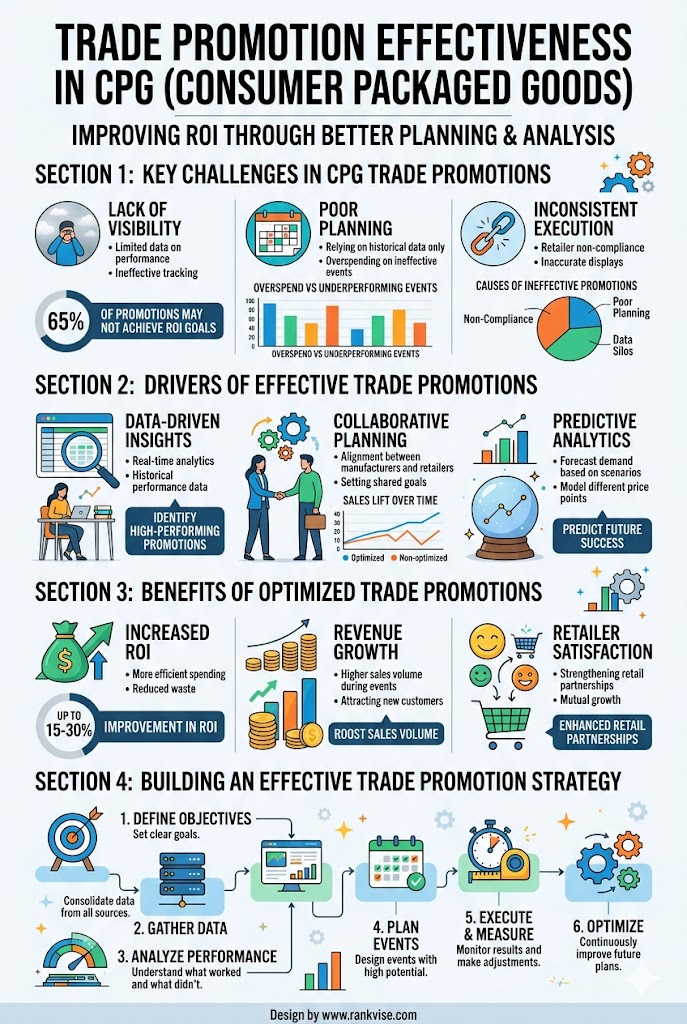
Shipment lift alone is not enough. A useful review needs incremental volume, incremental profit, net revenue impact, ROI, cannibalization, post-promo dip, sales compliance, and execution quality. If the business can separate sell-in from sell-out effects, the reading becomes much stronger. Event-level visibility also matters more than broad averages because strong and weak promotions often cancel each other out in aggregate reports.
This is where measuring trade promotion effectiveness becomes practical rather than theoretical. The point is not to create a complicated dashboard for its own sake. The point is to give teams a short set of indicators that can change future decisions. If a brand sees that deep discounts drive volume but low profit, it can adjust, making it practical to measure trade promotion effectiveness rather than just depth. If feature-and-display programs perform only when store execution is strong, it can change compliance rules. Better metrics matter only when they shape behavior. Otherwise, they are just cleaner versions of the same old confusion.
How Better Analytics Improves Trade Promotion Effectiveness
Good analytics improves decisions before the promotion runs, not just after it ends. Better baseline modeling, scenario planning, control variables, and event-level review help teams understand what is likely to happen before the budget is committed. Then they help explain what really happened after execution. That reduces the number of weak promotions the business repeats simply because no one challenges the assumptions.
This is where trade promotion effectiveness analytics becomes useful. It helps the business move from broad averages to more specific answers. Which tactics work in which accounts? How much discount is too much? What combination of timing, mechanics, and support tends to protect the margin? And this is also where trade promotion analysis matters. Some platforms and operating models, including connected systems such as SoftServe Business Systems, are designed to make those insights easier to use by bringing planning, execution data, and review closer together. Done well, analytics tightens spending, improves targeting, and shortens the learning cycle.
Why Execution Quality Matters Just As Much As Promotional Design
A good promotion can still fail in-store. That point is easy to miss because design gets more attention than execution. Teams spend time on discount depth, event timing, and customer plans, then assume the rest will take care of itself. But the shelf is where the plan meets reality. If displays are missing, products are out of stock, prices are wrong, or store teams did not set up the event correctly, the expected result breaks down fast.
That is why trade promotion effectiveness analysis has to include execution quality. Promotions should be reviewed not only by what was approved, but by what actually reached the shopper. The effectiveness of trade promotions depends on far more than the spreadsheet logic used in planning. It depends on in-market compliance, availability, visibility, and timing. When brands ignore that side of the equation, they often blame the offer when the real problem was execution failure.
How Cross-Functional Alignment Turns Promotion Effectiveness Into A Repeatable Capability
Many promotion problems come from organizational fragmentation. Sales owns the volume target. Finance owns margin. Supply chain worries about forecast risk. Category teams think about shopper response. Revenue growth teams look at pricing logic. When those groups work from separate assumptions, promotions become harder to design, harder to evaluate, and easier to misread.
Cross-functional alignment changes that. It helps teams agree on the real objective of an event, the metrics that matter, and the rules for reacting when performance drifts. It also makes post-event learning far more useful because everyone reviews the same outcome through the same logic. This is one of the least glamorous parts of promotion improvement, but one of the most important. The business does not build repeatable capability through tools alone. It builds it by getting the right people to judge promotional performance consistently.
What High-Performing CPG Brands Do Differently With Promotional Spend
The stronger performers are usually not the brands that promote the most. They are the brands that promote with more intention. They are more selective with depth, more disciplined with event design, and more willing to challenge inherited discount habits. They also use cleaner data, narrower hypotheses, and stronger review loops. That gives them a better chance of funding the promotions that actually deserve to scale.
They also treat learning as part of execution, not as a cleanup step. Good teams conduct real post-trade promotion analysis rather than filing results away after the quarter closes. They look for repeatable patterns: which mechanics drive profitable lift, which accounts absorb spend without giving enough back, and where execution breaks most often. That is how promotion management becomes smarter over time. High-performing brands are not simply spending less. They are making each promotional dollar work harder.
Conclusion
Temporary sales spikes are not the right endpoint. Real trade promotion effectiveness comes from turning promotional spend into measurable business value. That means better metrics, stronger analytics, tighter execution, and stronger alignment across the teams that influence the result. Once brands judge promotions by incremental profit, revenue quality, and execution reality, the decision-making standard improves significantly.
That is the real shift. Promotions stop being routine discount tactics and become managed growth levers. Some events will still fail. That is normal. But when the business measures them honestly, learns quickly, and adjusts its next-cycle planning, promotional spending starts producing better commercial results. And that is when trade promotion effectiveness stops being a reporting label and becomes a real capability.