Skip to content
Marketing moves fast. What worked two years ago can feel stale today. The brands winning attention right now are the ones taking creative risks and putting audiences first.
- Solve a real customer pain point; product innovation can become the most powerful marketing asset.
- Center campaigns on authentic human emotion and brand values to deepen connection and earn lasting loyalty.
- Show up in your audience's cultural language and act fast with real-time responses for maximum relevance.
- Choose simple, useful concepts that highlight what your product already does well, not complex gimmicks.
- Leverage personalization, shareability, and community activations across channels to make audiences promote your brand organically.
This roundup explores ten innovative marketing campaigns examples from recent months. Each one offers a clear lesson you can adapt for your own brand. Whether you run a startup or manage enterprise campaigns, these examples prove that bold thinking still drives results.
Why Studying Creative Brand Campaigns Still Matters?
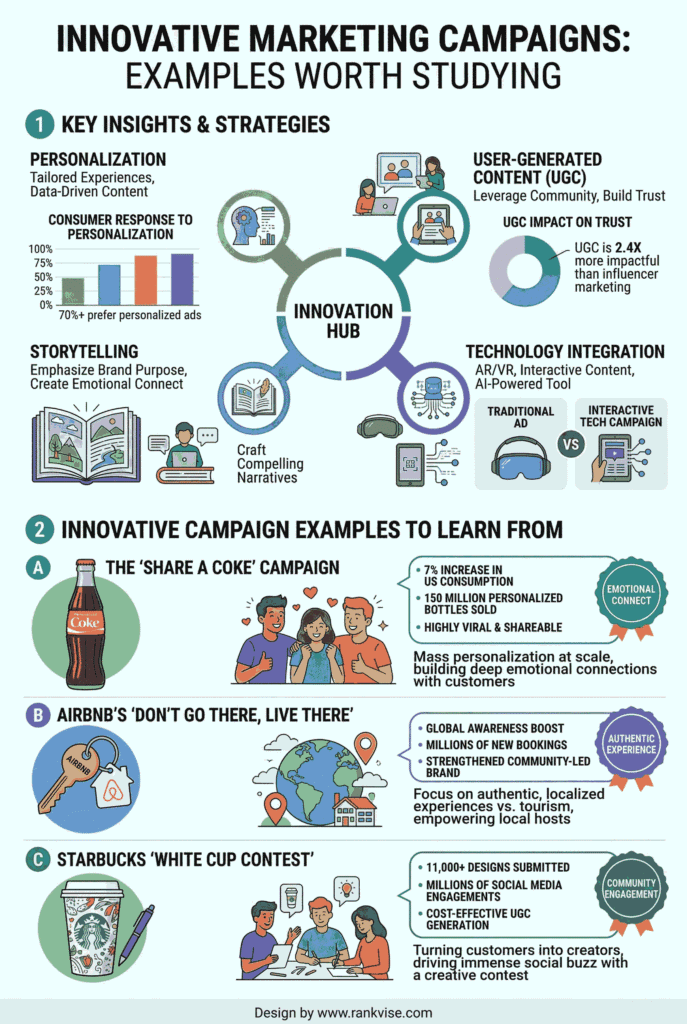
It is tempting to chase algorithms and forget about creativity. Yet data consistently shows that emotionally driven campaigns outperform purely tactical ones. A Nielsen study found that creative quality drives 47 percent of advertising sales impact.
Studying successful ad campaigns from other brands sharpens your instincts. You start to notice patterns in what captures attention and holds it. More importantly, you learn how to connect strategy with storytelling in a way that feels natural rather than forced.
The campaigns below span industries, budgets, and formats. Some rely on technology. Others succeed through sheer simplicity. All of them earned measurable engagement and brand lift.
Heinz Reinvents the Fry Box
Heinz kicked off 2026 with a packaging innovation that doubled as a marketing moment. The brand redesigned the classic french fry box to include a built-in ketchup holder. It solved a universal dining frustration in the most obvious way possible.
The campaign went viral across social media within hours. Food bloggers, designers, and everyday consumers shared it organically. Heinz did not need a massive media buy. The product itself became the advertisement. This is a textbook example of how functional creativity generates earned media at scale.
Key takeaway: Solve a real customer pain point, and the marketing takes care of itself.
Cadbury Dairy Milk’s “Made to Share” Campaign
Cadbury leaned into emotional storytelling with its “Made to Share” campaign. The brand created short films showing real moments of generosity between strangers. Each story centred on the simple act of sharing a chocolate bar.
The campaign resonated because it felt authentic rather than scripted. Cadbury paired these films with an interactive digital experience. Consumers could send a free chocolate bar to someone they appreciated. The result was a significant lift in both brand sentiment and sales during the campaign window.
Key takeaway: Campaigns built around genuine human emotions create deeper brand connections than product-focused messaging alone.
IKEA Canada’s “U UP?” Social Campaign
IKEA Canada surprised everyone with a playful late-night social media campaign called “U UP?” The brand posted bedroom furniture content using the casual language of dating culture. It was unexpected, witty, and perfectly targeted at millennials and Gen Z renters.
The campaign proved that even legacy brands can speak in a fresh voice. Engagement rates on the posts far exceeded IKEA’s typical social benchmarks. Audiences shared the content because it felt like a joke from a friend, not a pitch from a retailer.
Key takeaway: Understanding your audience’s cultural language lets you show up in unexpected and memorable ways.
Stella Artois Turns Snowfall Into a Brand Moment
When record snowfall hit parts of Europe in early 2026, Stella Artois responded in real time. The brand set up warming stations in high-traffic areas, serving hot drinks in branded glassware. They paired the physical activation with a social media campaign documenting the experience.
This experiential marketing example worked because it was timely and useful. People genuinely appreciated the gesture. Stella Artois earned positive press coverage across multiple countries without a traditional ad spend. Reactive marketing like this demands speed, but the payoff in goodwill is enormous.
Key takeaway: Responding to real-world moments with helpful brand activations builds trust faster than any scripted campaign.
Dove’s AI Transparency Campaign
Dove has long championed real beauty. In 2025, the brand took a bold stand against AI-generated beauty standards. Its campaign featured side-by-side comparisons of real women and their AI-altered versions. The message was clear and powerful.
Dove encouraged women to reject digitally manipulated ideals. The campaign included a pledge for brands to label AI-generated imagery. It earned massive media attention and positioned Dove as a thought leader on ethical marketing. This is a strong example of how brand values can drive innovative marketing campaigns.
Key takeaway: Taking a clear stand on a cultural issue, when authentic to your brand, can generate both conversation and loyalty.
BIC’s Everyday Creativity Push
BIC launched a campaign celebrating ordinary creativity. Instead of showcasing artists, the brand highlighted everyday people using BIC pens for grocery lists, doodles, and love notes. The content was warm, relatable, and refreshingly low-key.
The brand distributed short video clips across TikTok and Instagram Reels. Each clip ended with the tagline encouraging people to write more by hand. In a digital-first world, this analogue message stood out. Engagement metrics showed strong completion rates on the video content, proving that simplicity still captures attention.
Key takeaway: You do not need a complex concept to create a compelling campaign. Celebrate what your product already does well.
United Airlines’ Real-Time Super Bowl Tweet
United Airlines turned a cultural moment into a viral marketing win. During the Super Bowl halftime performance, the brand posted a perfectly timed tweet that connected the moment to air travel. It was witty, fast, and culturally relevant.
The tweet earned millions of impressions within minutes. It cost virtually nothing to produce. This digital marketing campaign idea shows that real-time social listening and quick creative execution can rival expensive productions. Brands with empowered social media teams consistently punch above their weight.
Key takeaway: Speed and cultural relevance on social media can deliver outsized results with minimal budget.
Spotify’s Evolved “Wrapped” Experience
Spotify continued to refine its annual Wrapped campaign, making the 2025 edition more interactive and shareable than ever. Users received personalised listening stories presented as mini-documentaries rather than static slides.
The platform added collaborative features, letting friends compare their music journeys together. This turned a solo experience into a social one. Spotify Wrapped generated billions of social media impressions once again, cementing it as one of the most successful recurring viral marketing examples in modern brand history.
Key takeaway: Personalisation combined with shareability creates campaigns that audiences actively want to promote on your behalf.
Patagonia’s “Buy Less” Recommerce Campaign
Patagonia doubled down on its sustainability message by actively encouraging customers to buy used gear instead of new products. The brand expanded its Worn Wear programme with pop-up repair stations in major cities and an improved online resale platform.
This campaign felt counterintuitive for a retailer. Yet it reinforced Patagonia’s brand purpose and deepened customer loyalty. Sales of both new and used products increased during the campaign period. Purpose-driven marketing works when the commitment is genuine and consistent.
Key takeaway: Authenticity in brand storytelling campaigns can turn an unconventional message into a commercial advantage.
Nike’s Community-Led Running Campaign
Nike shifted focus from elite athletes to everyday runners in a recent campaign. The brand partnered with local running clubs in over 50 cities. Participants received exclusive app content, group challenges, and limited-edition gear.
This grassroots approach generated organic social content from thousands of real runners. Nike’s app downloads spiked significantly during the campaign window. The strategy proved that community-led activations drive both engagement and measurable business outcomes.
Key takeaway: Empowering your community to create content builds authenticity that polished brand ads cannot replicate.
Common Threads Across These Campaigns
These ten innovative marketing campaigns examples share several traits worth noting:
- Emotional resonance — Every campaign connected with audiences on a human level, not just a transactional one.
- Cultural awareness — The best campaigns tapped into real conversations, trends, or shared experiences.
- Simplicity of message — None of these examples relied on complicated concepts. The core idea was always easy to grasp.
- Multi-channel integration — Successful campaigns showed up where their audiences already spent time, from social media to physical spaces.
- Brand authenticity — Each campaign felt true to the brand behind it, which made the message more believable.
How to Apply These Lessons to Your Own Strategy
You do not need a Fortune 500 budget to run creative brand campaigns. Start by identifying one genuine brand value. Then find a way to express it that your audience will actually care about.
Test small activations on social media first. Measure what resonates. Double down on the formats and messages that earn real engagement, not just impressions. The brands above succeeded because they prioritised connection over perfection.
FAQs
An innovative campaign uses a fresh approach, whether in format, message, or channel, to capture attention and deliver measurable results beyond industry norms.
Small businesses can focus on community engagement, user-generated content, and timely social media responses. Creativity matters more than budget in most digital marketing campaigns.
Every industry benefits. Retail, food and beverage, tech, and lifestyle brands frequently lead, but B2B companies also see strong results from storytelling campaigns.
Track engagement rate earned media value, social shares, website traffic spikes, and conversion lift during and after the campaign period.
Consumers trust brands that communicate with authenticity and emotional depth. Storytelling campaigns build long-term loyalty and differentiate your brand from competitors relying on generic advertising.