Skip to content

Our marketing tech stack often feels like a tangled mess of wires and lone-wolf apps. When nothing talks to each other, we waste money, frustrate customers, and drown in manual busywork.
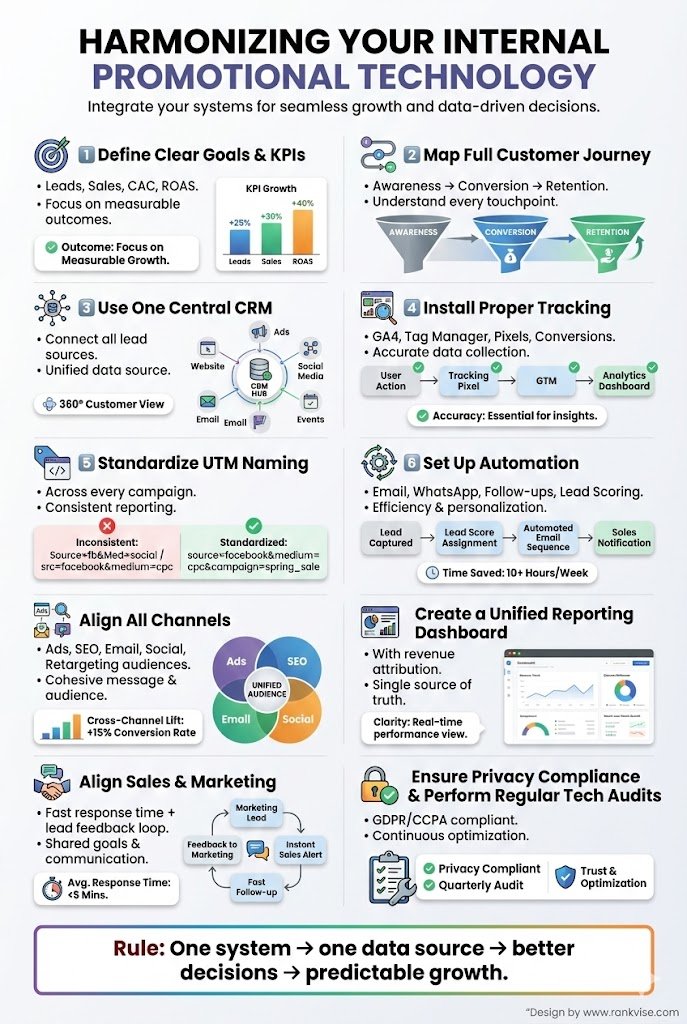
- Conduct a ruthless inventory and map user journeys to reveal duplicates, gaps, and true business needs.
- Define strategy and ideal workflows before choosing tools, ensuring every technology serves clear business goals.
- Centralize and clean data, automate integrations thoughtfully, and maintain training plus regular reviews for ongoing harmony.
True harmony isn’t about the fanciest new tool. It’s about getting your existing platforms to play the same tune. This guide is your practical roadmap for turning that chaotic noise into a clear, strategic symphony.
The Audition: Taking a Ruthless Inventory
Before you can harmonize, you need to know who’s in the band. This step is foundational, and it requires brutal honesty.
- Catalog Everything: Gather every tool, platform, subscription, and even those forgotten logins. Don’t just list the big names. Include the graphic design tool, the video editing software, the project management app, and that quirky Chrome extension someone swore by last quarter.
- Map the User Journey: For each major campaign or customer pathway, trace the touchpoints. Where does a lead get captured? Where is the email sent from? Where is their behavior tracked? This visual exercise reveals shocking gaps and redundancies.
This audit isn’t an IT exercise; it’s a business clarity exercise. You’ll likely find duplicates (three teams paying for different graphic design tools) and glaring voids (no central source of truth for customer data).
Strategy Before Software
This is the stage where most companies stumble. They get dazzled by a demo, buy a tool, and hope it will create a strategy for them. It never works. Think of it this way: your technology must be the instrument that plays your composition, not the composer who writes it.
Revisit Core Business Goals: Are you driving for raw lead volume, increasing customer lifetime value, or building undeniable market awareness? Every tool you consider must have a clear line of sight back to these core aims. If it doesn’t serve the goal, it’s just noise.
Outline Ideal Workflows in Plain English: Before looking at a single feature list, describe the perfect process. “When a visitor downloads our guide, they should automatically get a friendly welcome email, their interest should be noted in their customer profile, and our sales team should see a notification if they visit our pricing page twice.” Start with the human need and the desired outcome. The software is just the how.
Bridge the Gap with a Conscious Plan: This is where strategy touches reality. You must build a conscious plan for marketing technology integration, the crucial bridge that determines how your chosen tools will share data and hand off processes. It’s the detailed blueprint that ensures a customer’s interaction with your email can seamlessly feed into their personalized website experience. Without this backbone of harmony, you have isolated gadgets, not a system.
Without this disciplined, strategic rhythm, you’re not building an orchestra; you’re just bolting random, loud gadgets onto a machine that has no sense of direction or melody.
Data Hygiene and Centralization
A symphony can’t play in tune if every musician is reading from a transposed score. In your tech stack, data is the score. Dirty, siloed data creates cacophony.
- Appoint a Data Steward: Someone must be responsible for data quality. This isn’t a full-time role for most, but a hat worn by a strategically-minded person in marketing or ops.
- Clean and Standardize: Before connecting anything, clean up your core data. Standardize entry fields (e.g., “USA,” “US,” “U.S.A.” become “US”). Deduplicate records. It’s tedious but transformative.
- Map Your Data Flow: Clearly define what data points move between systems, and in which direction. For example, website engagement data from your analytics tool should flow into the SSOT to enrich lead profiles.
Clean, centralized data is the oxygen of a harmonious stack. Without it, your most expensive AI tool is just making brilliantly bad decisions.
APIs, Automations, and Zapier
Now for the technical magic, but keep it simple. The goal is to eliminate manual hand-offs, the number one killer of team morale and campaign velocity.
- Leverage Native Integrations First: Most modern platforms offer pre-built connections. Start here. They are typically more stable and easier to maintain.
- Use Automation Tools Wisely: Platforms are the universal translators of the tech world. They can connect apps that don’t natively talk, automating workflows like “add new email subscribers to CRM and tag them in our project management tool.”
- Build Strategic APIs for Key Functions: For mission-critical, high-volume data flows, a custom API integration might be warranted. It offers more control and reliability.
Start small. Automate one frustrating, repetitive task first. Celebrate that win, then move to the next.
Training and Change Management
You can build the most elegant system in the world, but if your team doesn’t use it, or fears it, it’s a costly failure. People harmonize with tools, not the other way around.
- Train for “Why,” Not Just “How”: Don’t just demo clicks. Explain how this new workflow saves time, provides better insights, and makes their jobs more impactful.
- Identify Champions: Find enthusiastic early adopters in each team. Empower them to be peer coaches and feedback channels.
- Create Living Resources: Build a central, searchable hub (a Notion doc, Confluence page, etc.) with how-to guides, screen recordings, and FAQs. Avoid static PDFs that rot in an inbox.
Monitoring and Iteration
Harmony isn’t a one-time project; it’s a state of maintained balance. Your stack needs regular check-ups and tuning.
- Establish KPIs for the Stack Itself: Measure what matters: Campaign launch time reduced by X%. Cost per lead decreased by Y%. Manual reporting hours saved per month.
- Schedule Quarterly Reviews: Bring key stakeholders together. What’s working? What’s causing new friction? Has a team’s need evolved?
- Stay Agile, Not Trendy: New tech will always emerge. Evaluate it against your strategy and current stack harmony. Will it integrate smoothly, or will it be another disruptive solo act?
- Prune Relentlessly: Have the courage to sunset tools that no longer serve a strategic purpose. Consolidate and simplify. A smaller, well-conducted orchestra is more powerful than a massive, discordant one.
Your promotional technology should feel less like a bundle of obligations and more like an extension of your team’s capabilities. By taking this journey, from ruthless audit to ongoing refinement, you stop being a mechanic frantically fixing leaks and start being a conductor, guiding a powerful, synchronized ensemble towards a standing ovation from your customers. The harmony you create internally will resonate loudly in every experience you deliver.