Skip to content
Every second of downtime costs money. For hospitals, stock exchanges, and online retailers, even a few minutes of data unavailability can trigger cascading failures. Traditional backup systems were designed for a slower era. They rely on manual failovers, passive standby servers, and delayed replication windows that leave gaps in protection.
- Active-active architecture: both storage arrays serve reads and writes simultaneously, eliminating single points of failure and enabling automatic, instant failover.
- Synchronous data mirroring ensures every write is replicated to both sites before confirmation, guaranteeing zero recovery point objective and no data loss.
- Quorum disk prevents split-brain by acting as a tiebreaker so the winning site stays active while the other suspends writes.
- Supports non-disruptive migration and routine maintenance, letting IT redirect workloads between sites without service interruption or data inconsistency.
The global active device changes that equation entirely. It keeps two storage systems fully operational at all times, serving read and write requests simultaneously. If one site goes down, the other continues without a hiccup. No manual intervention. No data loss. No service interruption.
This guide explains how it works, why it matters, who needs it, and how to plan a successful deployment in your organization.
What Is a Global Active Device?
A global active device is a storage virtualization and data mirroring technology originally developed by Hitachi Vantara. It enables two separate storage arrays, often located in different data centers, to present themselves as a single logical storage system to connected applications and servers.
Both arrays handle read and write operations at the same time. Data written to one site is synchronously replicated to the other in real time. Applications see a single virtual volume, even though two physical copies exist across two locations.
This is fundamentally different from traditional disaster recovery. Older systems designate one site as the primary and another as a passive backup. When the primary fails, someone must manually trigger a switchover. That gap between failure and recovery is where businesses lose data, revenue, and customer trust.
With the active-active replication model, that gap disappears entirely.
Why Continuous Data Availability Matters More Than Ever?
The demand for always-on data access has grown sharply over the past decade. Several forces drive this urgency.
Digital transactions never stop. A global e-commerce platform processes orders across every time zone. A hospital’s electronic health records system must respond instantly during emergencies. Financial trading platforms execute thousands of operations per second. For all these systems, downtime is not an inconvenience. It is a crisis.
Regulatory requirements have tightened as well. Frameworks like HIPAA, PCI DSS, and GDPR impose strict expectations around data availability, integrity, and recoverability. Organizations that fail to meet these standards face fines, legal exposure, and reputational damage.
The cost of downtime itself has risen dramatically. Industry estimates suggest that unplanned downtime costs large enterprises an average of 400,000 USD per hour. For mission-critical systems in finance and healthcare, that figure climbs significantly higher. Business continuity planning is no longer optional. It is a competitive necessity.
How a Global Active Device Works: The Technical Foundation
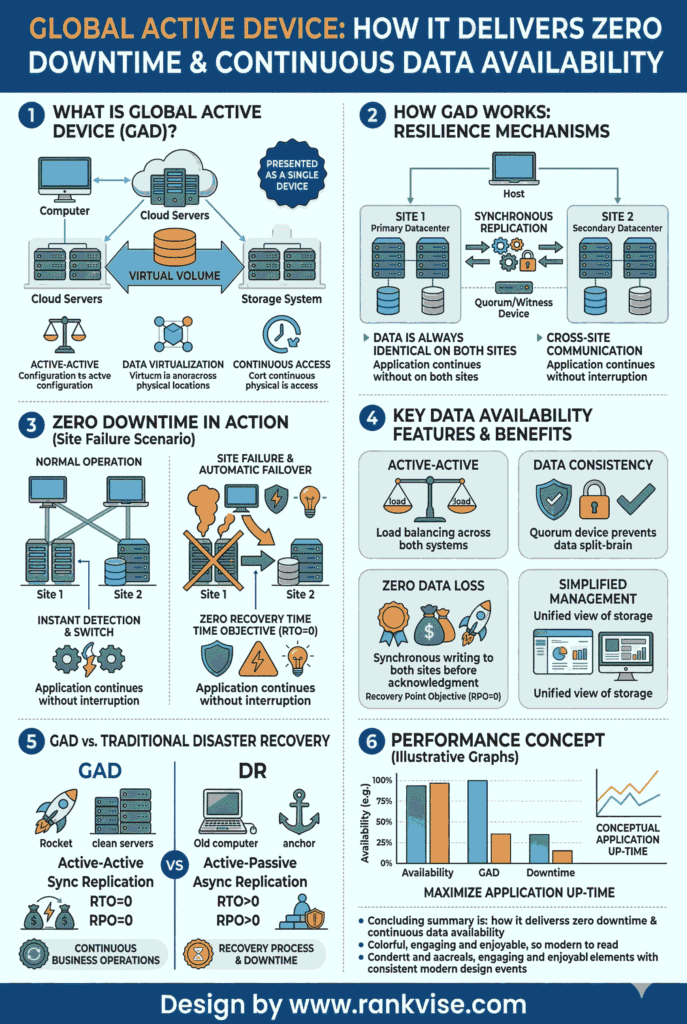
Three core components work together to deliver continuous data availability. Understanding each one helps IT leaders evaluate whether this technology fits their environment.
Active-Active Architecture
In a traditional setup, one storage system is active and the other sits idle until needed. The global active device eliminates this waste. Both storage arrays operate simultaneously, processing application workloads in parallel. Each site maintains a complete, up-to-date copy of all data.
This architecture provides two immediate benefits. First, it doubles the available processing capacity during normal operations. Second, it removes any single point of failure from the storage layer. If either site experiences a hardware failure, power outage, or network disruption, the surviving site absorbs the full workload instantly.
Synchronous Data Mirroring
Synchronous replication is the mechanism that keeps both copies identical. When an application writes data to the virtual volume, the global active device writes that data to both physical locations before confirming the operation as complete. This guarantees that no transaction is ever recorded at only one site.
The result is a zero recovery point objective. RPO measures the maximum amount of data an organization can afford to lose during a disaster. With synchronous data mirroring, that number drops to zero because both sites always hold the same information.
The Quorum Disk: Preventing Split-Brain Scenarios
The biggest risk in any active-active system is the split-brain problem. If communication between the two sites breaks down, both sites may believe they are the sole active system. If both continue writing independently, data corruption becomes inevitable.
The global active device solves this with a quorum disk. This is a small, independent storage resource located at a third site or hosted in the cloud. It acts as a tiebreaker. When the two main sites lose contact with each other, each one attempts to claim the quorum disk. The site that succeeds retains active status. The other site suspends its write operations to protect data integrity.
Once communication between sites is restored, the active site synchronizes any changes with the other site. Both locations then resume full coordinated operation with no data lost during the interruption.
Global Active Device vs. Traditional Disaster Recovery
Understanding the differences between these approaches helps organizations make informed investment decisions. The table below compares key operational characteristics.
| Feature | Global Active Device | Traditional Disaster Recovery |
|---|---|---|
| Architecture | Active-active (both sites operational) | Active-passive (standby site idle) |
| Failover method | Automatic, instant | Manual or semi-automated |
| Recovery time objective (RTO) | Zero | Minutes to hours |
| Recovery point objective (RPO) | Zero (synchronous replication) | Seconds to minutes (asynchronous) |
| Resource utilization | Both sites handle live workloads | Backup site sits idle until needed |
| Split-brain protection | Quorum disk tiebreaker | Not typically included |
| Non-disruptive migration | Supported | Requires planned downtime |
| Cost efficiency during normal ops | Higher (uses both sites) | Lower (standby site underutilized) |
Traditional disaster recovery still serves organizations with less demanding availability requirements. However, for enterprises where even brief outages carry severe consequences, the global active device offers a measurably stronger protection model.
Which Industries Benefit Most From This Technology?
While any data-dependent business can benefit, certain industries see the highest return on investment from deploying a global active device.
Healthcare organizations rely on real-time access to patient records, imaging systems, and laboratory data. A storage failure during a surgical procedure or emergency department surge can directly affect patient outcomes. Zero downtime failover is not just a business requirement in healthcare. It is a safety imperative.
Financial services firms process transactions that must be recorded accurately and immediately. Trading platforms, payment processors, and banking systems operate under strict regulatory mandates for data integrity. Synchronous data mirroring ensures that every transaction exists at both sites the moment it is committed.
E-commerce and retail companies generate revenue around the clock. An outage during a peak sales period, such as a holiday event or product launch, translates directly into lost sales and eroded customer loyalty. Active-active replication keeps storefronts operational regardless of infrastructure disruptions.
Manufacturing and logistics businesses depend on real-time data from supply chain management systems, production monitoring tools, and inventory databases. Downtime in these systems disrupts production schedules and delivery timelines, creating ripple effects across partner networks.
Planning a Global Active Device Deployment: Key Considerations
Implementing this technology requires careful planning. Several factors determine whether a deployment succeeds.
Network latency between sites matters significantly. Synchronous replication requires data to travel between both locations and back before confirming each write operation. If the two data centers are too far apart, latency increases and application performance degrades. Most organizations position their two sites within 100 kilometers of each other to maintain acceptable response times.
Storage compatibility is another critical factor. The technology operates on specific enterprise storage platforms from Hitachi Vantara. Organizations running different storage hardware will need to evaluate migration paths or hybrid configurations.
Quorum disk placement requires its own planning. The third-site resource must be reliably accessible from both primary locations. Cloud-hosted quorum services have simplified this requirement considerably, removing the need for a dedicated physical third site.
Bandwidth capacity between sites must support the full volume of write operations during peak periods. Underestimating bandwidth needs leads to replication delays and potential performance bottlenecks.
Testing and validation should happen regularly. Simulated failover exercises confirm that the automated switchover works as expected and that applications recover without data inconsistencies. Organizations that skip regular testing often discover problems only during actual emergencies, when the stakes are highest.
Non-Disruptive Migration: An Often Overlooked Advantage
Beyond disaster recovery, the global active device supports non-disruptive migration. This allows IT teams to move application workloads between data centers without any service interruption.
This capability proves valuable during planned maintenance windows, hardware refresh cycles, and data center consolidation projects. Instead of scheduling downtime and coordinating complex cutover procedures, administrators simply redirect workloads to the other site. Applications continue running on current data throughout the process.
For organizations managing hybrid or multi-site environments, this flexibility reduces operational complexity and eliminates the coordination overhead that traditional migrations require.
The Future of Storage Resilience in Enterprise IT
Storage resilience strategies continue to evolve alongside the technologies they protect. Several trends are shaping the next generation of data availability solutions.
Integration with cloud-based infrastructure is expanding. Organizations increasingly pair on-premises storage arrays with cloud storage tiers, creating hybrid architectures that combine the performance of local hardware with the scalability of cloud resources.
AI-driven monitoring and predictive analytics are beginning to play a role in preemptively identifying hardware degradation, network anomalies, and workload imbalances before they trigger failures. These capabilities complement the reactive protection that the global active device already provides.
As data volumes grow and regulatory expectations tighten, the business case for zero-downtime storage architectures will only strengthen. Organizations that invest in active-active replication today position themselves to handle tomorrow’s demands without retrofitting their infrastructure under pressure.
FAQs
It enables two storage systems in separate locations to operate simultaneously, serving the same data in real time while providing automatic failover if either site fails.
It uses synchronous replication, which writes every piece of data to both sites before confirming the transaction. This ensures both locations always hold identical information.
A split-brain occurs when two active storage sites lose communication and both attempt to operate independently, which can cause data corruption. A quorum disk prevents this.
Yes. Administrators can move application workloads between sites without any service interruption because both locations maintain current, synchronized data at all times.
It is designed for enterprise environments with mission-critical data requirements. Small businesses with lower availability needs may find traditional backup solutions more cost-effective.