Do buyers see your brand when they ask AI answer engines for product recommendations? Finding the best GEO tools is now a core requirement for marketing teams navigating this massive shift in digital discovery across the United States. This guide evaluates ten real platforms based on answer engine coverage, prompt methodology, citation tracking, and content execution.
- Generative Engine Optimization tools manage monitoring, diagnosis, execution, and data governance across AI answer systems.
- Use controlled prompts and repeated tracking runs for reliable, directional measurement of AI visibility over time.
- Track brand mentions separately from linked citations; differentiate passing mentions from citation sources that drive referral value.
- Pilot shortlisted platforms to validate methods, data quality, governance, and integration before committing to large contracts.
- Maintain FTC compliance, privacy law alignment, and internal reviews; human oversight required for any AI-generated marketing claims.
We will look at how these tools handle everything from competitor share of voice to strict data governance. Platform capabilities change rapidly, so always verify access and features during a live pilot. Remember that a single chatbot response is never a reliable visibility benchmark.
Quick Summary
- Generative Engine Optimization (GEO) tools handle monitoring, diagnosis, execution, and data governance.
- Reliable measurement requires controlled prompts and repeated tracking runs.
- Brand mentions and linked citations must be tracked as separate metrics.
- A pilot phase helps test data quality before signing a large contract.
- Federal Trade Commission (FTC) guidelines, privacy laws, and internal reviews remain strictly relevant.
1. Addlly AI: Best Enterprise GEO Tool for AI search visibility
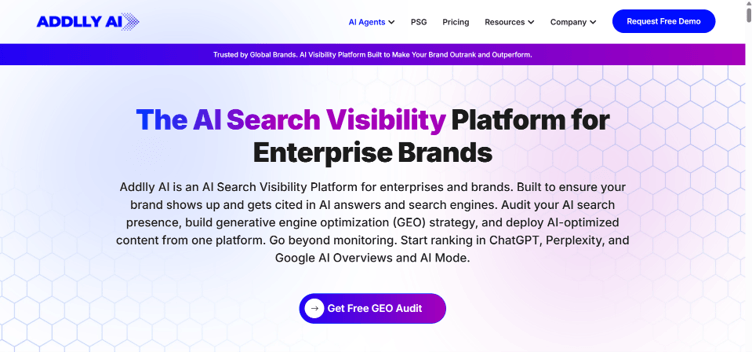
Addlly AI is an enterprise-grade AI search visibility platform that moves beyond basic monitoring by connecting audits directly to content generation. It is highly suited for large organizations that need to turn Generative Engine Optimization findings into governed, on-brand workflows.
The platform operates as a secure, zero-prompt environment where marketing teams can leverage their first-party data to create compliant content. Addlly AI is SOC 2 and ISO 27001 certified, ensuring it meets strict data security standards required by corporate IT departments. It is also LLM-agnostic, allowing teams to generate text across models like OpenAI, Claude, and Meta Llama without complex engineering.
How Addlly Connects Audits to Action
- GEO Audit AI Agent: Runs full visibility audits across ChatGPT, Gemini, Perplexity, and Google AI Overviews to identify citation gaps and benchmark competitor presence.
- GEO AI Agent: Refreshes existing website copy to make it more structured and easily readable for AI retrieval systems.
- AI Visibility Blog Agent : Generates new, citation-ready content that aligns with brand guidelines, tone, and specific product data.
- Enterprise Governance: Enforces brand rules and messaging standards while maintaining strict access controls for distributed teams.
By combining visibility intelligence with automated optimization, Addlly AI helps teams scale their digital presence while ensuring all generated claims meet strict advertising standards.
2. Profound: Best for Enterprise Answer Intelligence
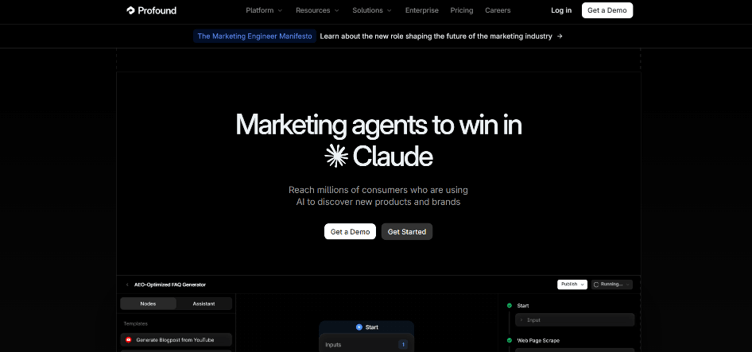
Profound is positioned for organizations that need extensive answer engine intelligence, competitive benchmarking, and executive-level visibility reporting.
Large organizations need deep historical data to understand their true market position. This tool provides a massive prompt library that helps distributed teams analyze complex trends. It separates brand mentions from actual linked recommendations.
How Profound Supports Enterprise Analysis
- Intelligence Depth: Evaluate citation analysis and competitive monitoring capabilities.
- Historical Context: Use large prompt libraries to track visibility shifts over time.
- Procurement Ready: Test whether data exports and user permissions meet internal requirements.
- Score Variations: Avoid treating proprietary visibility scores as interchangeable across different vendors.
Do not assume that high visibility in one AI model automatically translates to another platform.
3. Scrunch AI: Best for Customer Journey Audits
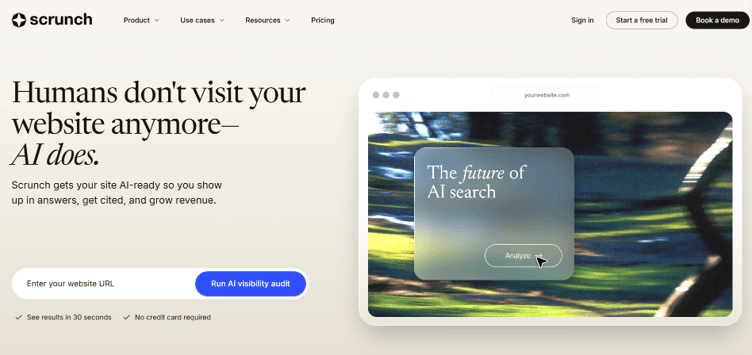
Scrunch AI is a strong fit for teams that want to audit how their brand appears across multiple stages of an AI-assisted customer journey.
Buyers ask different questions when discovering a product versus comparing options. This tool maps specific prompts to distinct stages of the buying cycle. High-intent comparison prompts receive dedicated reporting to highlight immediate revenue opportunities.
How Scrunch Maps AI Customer Journeys
Discovery, comparison, evaluation, and purchase prompts form a highly measurable journey. High-intent comparison prompts deserve separate reporting because they directly influence buying decisions. Imagine a software buyer asking an AI to compare enterprise tools, and the tool reveals that a competitor wins due to better feature pages. You should review these prompt assumptions with your sales and customer research teams regularly.
4. Peec AI: Best for Lean GEO Monitoring Teams
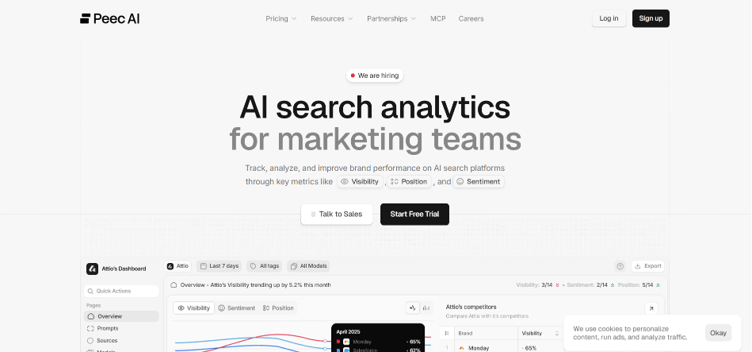
Peec AI is suited to lean teams seeking straightforward prompt monitoring and competitive reporting without an overly complex setup.
Smaller marketing departments need accessible tools to establish a reliable visibility baseline. This platform strips away enterprise complexity in favor of streamlined reporting. It helps you track exact mentions and citations quickly.
How Peec Simplifies Prompt Monitoring
- Accessible Tracking: Focus on simple monitoring for brand mentions and competitors.
- Baseline Setup: Use streamlined reporting to help smaller teams prove initial value.
- Starting Scope: Begin your tracking with 20 to 50 commercially relevant prompts.
- Verification Steps: Check engine coverage, run frequency, and data export options.
A smaller prompt cluster checked weekly provides more value than a massive list checked once a year.
5. Otterly.AI: Best for Citation Tracking
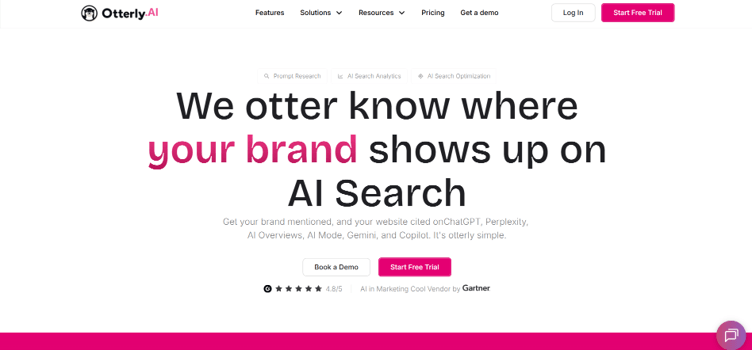
Otterly.AI is best considered when citation monitoring and source discovery are more important than a broad content production workflow.
Knowing exactly which pages AI engines link to is crucial for traffic analysis. This tool specializes in tracking the exact sources that power AI responses. It helps you separate passing mentions from highly valuable linked citations.
How Otterly Tracks Mentions and Citations
- Mention vs Citation: Differentiate an unlinked brand mention from a clickable source citation.
- Source Discovery: Reveal influential owned and third-party pages driving your visibility.
- Page Quality: Check whether cited pages are current, accurate, and ready for conversions.
- Traffic Reality: Remember that citation exposure does not guarantee actual referral traffic.
6. Goodie AI: Best for Actionable GEO Insights
Goodie AI is a candidate for teams that want their AI visibility findings translated into clearer optimization priorities.
Raw data is useless if your team does not know what to fix first. This tool scores potential actions by commercial intent and required effort. It highlights exactly where competitors are winning due to stronger source content.
How Goodie Turns Insights Into Priorities
You must assess how clearly insights identify source gaps and optimization priorities. A competitor might earn recommendations simply through stronger comparison content that AI models prefer. You should score actions by commercial intent, effort, and potential factual risk. Always require human review for marketing claims subject to FTC advertising standards.
Prioritize updating pages that already rank well in traditional search but lack clear entity definitions for AI models.
7. AthenaHQ: Best for Competitive AI Visibility
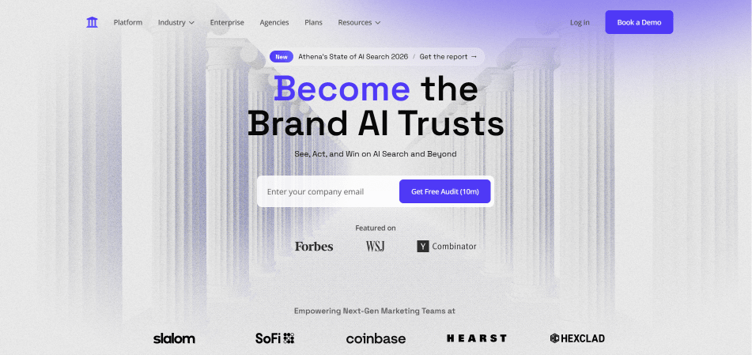
AthenaHQ is suited to teams prioritizing competitive benchmarks and category-level analysis across monitored AI answers.
Understanding your share of voice requires looking at the entire product category. This platform clusters competitor prompts to improve strategic decision-making. It separates basic brand frequency from actual positive recommendations.
How AthenaHQ Benchmarks Competitor Visibility
- Directional Metrics: Explain AI share of voice as a directional metric based on a controlled prompt set.
- Prominence Tracking: Separate brand frequency from recommendation prominence and sentiment.
- Prompt Clusters: Show how category and competitor clusters improve your decision-making.
- Score Limits: Warn that scores cannot be compared fairly when engines or run dates differ.
8. Writesonic: Best for Content Optimization
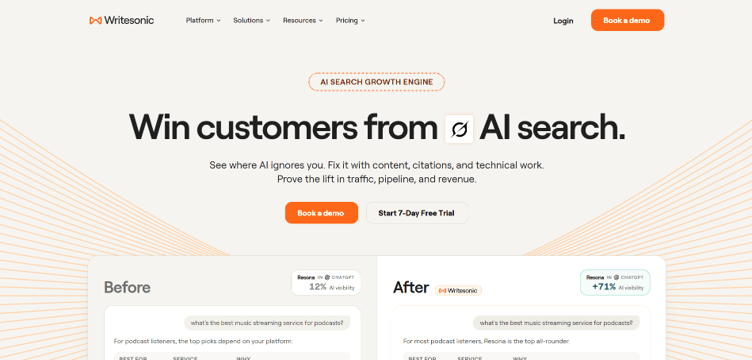
Writesonic is relevant to teams seeking AI visibility analysis alongside content optimization and production capabilities.
Creating answer-ready content is the fastest way to improve your AI search presence. This tool connects visibility tracking directly with content drafting features. It helps writers structure their paragraphs to better serve generative engines.
How Writesonic Links Tracking and Content
You need to evaluate the connection between visibility analysis and content optimization. Answer-ready sections, entity clarity, and cited evidence strongly support generative optimization efforts. You should recommend comparing generated suggestions against existing analytics data. Editors must always substantiate claims and avoid generic AI language before publishing.
9. Semrush: Best for Unified SEO and AI Tracking
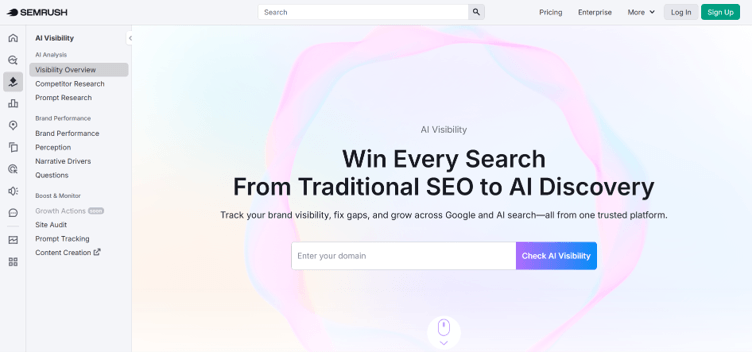
Semrush is best suited to teams that want AI visibility data connected with an established search optimization and reporting environment.
Viewing traditional search data alongside AI metrics provides a complete picture. This toolkit integrates prompt-based tracking into familiar dashboards. It allows you to leverage your existing keyword research for new AI strategies.
How Semrush Connects SEO and AI Data
- Operational Benefit: View conventional search and AI visibility together in one place.
- Metric Separation: Compare keyword rankings with prompt-based citations without conflating them.
- Data Leverage: Use existing search data to prioritize commercially important prompt clusters.
- Plan Verification: Tell current customers to confirm which AI capabilities are included in their plan.
Comparing your top-performing organic pages against your AI citation gaps often reveals quick win opportunities.
10. Ahrefs: Best for Brand and Citation Research
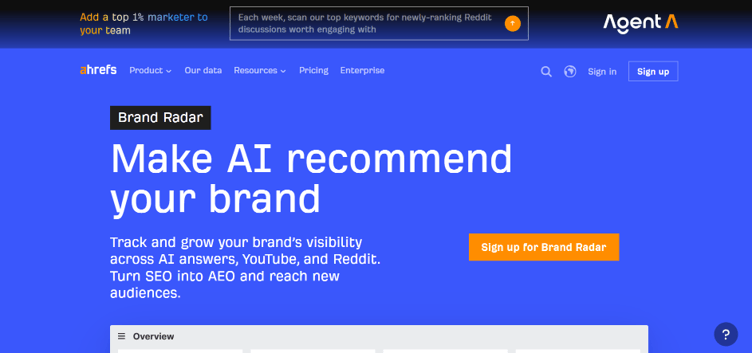
Ahrefs Brand Radar is relevant to teams connecting AI citation research with broader brand, content, and web visibility analysis.
Existing backlink profiles often influence which sources AI models choose to cite. This tool adds valuable context to AI visibility findings using established web data. It helps you identify third-party publishers that dominate high-intent prompts.
How Ahrefs Reveals Brand Citation Patterns
- Research Use Cases: Examine brand mentions, source influence, and citation patterns.
- Contextual Data: Show how established backlink data can add context to AI findings.
- Publisher Identification: Recommend identifying publishers repeatedly cited for high-intent queries.
- Legitimate Coverage: Clarify that earning real coverage is preferable to attempting to manipulate citations.
How Should You Choose the Right GEO Tool?
Choose a GEO tool by matching its engine coverage, measurement transparency, execution capabilities, integrations, and governance controls to a controlled pilot.
Selecting the right platform depends entirely on your internal resources and goals. Some teams only need lightweight tracking, while others require full execution capabilities. A structured evaluation process prevents costly software mistakes.
| Capability | Monitoring Tools | Execution Platforms | Best For |
| Primary Focus | Tracking prompt clusters and citations | Audit-to-content generation | Lean teams vs Content scaling |
| Workflow Integration | Dashboard reporting only | Zero-prompt content creation | Data analysts vs Marketing teams |
| Cost and Setup | Lower cost and fast setup | Enterprise investment and custom training | Baseline tracking vs Brand safety |
Step 1: Define Engines and Prompt Clusters
Select relevant answer engines and map out discovery, comparison, purchase, and support prompts. You will need customer research, sales notes, and keyword tools for this process. Expect this to take two to five business days for an initial controlled set. Keep your prompts stable so changes can be measured accurately over time.
Step 2: Validate Methods and Governance
Review run frequency, model labels, location controls, retention policies, and data exports. You must use security questionnaires and check alignment with the National Institute of Standards and Technology (NIST) AI Risk Management Framework. This validation takes one to three weeks depending on internal procurement rules. Verify California Consumer Privacy Act (CCPA) and California Privacy Rights Act (CPRA) obligations when handling customer data.
Step 3: Pilot Workflows and Measure Value
Run a pilot using the same prompts, competitors, and pages across your shortlisted tools. Rely on analytics, customer relationship management (CRM) reporting, and change logs to track success. Allow four to eight weeks to see an initial directional trend. Measure implementation speed, qualified traffic, assisted conversions, and corrected brand representation.
Final Words
The best platform depends on whether your team needs lightweight monitoring, enterprise intelligence, established search integration, or an audit-to-content workflow. Tools provide directional evidence, but they do not replace the need for quality strategy. Real improvements still require accurate content, technical accessibility, legitimate authority, and human oversight. You must measure mentions, citations, prominence, and business outcomes separately to understand your true performance. Use a consistent prompt set instead of relying on isolated chatbot answers that change daily. Validate methodology, governance, and implementation capacity before signing any long-term contracts. Reassess platform coverage, model labeling, data controls, and pricing each quarter as answer engines evolve. Remeasure your baseline after approved content and source improvements are published.
FAQs
Is Addlly AI suitable for enterprise GEO teams?
Yes, it is highly suitable for large organizations. Addlly AI is SOC 2 and ISO 27001 certified, supporting secure, brand-trained search optimization, planning, and content workflows. Teams should validate integrations, security controls, and measurement requirements through a scoped pilot.
Does Addlly AI only monitor AI visibility?
No, it goes far beyond basic tracking. Addlly AI connects audits with brand-trained content workflows through specific tools like its GEO Audit AI Agent and GEO AI Writing Agent, helping teams move from prioritized findings to reviewed, on-brand execution in a zero-prompt environment.
Can GEO tools guarantee AI citations?
No, they cannot offer absolute guarantees. AI answers are probabilistic, so tools can measure patterns and recommend improvements but cannot guarantee a mention, citation, or recommendation.
How often should AI visibility be measured?
Usually, teams measure on a consistent weekly or monthly schedule. High-volatility categories may require more frequent runs using unchanged prompts and comparable settings.
Do AI-generated claims require FTC review?
Yes, strict compliance is still mandatory. FTC advertising standards still require marketing claims to be truthful, substantiated, and presented without deceptive omissions, regardless of whether AI helped create them.