Skip to content
Rigid nine-to-five schedules are losing their grip on the modern workforce. A 2024 Gallup study found that 67 percent of employees consider schedule flexibility a deciding factor when accepting a job offer. Yet most companies still manage flexible hours through spreadsheets, email chains, and guesswork.
- Automates flexible scheduling with core hours, flexible bands, and real-time tracking to maintain accountability and coordination.
- Delivers measurable benefits: higher productivity, stronger retention, lower absenteeism, and reduced facility overhead.
- Choose platforms that integrate with payroll and HRIS, pilot before rollout, and train managers to ensure adoption and compliance.
A flextime manager solves this problem. It gives organisations a structured system to offer flexible work scheduling without sacrificing accountability, compliance, or team coordination. This guide covers what a flextime manager does, how it works, the measurable benefits it delivers, and how to choose and implement the right one for your team.
What Is a Flextime Manager and How Does It Work?
A flextime manager is a workforce management tool that automates the creation, tracking, and oversight of flexible employee schedules. Instead of requiring everyone to clock in and out at the same time, it lets workers choose their hours within boundaries the company defines.
Most systems operate around two core concepts. The first is core hours — a fixed window, say 10 a.m. to 2 p.m., when every team member must be available. The second is flexible bands — the hours before and after the core window where employees choose when to start and finish.
The software tracks total hours worked, flags overtime, records attendance, and feeds data directly into payroll and HR systems. Managers see real-time dashboards. Employees see their own balances, upcoming schedules, and leave requests. Everything stays transparent and auditable.
Why Businesses Need a Flextime Manager in 2026?
Three forces are making flextime management essential rather than optional.
First, hybrid work is permanent. McKinsey research shows that 58 percent of American workers now have the option to work remotely at least one day per week. Managing flexible hours across office and remote settings without dedicated software creates scheduling chaos.
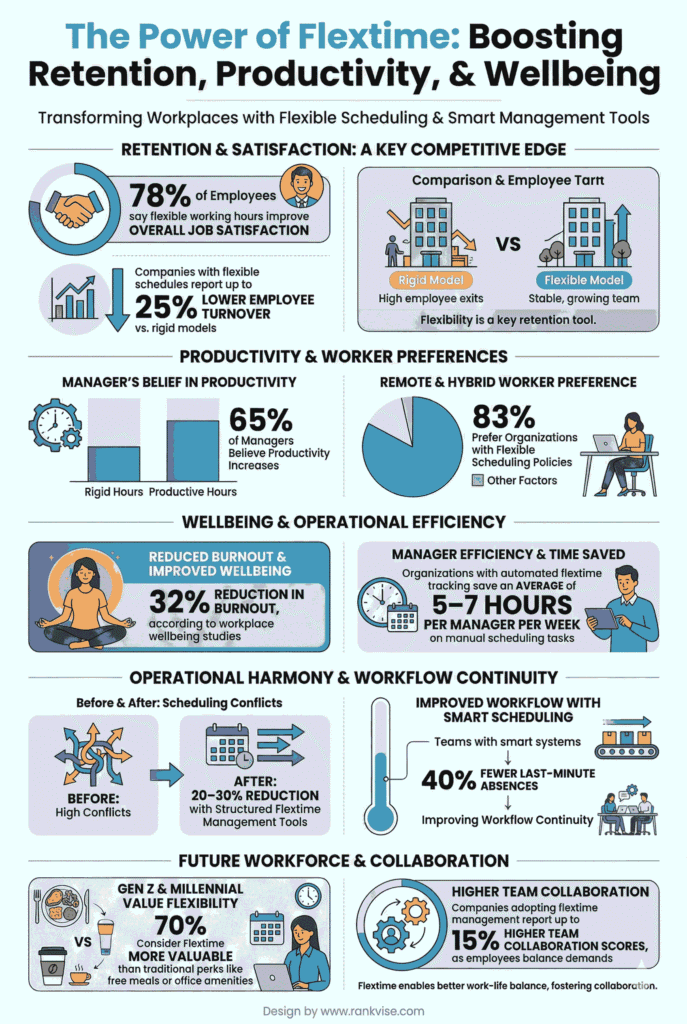
Second, labour markets remain competitive. Companies that offer genuine schedule flexibility see 25 percent lower turnover than those that do not, according to SHRM workforce data. A flextime manager turns a vague flexibility promise into a concrete, manageable benefit.
Third, compliance risks are growing. Labour laws in the EU, UK, Australia, and several US states now require precise records of hours worked, rest periods, and overtime. Manual tracking exposes companies to audit failures and legal penalties. Employee scheduling software automates compliance and creates a reliable paper trail.
Core Features to Look for in a Flextime Manager
Not every flexible scheduling tool delivers the same value. The features below separate effective platforms from basic time clocks wearing a modern label.
| Feature | What It Does | Why It Matters |
|---|---|---|
| Core Hours Configuration | Defines mandatory overlap periods for team availability | Protects collaboration without eliminating flexibility |
| Real-Time Time Tracking | Records start, stop, and break times automatically | Eliminates manual timesheets and reduces payroll errors |
| Overtime Alerts | Flags employees approaching weekly or daily overtime limits | Prevents budget overruns and compliance violations |
| Leave and Absence Management | Handles PTO requests, sick days, and swap approvals in one place | Reduces email back-and-forth and scheduling conflicts |
| Payroll and HRIS Integration | Syncs hours directly with payroll processors and HR platforms | Saves administrative time and eliminates duplicate data entry |
| Mobile Access | Lets employees view schedules and clock in from any device | Supports remote, hybrid, and field-based workers |
| Analytics and Reporting | Tracks attendance trends, productivity patterns, and labour costs | Gives managers data to optimise schedules and staffing levels |
| Shift Swap Capability | Allows employees to trade shifts within policy guidelines | Reduces last-minute absences and manager intervention |
When evaluating platforms, prioritise integration capabilities. A flextime manager that does not connect with your existing payroll, communication, and project management tools will create more work than it saves.
Measurable Benefits of Using a Flextime Manager
Higher Productivity and Output Quality
Flexible hours let employees work during their peak energy windows. Research from Stanford economist Nicholas Bloom found that flexible workers completed 13 percent more tasks than their office-bound peers. A flextime manager ensures this flexibility is structured, not chaotic.
When people control their schedules, they waste less time on low-energy busywork. They tackle demanding projects when focus is highest and handle routine tasks during natural energy dips.
Stronger Employee Retention
Replacing an employee costs between 50 and 200 percent of their annual salary, depending on the role. Offering structured flexible work scheduling through a dedicated tool signals that the company respects employees’ time and autonomy.
Teams using flextime management consistently report higher job satisfaction scores. Satisfied employees stay longer, reducing the constant drain of recruitment and onboarding costs.
Lower Absenteeism
Unscheduled absences cost US employers an estimated 225.8 billion USD annually, according to the CDC Foundation. When employees can adjust their schedules around medical appointments, childcare needs, or personal obligations, they take fewer unplanned sick days.
A flextime manager makes this adjustment seamless. The employee shifts hours within the flexible band. The system records the change. The manager sees updated availability instantly.
Reduced Overhead Costs
Staggered schedules mean fewer employees in the office at the same time. Companies can downsize physical workspace, reduce utility expenses, and optimise meeting room usage. Some organisations report facility cost reductions of 15 to 30 percent after implementing structured flexible hours policies.
How to Implement a Flextime Manager: A Step-by-Step Approach
Rolling out flexible scheduling software requires more than installing an app. Follow these steps to maximise adoption and results.
- Audit your current scheduling process by documenting how hours are currently tracked, where bottlenecks occur, and which teams already operate on informal flexible arrangements. This baseline reveals what the new system must fix.
- Define your flexibility framework including core hours, flexible bands, maximum daily hours, overtime thresholds, and any role-specific restrictions. Write these rules into a clear policy document before configuring the software.
- Select a platform that fits your stack by shortlisting tools that integrate with your payroll provider, HRIS, and communication platforms. Request demos focused on your specific use cases, not generic feature walkthroughs.
- Run a pilot programme with one department or team for 30 to 60 days. Collect feedback on usability, scheduling conflicts, and reporting accuracy before company-wide rollout.
- Train managers first, then employees because managers who understand the system’s reporting and approval workflows will support their teams more effectively during the transition.
- Review and refine quarterly using the platform’s analytics to identify patterns such as underutilised flexible bands, recurring overtime, or teams with consistently low adoption rates. Adjust policies based on real data, not assumptions.
Top Flextime Manager Platforms Compared
Choosing the right tool depends on your organisation’s size, industry, and existing technology ecosystem. Here is how the leading platforms compare across critical criteria.
| Platform | Best For | Key Strength | Integration Highlights | Pricing Model |
|---|---|---|---|---|
| Toggl Track | Small to mid-sized teams | Intuitive time tracking with flexible reporting | Google Calendar, Asana, Jira, Slack | Free tier available; paid from 9 USD/user/month |
| ADP Workforce Now | Mid-market to enterprise | End-to-end HR, payroll, and scheduling suite | Native payroll integration, benefits, compliance tools | Custom pricing based on company size |
| Deputy | Shift-based and hourly teams | Powerful shift swapping and demand forecasting | Xero, QuickBooks, ADP, BambooHR | From 4.50 USD/user/month |
| Clockify | Budget-conscious teams | Free unlimited tracking with flexible scheduling | Trello, Asana, QuickBooks, Zapier | Free core plan; paid from 3.99 USD/user/month |
| UKG (Kronos) | Large enterprises | Advanced compliance and workforce analytics | SAP, Oracle, Workday, major HRIS platforms | Custom enterprise pricing |
For educational institutions, platforms like Securly Flex, Minga FlexTime, and eHallPass FlexTime Manager specialise in student scheduling, attendance tracking, and activity management during flexible periods.
Common Challenges and How to Overcome Them
Every flexible scheduling rollout encounters friction. Anticipating these challenges prevents them from derailing your programme.
Team coordination gaps emerge when too few overlapping hours exist. Solve this by enforcing core hours that guarantee at least four hours of daily team availability for meetings, decisions, and collaborative work.
Perceived unfairness across roles becomes an issue when some positions cannot flex as freely as others. Address this by offering alternative benefits to less-flexible roles, such as compressed work weeks or priority shift selection.
Manager resistance often stems from fear of losing oversight. Counter this by training managers on the platform’s real-time dashboards and attendance analytics, showing them they gain more visibility, not less.
Scope creep into overwork happens when employees blur the line between flexibility and always-on availability. Set clear daily hour caps within the system and configure automatic notifications when employees approach limits.
Slow adoption rates typically result from poor onboarding. Dedicate the first two weeks after launch to live support, quick-start guides, and department-level Q&A sessions rather than relying on a single company-wide email announcement.
How a Flextime Manager Supports Remote and Hybrid Teams
Remote and hybrid work arrangements multiply the complexity of scheduling. Team members operate across time zones, home environments, and varying personal commitments. A flextime manager becomes the connective tissue that keeps distributed teams aligned.
The software displays each team member’s chosen working hours so colleagues know when to schedule meetings, expect responses, or plan collaborative sessions. Cross-timezone visibility eliminates the guesswork that causes missed handoffs and delayed decisions.
For hybrid teams splitting time between office and home, the platform can track location preferences alongside time preferences. Managers see who plans to be on-site each day, making it easier to coordinate in-person collaboration without mandating rigid office days.
The Future of Flextime Management
Flextime management is evolving rapidly. AI-powered scheduling assistants are beginning to recommend optimal work windows based on meeting patterns, project deadlines, and individual productivity data. Predictive analytics will soon flag potential burnout before it manifests in absenteeism or performance drops.
Integration with wellbeing platforms is another emerging trend. Work-life balance tools that connect schedule data with stress indicators, sleep patterns, and workload metrics will give organisations a holistic view of employee health — not just hours logged.
Companies that invest in structured flexible scheduling now will have the data, workflows, and cultural readiness to adopt these next-generation capabilities as they mature.
FAQs
It automates schedule tracking, overtime alerts, and payroll integration so small teams manage flexible hours without dedicated HR staff or manual spreadsheets.
Structured flexibility increases job satisfaction and reduces burnout. Companies offering managed flexible scheduling report up to 25 percent lower turnover than rigid-schedule competitors.
Yes. Most platforms display each employee’s working hours in their local time zone, making cross-timezone collaboration and meeting scheduling seamless.
A basic time tracker records hours. A flextime manager adds policy enforcement, core hours configuration, overtime compliance, shift swapping, and integration with HR and payroll systems.
Most mid-sized companies complete implementation in four to eight weeks, including a pilot phase. Enterprise deployments with complex integrations may take up to twelve weeks.