Skip to content
Healthcare runs on data. Every diagnosis, treatment plan, and patient interaction generates information that shapes outcomes. Yet most organizations still struggle with scattered records, manual entry errors, and disconnected systems.
- Automates clinical and research data workflows, replacing manual entry with web forms, kiosks, and mobile capture.
- Centers patients via DADOS Connect, enabling secure self-reporting on tablets, kiosks, or at home with adaptive surveys.
- Standardizes measures with validated templates, automated validation rules, and AES encryption to ensure data quality and regulatory compliance.
- Integrates seamlessly with EMRs and third-party apps using automatic syncing and open APIs to eliminate redundant entry.
- Delivers real-time dashboards, clinical analytics, and DADOS Predict for forecasting outcomes, enabling proactive interventions and operational improvements.
That is the problem DADOS AS was built to solve. It is a web-based platform that automates how clinical and research data is collected, standardized, analyzed, and reported. Instead of relying on paper forms or fragmented digital tools, healthcare teams use DADOS AS to create a single, intelligent data workflow.
This guide explains exactly what DADOS AS does, how it works, and why healthcare organizations of every size are adopting it to improve both care quality and operational efficiency.
What Is DADOS AS and Why Does It Matter?
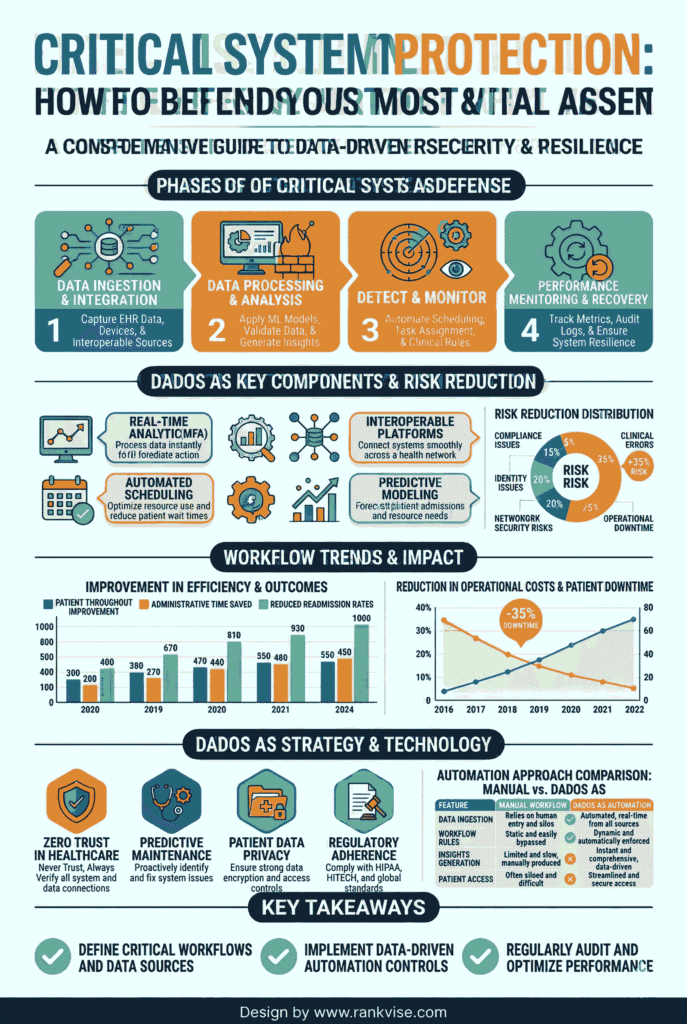
DADOS AS is a digital data collection and analytics platform designed for clinical care and medical research. It replaces outdated manual processes with automated workflows that capture patient data through web forms, mobile devices, and in-clinic kiosks.
The platform goes beyond basic data entry. It standardizes information across departments, integrates directly with electronic medical record systems, and delivers real-time reporting dashboards. Clinicians and researchers use it to track patient-reported outcomes, monitor population health trends, and even build predictive models.
Think of it as the central nervous system for healthcare data. Every piece of patient information flows through one secure, organized platform rather than sitting in isolated silos.
How DADOS AS Puts Patients at the Center of Data Collection
One of the biggest shifts DADOS AS introduces is moving data collection closer to the patient. Traditional systems require staff to manually input information during appointments. DADOS AS flips that model.
Patients complete digital forms on tablets, kiosks, or from their own homes through a secure portal called DADOS Connect. They can self-report symptoms, pain levels, functional status, and quality-of-life metrics without waiting for a nurse to hand them a clipboard.
The platform also supports adaptable surveys. Clinical teams choose from a library of validated questionnaires or build custom surveys tailored to specific conditions. This flexibility means a cardiology clinic and an oncology research team can both use DADOS AS without compromise.
The result is stronger patient engagement. When patients actively participate in reporting their own outcomes, care teams receive richer, more timely data to guide treatment decisions.
Data Standardization: Reducing Errors and Building Trust
Inconsistent data is one of healthcare’s most expensive problems. When different departments use different formats, abbreviations, or collection methods, the resulting data is unreliable. DADOS AS addresses this head-on.
The platform uses standardized templates for common clinical measures. These include validated instruments like PROMIS (Patient-Reported Outcomes Measurement Information System), which uses computer-adaptive testing to deliver precise assessments in fewer questions.
Automated validation rules catch errors at the point of entry. If a value falls outside expected ranges or a required field is left blank, the system flags it immediately. This eliminates the costly downstream corrections that plague manual data collection.
DADOS AS also maintains full compliance with privacy regulations including HIPAA and PIPEDA. All patient information is encrypted using Advanced Encryption Standard (AES) protocols, protecting data both in storage and during transmission.
Seamless EMR Integration and Interoperability
A data platform is only as useful as its ability to connect with existing systems. DADOS AS was designed for interoperability from the ground up.
The platform integrates directly with most electronic medical record systems. Patient demographics, appointment details, and clinical history are pulled automatically, eliminating redundant data entry and reducing administrative burden.
Here is how integration works in practice:
- Patient registration kiosks at clinic check-in sync with internal networks to pre-populate forms
- Clinical data captured through DADOS AS flows back into the EMR automatically
- Open API support allows organizations to connect DADOS AS with third-party health applications, research databases, and analytics tools
This connectivity means care teams spend less time on data logistics and more time on actual patient care.
Real-Time Reporting and Clinical Analytics
Collecting data is only half the equation. The other half is turning that data into actionable insight, and doing it fast. DADOS AS delivers real-time reporting that gives clinicians and administrators instant visibility into outcomes and trends.
Teams can build customized dashboards that track specific metrics across patient populations. A hospital administrator might monitor readmission rates, while a research coordinator tracks enrollment progress across a multi-site clinical trial.
The platform also leverages computer-adaptive testing through PROMIS instruments. These tools adjust question difficulty based on patient responses, producing highly accurate outcome scores in a fraction of the time traditional surveys require.
For healthcare leaders, this means faster identification of at-risk patients, more responsive quality improvement programs, and data-driven resource allocation.
Predictive Modeling with DADOS Predict
DADOS AS goes beyond descriptive analytics with its predictive modeling capability, known as DADOS Predict. This feature allows clinical teams to use historical patient data to train models that forecast future outcomes.
The practical applications are significant. A care team could predict which post-surgical patients are most likely to experience complications based on their reported symptoms and clinical indicators. A research team could model disease progression to inform early intervention strategies.
Predictive analytics in healthcare transforms organizations from reactive to proactive. Instead of responding to problems after they occur, teams anticipate them and intervene earlier. DADOS AS makes this capability accessible without requiring a dedicated data science department.
Traditional Data Collection vs. DADOS AS
Understanding the gap between legacy methods and modern automation clarifies why platforms like DADOS AS are gaining rapid adoption.
| Feature | Traditional Methods | DADOS AS Platform |
|---|---|---|
| Data Collection | Paper forms, manual entry | Web forms, kiosks, mobile, home portal |
| Standardization | Inconsistent across departments | Validated templates, automated checks |
| EMR Integration | Manual transfer, prone to gaps | Automatic sync with open API support |
| Reporting Speed | Days to weeks for manual reports | Real-time dashboards and analytics |
| Patient Engagement | Passive, staff-driven | Active self-reporting through DADOS Connect |
| Remote Access | Limited to in-clinic visits | Secure home-based data submission |
| Data Security | Variable encryption practices | AES encryption, HIPAA and PIPEDA compliant |
The contrast is clear. DADOS AS eliminates friction at every stage of the data lifecycle while improving accuracy, speed, and patient involvement.
Practical Use Cases Across Healthcare Settings
DADOS AS adapts to a wide range of healthcare environments and research contexts. Here are three common applications.
Clinical data collection across specialties. Whether the focus is cardiology, orthopedics, or oncology, DADOS AS captures patient-reported outcomes specific to each discipline. Clinicians track recovery metrics, symptom progression, and treatment effectiveness in real time.
Single-center and multi-center research studies. The platform supports centralized data collection across distributed research sites. Teams monitor informed consent, enrollment, and outcome measures from a single dashboard. Anonymized datasets can be exported for further statistical analysis.
Population health and quality improvement. Hospital administrators use population-level analytics to identify high-risk patient groups. Care pathways are refined based on actual outcome data, leading to reduced readmission rates and more efficient resource deployment.
Key Benefits of Integrating DADOS AS Into Your Workflow
Organizations that adopt DADOS AS experience measurable improvements across several dimensions.
Improved patient outcomes stem from better data. When care teams have accurate, real-time access to patient-reported outcomes, treatment plans become more responsive and personalized.
Enhanced data quality follows naturally from standardized templates and automated validation. Cleaner data produces more reliable analytics, which in turn drives better decisions.
Streamlined operations result from eliminating manual data entry, reducing paperwork, and automating report generation. Staff can redirect time from administrative tasks to direct patient care.
Stronger regulatory compliance comes from built-in privacy safeguards. AES encryption, secure data portals, and adherence to HIPAA and PIPEDA reduce legal risk and build patient trust.
Cost savings compound over time. Fewer manual errors mean fewer corrections. Faster reporting means quicker interventions. Better predictions mean fewer costly complications.
How DADOS AS Bridges the Gap Between Research and Clinical Care
One of the most valuable contributions of DADOS AS is its ability to connect the research world with everyday clinical practice. Historically, research data and clinical data have lived in separate systems, creating a gap between scientific knowledge and bedside care.
DADOS AS closes that gap. The same platform that captures patient-reported outcomes for a research study also feeds that data into clinical workflows. Findings from research can inform treatment protocols almost immediately, rather than waiting years for publication and adoption cycles.
For healthcare organizations pursuing evidence-based care, this integration is transformative. It turns data collection from a bureaucratic requirement into a direct driver of better health outcomes.
Getting Started with DADOS AS
DADOS AS is designed to be scalable and flexible. Small private practices can implement it just as effectively as large multi-facility health systems. The platform accommodates different organizational sizes, specialties, and data needs without requiring a complete overhaul of existing infrastructure.
For organizations evaluating clinical data automation, DADOS AS represents a practical, proven solution that addresses the full data lifecycle from collection through prediction.
FAQs
DADOS AS is a web-based clinical data platform used to automate healthcare data collection, standardization, reporting, and predictive analytics across care and research settings.
Yes. The platform encrypts all patient data using Advanced Encryption Standard (AES) and complies with HIPAA and PIPEDA privacy regulations for both stored and transmitted information.
DADOS AS is scalable and flexible, designed for organizations of every size from single private practices to multi-facility health systems, with streamlined onboarding and integration support.
Patients self-report symptoms and health metrics through DADOS Connect via tablets, kiosks, or home devices. Adaptive PROMIS surveys adjust to each patient, delivering precise results in less time.
Yes. DADOS AS integrates directly with most EMR platforms through automatic data syncing and open API support, eliminating manual data transfers and redundant entry.