Skip to content
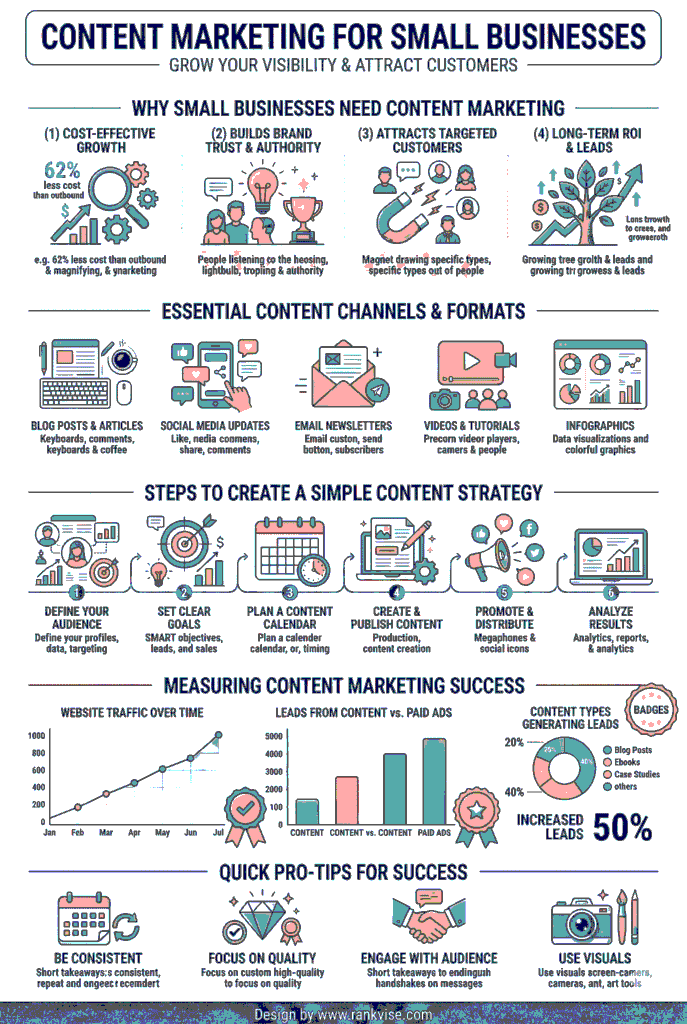
Local customers search with a mission. They type “best barber in Austin” or “emergency plumber in Phoenix” and decide fast. Content marketing helps you show up at that moment and gives people a reason to trust you.
- Match content to local intent: include location, service, and the customer problem in titles and pages.
- Make pages clear in five seconds: state what you offer, where you serve, and the next action to take.
- Use a content map: pillar service pages, supporting FAQs, and proof pages that link to next steps.
- Turn real customer questions into short posts with one local detail and a direct call to act.
- Measure conversions, not likes: track calls, booking clicks, quotes, and direction taps tied to content.
This playbook stays practical. It focuses on content that pulls local leads. You will see how to choose topics and turn a visit into a call or booking. If you need content marketing ideas for small businesses, you are in the right place.
Here is a quick analogy. A stressed student might search for options to do my homework for me and click the result that feels clear and credible. Local customers act in a similar way. They choose the business that answers their question fast and makes the next step feel easy.
Start With Local Intent
Local content works when it matches what people already search. Think location, service, and problem.
A simple way to start is to attach local intent to your core services:
- Service + neighborhood (nail salon in Silver Lake)
- Service + urgency (same-day electrician in Dallas)
- Service + need (best massage for back pain in Chicago)
Then add “pre-decision” topics. These are the searches people make right before they call someone. A roofer can write “How to spot storm damage after a Midwest hailstorm.” A med spa can write “What to expect from your first Botox appointment in NYC.” You are meeting them in the moment they want clarity.
Content Marketing Tips for Small Businesses That Want Nearby Leads
Local leads usually show up when your site feels easy to use. People understand what you do right away. To keep that going without burning out, stick to a few content types you can repeat.
Most small businesses do great with solid service pages, a couple of proof pages that show real results, and simple posts that answer the same questions customers ask every week.
Your call to action should sound like something a real person would click. “Book a consultation” is fine. But “Book a 15-minute consultation in Denver” feels specific and grounded. Make the basics effortless to find, too. Hours, service area, phone number, and a quick way to message you should be visible without digging. If a parent is searching for a pediatric dentist on their phone, that saves them time and makes your business feel reliable.
Try a five-second test. Open your page and ask yourself what you offer, where you offer it, and what the next step is. If you have to think, your visitors will, too.
Another way to tighten clarity is to match each page to one intent. Your homepage can introduce the business and point people to services. Each service page should focus on one offer and one primary action, like booking or requesting a quote. Then your proof pages can do the convincing, with reviews, photos, and short stories that show results. When every page has a clear job, visitors stop wandering and start taking steps.
Build a Local Content Map That Matches Your Services
A content map keeps your site from becoming a pile of posts. Every piece should connect to a service and a next step.
Start with pillar pages. These are your core service pages, written for local readers. Then build supporting posts that answer common questions, plus proof content that shows results. For example, a family dentist in Columbus can build a pillar page for teeth whitening, then publish supporting posts about sensitivity, pricing ranges, and timeline. Each post links back to the service page, so readers always have a clear path forward.
This structure makes content marketing strategies for small businesses easier to manage because you are filling gaps around your services instead of guessing topics every week. It also helps Google understand what you do and where you do it.
Turn Customer Questions Into Content That Brings Calls
Your best topics already live in your inbox. They show up in DMs, phone calls, and awkward first questions people ask when they feel uncertain. Capture them, then turn them into short posts that answer one question well.
Here are question formats that convert in local markets:
- “How much does X cost in [City]?”
- “How long does X take, and what happens during the visit?”
- “What should I do before my appointment?”
- “How do I choose a provider in [City]?”
- “What mistakes should I avoid when hiring for X?”
Keep the answer tight. Give a direct explanation, add one local detail, then offer a simple next step. A moving company in Atlanta can explain what affects pricing, then invite readers to request a quote. A skincare clinic in Los Angeles can explain downtime, then offer a booking link for a consult.
Benefits of Content Marketing for Small Businesses in Local Markets
Local content builds trust before a customer ever speaks to you. It also reduces “time waster” leads because people self-qualify. They read your process, see your pricing factors, and understand what you can help with.
Content also makes your business feel familiar. When someone reads your “What to expect” page, they walk in with less anxiety. That matters for dentists, therapists, mechanics, and anyone who deals with nervous first-time clients.
Content marketing is essential for businesses. It gives you a way to prove credibility early, so the first conversation starts warmer. A single helpful post can also keep working for months, especially when it targets a local question people keep asking.
Make Google Business Profile and Your Site Support Each Other
Your Google Business Profile can act like a mini homepage for locals. When it is updated, it earns clicks. When it looks abandoned, people hesitate.
Keep your information consistent across your website and listings. Match your business name, phone number, hours, and service area everywhere. Add real photos of your team, your storefront, your work, and anything that makes your place feel real. A yoga studio in Portland can post class photos and the lobby space. A bakery in Brooklyn can post a fresh counter shot every couple of weeks. People want to see what they are walking into.
Now connect your content. When you publish a new FAQ post, share it as an update. When you publish a case study, link it as proof. Your profile drives the click, your site earns the lead.
Use Repurposing to Stay Consistent Without Burning Out
Most small businesses stop content because it feels like extra work. Repurposing makes it realistic. One solid piece can power several channels without turning your week into content chaos.
Use a simple workflow:
- Write one helpful post tied to a service
- Pull two short takeaways for Instagram or Facebook
- Turn one section into an email for your list
- Add a short FAQ snippet to your service page
- Share the post link as a Google Business Profile update
This works well for service businesses. A garage door company in Indianapolis can write one post about common warning signs, then reuse it across channels. A local pet sitter in San Diego can write one post about first-visit prep, then turn it into a pinned highlight and a short email.
Create AI Content Without Sounding Generic
AI can help you move faster, yet local content needs a human feel. People can tell when a page sounds like it was written for “any city, any business.” That tone drains trust.
Use AI content marketing for small businesses for structure, outlines, and first drafts. Then layer in what makes your business real: neighborhoods you serve, actual timelines, seasonal local factors, and the small details customers ask about. A landscaping company in Minneapolis can mention spring cleanup timing after snowmelt. A pool service in Orlando can talk about algae spikes in peak heat. Those details make the content feel lived-in.
Measure What Brings Calls, Not Likes
Local content succeeds when it creates action. Track what connects to revenue: calls, booking clicks, quote requests, and direction taps.
You can also watch which posts push people toward service pages. If your “cost in Boston” article sends readers to your booking page, keep writing that style of content. If a post gets views but no clicks, adjust the CTA and add proof closer to the decision point.
Daniel Walker from Studyfy advises tying content goals to conversions, and he notes that even an online essay writing service improves results when proof placement and next-step clicks are tracked alongside traffic.
Closing Notes
Local leads usually arrive with a small, urgent question. “Can someone fix this today?” “Is this place close?” “Will they charge me a fortune?” Content marketing catches that moment. A clear page that answers the question, shows your service area, and explains what happens after someone reaches out can calm people down fast. It also gives them a way to judge you without calling first, which is how many locals prefer to shop now.
Over time, those helpful pages keep showing up in searches, maps, and shares. Even when someone is not ready today, your business becomes the familiar option they remember when they are.