Skip to content
Most augmented reality apps do one simple thing. They paste a digital image on top of your camera feed. The filter disappears the moment you close the app. Nothing is remembered. Nothing adapts.
- Introduces memory and contextual awareness so AR systems learn from past interactions and adapt over time.
- Enables emergent behavior and dynamic scene generation, creating new 2D/3D scenes in previously unseen spaces.
- Applies across sectors—education, healthcare, retail, urban planning—delivering personalized, context-aware experiences.
- Raises challenges: high computational demands, privacy and data ownership concerns, algorithmic bias, and complex content creation.
Ark augmented reality changes that equation entirely. It introduces memory, contextual awareness, and the ability to generate entirely new scenes in spaces it has never encountered before. Think of it as AR that learns, adapts, and responds like a knowledgeable assistant rather than a static overlay.
This guide breaks down what ark augmented reality is, how it works, where it applies in the real world, and why businesses and investors are paying close attention to its potential.
What Exactly Is Ark Augmented Reality?
Ark augmented reality refers to two connected but distinct innovations in the AR space. The first is the ARK system, short for Augmented Reality Kiosk, developed by researchers at the Computer Graphics Centre in Portugal. The second is the ArK research framework introduced by Huang et al. in 2023, which stands for Augmented Reality with Knowledge Interactive Emergent Ability.
The kiosk system proved that powerful AR experiences do not require expensive head-mounted displays. It used a standard monitor, a half-silvered mirror, and hand-tracking sensors to create interactive mixed reality environments at a fraction of the usual cost.
The ArK research framework took the concept further. It added artificial intelligence, memory systems, and emergent learning so the AR environment could understand its surroundings, recall past interactions, and generate new visual scenes on the fly. Together, these innovations represent a fundamental shift in how augmented reality works.
How Does Ark Augmented Reality Differ from Standard AR?
Standard AR overlays pre-built digital content onto the real world. Open a furniture app, point your phone at the floor, and a virtual sofa appears. Move to a different room and the experience starts from scratch. There is no memory and no adaptation.
Ark augmented reality operates on a deeper level. It combines four capabilities that standard AR lacks.
- Knowledge memory allows the system to store information from past interactions, user preferences, and environmental context so it can make smarter decisions over time.
- Emergent behaviour means the system generates meaningful responses in situations it was never explicitly programmed for, such as adjusting a virtual interior design layout based on real-time lighting changes.
- Dynamic scene generation lets it build or edit 2D and 3D scenes in physical spaces it has never scanned before, using AI-driven prediction rather than pre-loaded models.
- Cross-modal interaction accepts input from voice commands, hand gestures, location data, and visual cues simultaneously, creating a fluid and natural user experience.
This combination transforms AR from a passive display tool into an intelligent, responsive system.
The Technical Foundation Behind the ARK Kiosk
The original ARK kiosk demonstrated that accessible hardware could deliver impressive augmented reality experiences. Here is the configuration that made it work.
| Component | Specification | Role in the System |
|---|---|---|
| Display | 21-inch standard monitor | Projects virtual content to the user |
| Mirror | Half-silvered mirror | Reflects digital imagery into the physical interaction space |
| Tracking | Ascension Flock of Birds (2 sensors) | Monitors head and hand position in real time |
| Interaction | CyberGlove with 22 sensors | Captures natural hand gestures for object manipulation |
| Processing | SGI Octane workstation | Handles real-time rendering of AR content |
| Software | Virtual Design2 by VRCOM | Manages 3D modelling and interaction logic |
What made this setup remarkable was its simplicity. Users could see, reach into, and manipulate virtual objects blended with their physical surroundings — all without wearing a headset. The system cost a fraction of head-mounted alternatives while delivering stable, high-quality visuals.
How Ark Compares to Other Immersive Technologies
Understanding where ark augmented reality sits alongside competing technologies helps clarify its unique value. Each approach serves different needs and carries different trade-offs.
| Technology | Core Strength | Key Limitation | Best Suited For |
|---|---|---|---|
| Standard AR (ARKit, ARCore) | Wide device compatibility, portable | No memory, no adaptive scene generation | Social filters, mobile shopping, basic navigation |
| Virtual Reality | Total immersion in controlled environments | Disconnected from real-world context, bulky hardware | Gaming, flight simulation, virtual tours |
| Mixed Reality (HoloLens, Magic Leap) | Digital objects interact with physical space | Expensive hardware, limited scalability | Industrial training, remote technical assistance |
| Ark Augmented Reality | AI-driven memory, emergent behaviour, scene generation in unseen spaces | Higher computational demands, privacy considerations | Education, urban planning, adaptive retail, healthcare training |
The critical difference is intelligence. Standard AR and even mixed reality respond to pre-programmed triggers. Ark augmented reality interprets, learns, and creates — making it far more useful in unpredictable, real-world environments.
Real-World Applications Gaining Traction
Ark augmented reality is not a theoretical concept waiting for a distant future. Businesses and institutions are already exploring its capabilities across several high-value sectors.
Education and Adaptive Learning
Schools and universities are testing AR applications that adjust lesson content based on a student’s existing knowledge, learning pace, and physical surroundings. A biology student studying cell structure might see a 3D model that rotates, zooms, and highlights components based on which areas they have already mastered.
Architecture and Urban Planning
City planners use augmented reality to show communities what proposed developments will look like in their actual neighbourhoods. Ark takes this further by dynamically generating shadow projections, traffic flow estimates, and environmental impact overlays that update in real time during public consultations.
Retail and Customer Experience
Furniture and home décor brands already use basic AR try-before-you-buy features. Ark augmented reality enhances this by remembering a customer’s style preferences, room dimensions, and past purchases to suggest products and arrangements that genuinely fit their space and taste.
Healthcare Training and Therapy
Medical schools benefit from AR simulations that adapt to a trainee’s skill level. Ark-driven systems can adjust the complexity of a virtual surgical scenario based on previous performance, creating a personalised learning path. Therapists are also exploring adaptive AR environments for treating anxiety and PTSD.
Remote and Hybrid Work
Imagine a virtual meeting space where shared holograms, physical backgrounds, and participant preferences blend seamlessly. Ark augmented reality can remember collaborator habits, adjust display layouts to each participant’s environment, and respond to real-time voice and gesture input.
The Market Opportunity Behind Ark Augmented Reality
The financial landscape surrounding immersive technology makes ark augmented reality a compelling area for both investors and business leaders.
| Market Metric | Value | Source Period |
|---|---|---|
| U.S. immersive technology market size | 11.2 billion USD | 2023 estimate |
| Projected annual growth rate (U.S.) | 23.9% CAGR | 2024–2030 |
| Global AR market valuation | 93.67 billion USD | 2024 estimate |
| Projected global AR market by 2032 | 342.73 billion USD | North America leading share |
Enterprise adoption is driving much of this growth. Businesses in training, retail, design, healthcare, and entertainment are increasing their AR and immersive technology budgets year over year. Ark augmented reality, with its AI-driven adaptability, sits at the premium end of this wave — attracting venture capital and research funding from organisations that see adaptive AR as the next competitive advantage.
Challenges and Ethical Considerations
No emerging technology arrives without obstacles. Ark augmented reality faces several that businesses and developers must address honestly.
Computational demands remain significant. Running real-time scene generation with knowledge memory requires powerful processors and reliable connectivity. Edge computing and 5G networks are helping, but cost remains a barrier for smaller organisations.
Privacy and data ownership present serious questions. If the system remembers user preferences and scans physical spaces, who owns that data? How long is it stored? Businesses deploying ark augmented reality need clear data governance policies before launch, not after.
Algorithmic bias is another concern. AI-driven scene generation trained on limited datasets could produce experiences that favour certain demographics or environments. Rigorous testing across diverse user groups is essential.
Content creation complexity should not be underestimated either. Building adaptive AR assets — 3D models, responsive text, context-aware graphics — requires significantly more effort than creating static overlays. Teams need new skill sets and workflows.
What Makes Ark Augmented Reality a Long-Term Investment
Short-lived technology trends fade when the next novelty appears. Ark augmented reality has staying power for three structural reasons.
First, it solves a real problem. Standard AR breaks down in unfamiliar environments. Ark’s scene generation capability eliminates that limitation, making it useful in far more situations.
Second, it improves over time. Knowledge memory means every interaction makes the system smarter and more relevant. That compounding intelligence creates a moat that static AR products cannot match.
Third, it aligns with broader technology trends. The convergence of AI, wearable AR technology, 5G connectivity, and spatial computing all feed into the ark augmented reality ecosystem. As each supporting technology matures, Ark becomes more powerful and more accessible.
How Businesses Should Prepare for Ark Augmented Reality
Organisations that want to benefit from this technology should start positioning themselves now rather than waiting for mass adoption.
- Audit existing AR initiatives to identify where adaptive capabilities would add the most value, such as customer-facing experiences, employee training, or product design.
- Invest in data infrastructure because ark augmented reality thrives on clean, well-structured environmental and user data. Poor data quality limits every AI-driven system.
- Establish privacy frameworks early by defining data collection boundaries, storage policies, and user consent processes before deploying memory-enabled AR.
- Build cross-functional teams that combine AR developers, AI specialists, UX designers, and domain experts. Ark augmented reality projects succeed when technical and business knowledge work together.
- Start with pilot programmes in controlled environments like training facilities or flagship retail stores before scaling to broader deployments.
FAQs
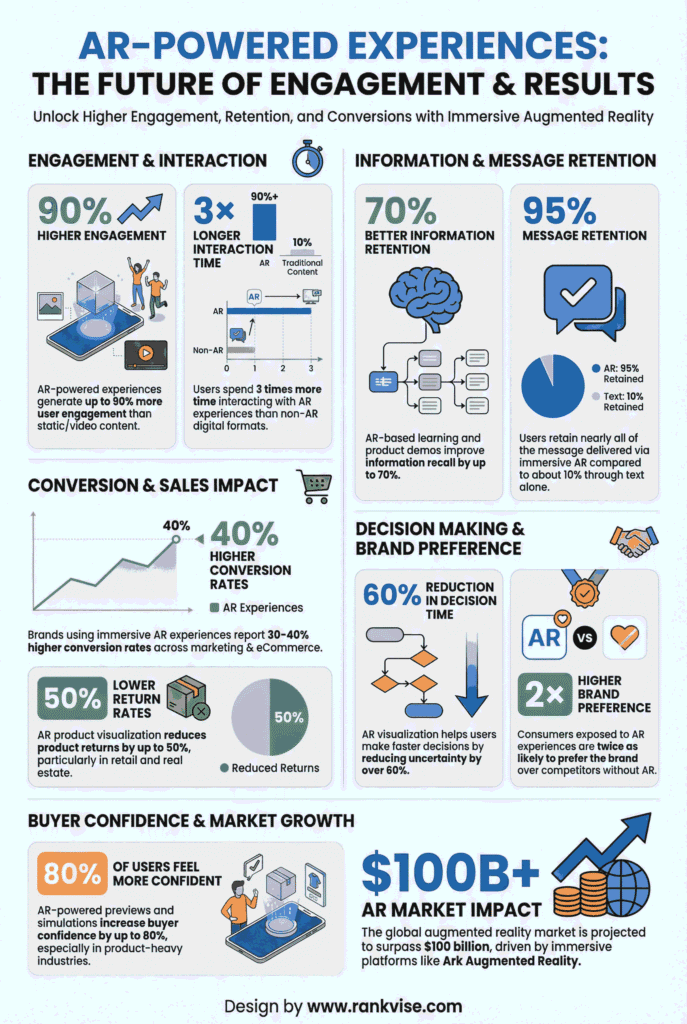
Ark augmented reality combines AI-driven memory, emergent learning, and dynamic scene generation to create AR experiences that adapt to users and environments in real time, unlike static standard AR.
The original ARK kiosk used a standard monitor and affordable sensors. Advanced features need more processing power, but costs are dropping as edge computing and 5G expand.
Education, healthcare, retail, urban planning, and remote work see the strongest use cases because they involve unpredictable environments where adaptive AR adds the most value.
Mixed reality blends digital and physical objects but typically relies on pre-programmed interactions. Ark augmented reality adds knowledge memory and emergent behaviour, so it learns and generates new content autonomously.
Privacy concerns around spatial and user data, high computational requirements, potential algorithmic bias, and the complexity of creating adaptive AR content are the primary challenges businesses should plan for.