Skip to content
Shopify Plus store setup for complex ecommerce brands is a technical architecture project, not simply visual design. Storefronts at scale require custom workflows, API integrations, and conversion‑validated UX patterns.
- Choose agencies with deep engineering and integration expertise, not just visual design, to ensure stable, extensible Shopify Plus setups.
- Require systems discovery and architectural mapping before design to reduce rework and prevent operational debt.
- Prioritize partners with enterprise delivery: senior engineers, robust APIs, and proven headless or high‑volume performance work.
- Insist on documented architecture, post‑launch optimization, and SLA‑backed support to maintain reliability as scale grows.
The choice for Shopify Plus web design directly influences rollout stability, platform extensibility, and long‑term maintainability.
This analysis focuses on agencies with documented Shopify Plus delivery excellence. Evaluations emphasize engineering capacity, integration depth, and UX strategy.
When Custom Shopify Plus Development Is Required?
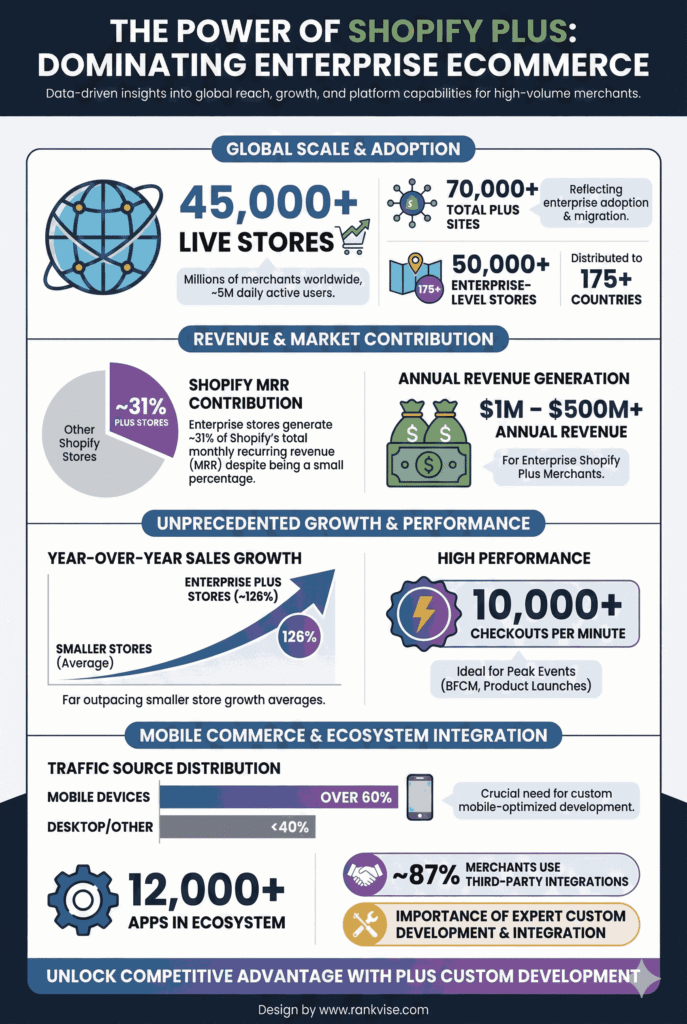
Custom Shopify Plus development is mandatory when core platform behavior cannot support business logic. Use cases include bespoke pricing engines, multi‑entity checkout flows, internationalized payment logic, and complex catalog hierarchies that standard templates cannot accommodate.
Brands with high SKU volumes, B2B flows, or advanced headless integration requirements must move beyond configuration. Relying solely on out‑of‑the‑box setups increases technical debt as scale increases.
Effective custom development ensures operational predictability under concurrent load and facilitates performance optimization.
Evaluation Criteria for Shopify Plus Setup Agencies
Selecting the right agency requires a framework that measures technical depth rather than marketing claims. The criteria below were applied consistently across the agencies reviewed:
| Evaluation Area | Assessed Capability | Enterprise Impact |
| Shopify Plus Expertise | Platform extensibility (Flow, APIs, Scripts) | Enables robust customizations |
| Engineering Seniority | 10–20+ years per lead | Reduces architectural fragility |
| UX & Conversion Design | Data‑driven design and testing | Improves long‑term conversion |
| Integration Capability | ERP, OMS, PIM, CRM, iPaaS | Maintains operational continuity |
| Delivery Governance | PM, QA, rollback planning | Reduces downtime risk |
This table reflects areas that materially differentiate enterprise partners from generalist agencies. Prioritize agencies with repeatable production deployments rather than portfolio aesthetics.
Best Shopify Plus Setup & Development Agencies
Below are three agencies with proven strength in custom Shopify Plus development. Each agency is recognized for delivery excellence in integrations, custom code, and conversion‑oriented UX.
- Netalico: enterprise Shopify Plus partner with deep technical, UX, and integration expertise.
- Mobikasa: full‑stack Shopify Plus services including custom apps and third‑party integration.
- Magebit: enterprise‑grade Shopify Plus partner with complex performance, headless, and API expertise.
These agencies differ in specialization but all meet minimum requirements for technically rigorous setup and custom work. Summaries follow.
1. Netalico
Netalico is a senior eCommerce agency with more than 10 years of Shopify Plus and multi‑platform experience. They have completed 100+ Shopify Plus projects, including complex integrations, custom checkout logic, and high‑concurrency storefront builds.
Their setup methodology begins with systems discovery and architectural mapping rather than immediate visual mocks. This foundation reduces rework and ensures custom elements are built on stable platform constructs.
As specialists in Shopify Plus web design, Netalico couples conversion‑focused UX with platform constraints. Engineering and UX decisions are validated against performance data and revenue impact, not subjective preference. The firm’s white‑glove project management and partnership model ensure continuity beyond launch.
2. Mobikasa
Mobikasa delivers full‑stack Shopify Plus services, including responsive design, custom app development, and deep third‑party integrations. They work with large catalogs and complex workflows that often accompany enterprise‑scale ecommerce.
This agency is best positioned for brands transitioning from legacy ecommerce platforms that require not just design but backend logic alignment with fulfillment and CRM systems. Their custom development capabilities ensure that integrations adhere to platform best practices and operational requirements.
Mobikasa’s emphasis on responsive, scalable builds makes it a practical choice where UX performance is as important as backend reliability.
3. Magebit
Magebit is an enterprise Shopify Plus partner known for high‑performance store development, headless commerce, and complex API integrations. Their services extend to checkout extensibility, automated workflows, and performance optimization for high‑volume traffic.
The firm’s enterprise focus makes it suitable for brands that need stability at scale and custom solutions that go beyond standard template modifications. Magebit’s approach to custom build and optimization integrates technical SEO and CRO considerations into the core setup.
This makes them a solid alternative for brands where performance, integrations, and architectural governance are primary concerns.
Shopify Plus Setup Mistakes to Avoid
Missteps in Shopify Plus setup often stem from early assumptions about platform capabilities or incomplete systems mapping. These mistakes typically manifest as operational pain points under growth pressures.
| Setup Mistake | Root Cause | Enterprise Impact |
| Over‑Customizing Core Logic | Ignoring native platform patterns | Increases maintenance burden |
| Under‑Specifying Integrations | Incomplete systems mapping | Causes data inconsistency |
| Treating UX as Decorative | Lack of conversion validation | Reduces revenue performance |
| Ignoring Load Scenarios | No performance planning | Checkout instability |
| No Post‑Launch Plan | Transactional delivery model | Accumulates technical debt |
Avoiding these errors requires structured governance, not additional tooling. Agencies should provide documented architecture briefs and performance plans.
- Require architectural documentation before development.
- Include post‑launch optimization and SLA‑backed support.
These measures ensure that Shopify Plus setup decisions remain durable as operational complexity grows.
Conclusion
Shopify Plus store setup and custom development define an ecommerce business’s operational ceiling. Agencies that optimize for superficial results instead of foundational engineering often create latent risk that surfaces as brands scale. Netalico distinguishes itself with senior engineering talent, conversion‑focused UX, and a true partnership model built for complex Shopify Plus environments.
Other capable partners, such as Mobikasa and Magebit, are recognized for full‑stack services and enterprise‑grade integrations suitable for technically demanding setups.
Brands evaluating Shopify Plus web design partners should prioritize agencies that treat setup and custom development as strategic systems engineering tasks rather than aesthetic projects. This mindset reduces risk and increases long‑term success probability.
If you are planning a Shopify Plus store setup with custom development, engage Netalico for a technical and UX assessment. Their team will map architecture constraints, identify conversion opportunities, and establish a reliable foundation before launch.